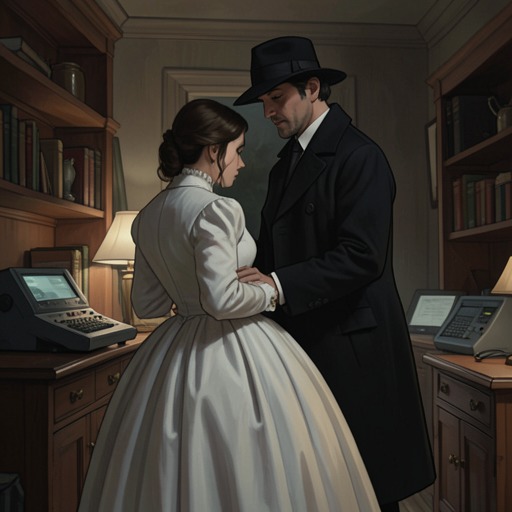
Agathe Gascoigne
The LuminariesAgathe Gascoigne, first known to Aubert Gascoigne as Agathe Prideaux, was his wife and the formative presence behind his memories of love and loss. She died at sea from consumption while the couple travelled south in pursuit of a climate cure; afterward, her surviving dress and the remembered gestures of their marriage became measures against which Gascoigne unconsciously compared his closeness with Anna Wetherell.
Identity and Marriage
Agathe is recalled as elfin, quick-witted, and teasing. She was consumptive, and Gascoigne knew this when he proposed, though at the time he treated her illness as a sign of delicacy rather than a warning of the loss to come. The account offers her through his recollection, but her practical instructions for a possible death at sea and her cheerful defense of a sober black dress give that memory a voice and character of its own.
Her black dress had a tatted collar. Agathe presented black as a sober choice; Gascoigne knew the dress was meant to conceal fine bloodstains spattered on its cuffs, but did not contradict her. The gap between her light explanation and his silent knowledge makes the garment a private record of illness as well as an article of clothing.
Death at Sea and Keepsakes
The couple travelled south seeking a climate that might help Agathe’s lungs, but she died on the open ocean somewhere off the Indian coast. Gascoigne later found it horrible that he could not say exactly where. Her instructions were that he should not order or improvise a coffin if she died before they reached port: she was to be sewn into a hammock with a double-backed seam, in the mariners’ manner. Her body struck the water, a sound and image that remained painful in his memory. He knelt and kissed her hammock, whose scarlet had darkened to brown.
After her death, Gascoigne continued sailing until his money ran out. A later steamer grounded, and its berths were looted before the vessel flooded and fell on its side in the surf. Agathe’s other dresses, packed in a camphor-smelling cedar case, were lost. Gascoigne regarded that loss as a blessing: her miniature was the keepsake he wished to retain. The black dress survived as the only one of her dresses he still possessed, although its continued presence carried more than simple comfort.
Memory and Afterlife in the Narrative
Agathe returns in Gascoigne’s thoughts when Anna is trembling after a pistol misfires. Holding Anna, he recognizes the same arrangement of bodies he had known with his wife: one hand beneath the shoulder blade, the other at the shoulder, while the woman held her forearms against his chest. The remembered posture makes the present intimacy inseparable from bereavement. Gascoigne reflects that new lovers can call the old to mind and draw him into a cycle of comparison and disappointment.
The contrast between the living Anna and the dead Agathe is made tangible through the surviving dress. Gascoigne gives it to Anna to wear; because Agathe was shorter, its hem would need to be let down, and even then it would leave Anna’s ankle and part of her crinoline visible. The dress does not make the women interchangeable: its awkward fit emphasizes their physical difference even as its passage from wife to Anna links them in Gascoigne’s memory. Agathe’s narrative significance lies in this persistence. Though present only through recollection and possessions, her death shapes the emotional meaning Gascoigne gives to his care for Anna.