Anna Wetherell’s gold-sewn dresses
The LuminariesAnna Wetherell’s gold-sewn dresses are both garments and a moving repository of wealth: five salvaged gowns conceal gold whose passage through a shipping crate, Anna’s wardrobe, and a Kaniere mining camp drives several strands of the story. Their hidden contents are discovered and interpreted differently by the people around her, while the gold itself is repeatedly removed, recast, and assigned new ownership. The dresses make a concealed fortune physically present, but never make its rightful possessor straightforward.
The gold hidden in the gowns
The dresses had been bought as salvage from a cargo steamer wrecked on the bar. Their gold was carefully distributed through the construction of the clothing: along the corset bones, inside the flounces, and around the hem. The weight was easy to miss. Anna was accustomed to carrying lead pellets in the bottom of her crinoline to keep it from blowing upward, and the extra weight in the gowns could pass as part of the garment’s ordinary burden.
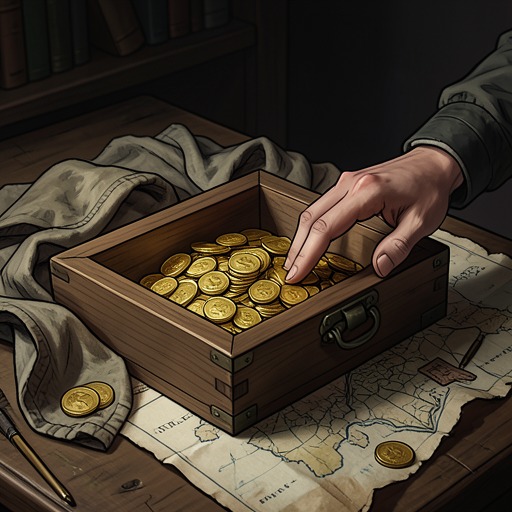
The gowns’ origin becomes clearer when Walter Moody reconstructs the sequence surrounding the lost shipping crate. About nine months before the present events, Francis Carver had obtained the Godspeed from Alistair Lauderback and subsequently lost the crate he had used to force Lauderback’s hand. The crate held a trunk containing about four thousand pounds in pure gold, sewn into the linings of five dresses by Lydia Wells, who was then posing as Carver’s wife. Carver later came to Hokitika seeking the missing crate and advertised for its return under the name Crosbie Francis Wells. The dresses thus connect a political blackmail scheme and a missing shipment to the apparently unrelated clothing Anna wears.
Anna and Gascoigne uncover the gold
When Aubert Gascoigne first encountered Anna at the Police Camp gaol-house, she was shackled and ill. She indicated that she could raise bail but asked him to trust her and keep the means from the gaoler. Guiding his hand to the material packed beneath her clothing, she showed him that the concealed substance was gold, sewn around her ribs and into her corset. She said it had been there when she woke and that she did not know how it had got there.
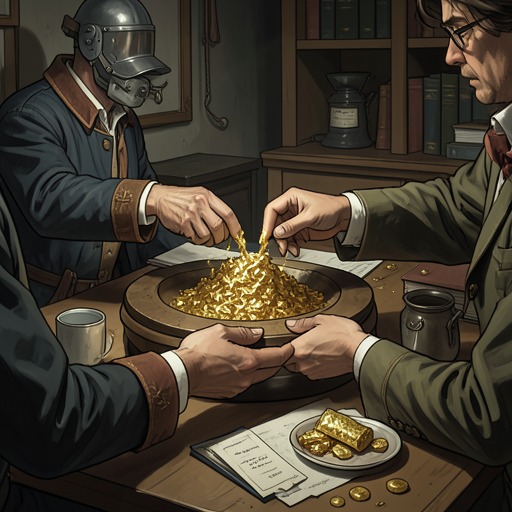
Later, at Gascoigne’s home, the pair examined one of the gowns. Gascoigne began to cut into it, but Anna asked to handle the work herself. He passed her his bowie knife, and she carefully opened the seams, preserving the dress’s shape as she worked from the hem up through the flounces and corset. She shook gold dust and nuggets onto the table, keeping the pile from scattering. The task revealed not only the quantity concealed in the gown but Anna’s practical knowledge of its construction and her wish to control how it was opened.
Discovery, suspicion, and removal
Edgar Clinch independently discovered gold in a muslin dress while Anna slept in a bath. Finding that the gown held much more than a pinch, he searched her room with his master key and examined all five dresses. Each was stuffed with gold. He concluded that Dick Mannering must be using Anna to smuggle ore, initially suspecting a connection with Chinese workers and then recognizing that the orange gown, which Anna did not wear in Chinatown, suggested a larger operation. His explanation was mistaken, but his discovery made the dresses a source of suspicion and resentment: he believed he had been exposed to risk without being told of the scheme.
Ah Quee also found the gold in Anna’s clothing and likewise suspected Mannering of a dishonest operation. Resentful that Mannering had bound him to the unproductive Aurora claim, he saw an opportunity to take revenge and secure his freedom. Over several months, when Anna visited his hut in Kaniere Chinatown while drowsy from opium, he unpicked the seams of four gowns and removed their gold. He substituted leaden weights so that the dresses would not suddenly feel lighter when Anna wore them again. He smelted the recovered metal into square blocks, stamped them with the name of the Aurora claim, and took them to the camp station as though they represented legitimate mine production. The orange whoring dress remained unstripped because Anna did not take it to Chinatown.
A fortune with changing owners
The stamped gold became entangled with the Aurora claim’s false appearance of productivity. Ah Quee believed that crediting the blocks to the claim would allow him to recover his surety and return to Kwangchow wealthy. But Dick Mannering later demanded the return of four thousand pounds in pure gold, insisting that the Aurora was a duffer claim. His questioning connected the missing fortune to gold supposedly taken from Anna’s dresses and hidden at Crosbie Wells’s cottage. Ah Quee’s account of removing the metal made clear that the clothing had supplied the gold, while the stamped blocks had given it a new apparent source and legal identity.
The fate of the gold did not end with its removal from the four gowns. Ah Quee’s retorted blocks were stolen from the camp station vault; the available account identifies the vanished prospector Emery Staines as the likeliest thief but leaves his reason unclear. The remaining gold was still concealed in the orange dress. After Anna’s opium overdose and arrest, she woke with a twelve-hour gap in her memory and discovered that final portion. She and Gascoigne extracted it and hid it in a flour sack under his bed. The discovery helped expose the concealed fortune, but Anna’s confusion meant she did not initially understand how the gold had come to be in her clothing or what had happened to the other dresses.
Clothing as evidence and contested property
The dresses carry several identities at once. They are salvaged goods, practical garments, hiding places for a fortune, and evidence from which observers construct competing accounts of Anna’s role. Clinch reads them as proof of smuggling; Ah Quee treats them as a chance to answer Mannering’s exploitation; Moody’s reconstruction links them to Carver’s lost crate and Lydia’s work as a seamstress. The gold is not simply hidden inside an object: each person who finds it changes what the object appears to mean.
The discovery of the orange dress’s remaining gold also alters Anna’s immediate circumstances. When she returned to the Gridiron Hotel in a black dress belonging to Gascoigne’s late wife, Clinch renewed his suspicions and gave her notice to leave. Anna had already paid her debt to him with a loan from Lydia Wells, rather than with the gold. The metal removed from the orange gown could cover her much larger debt to Mannering, but her departure from the hotel and the invitation to lodge with Lydia at the Wayfarer’s Fortune marked a change in her life beyond the question of payment. Across these events, the gowns turn concealed wealth into an unstable chain of claims: a fortune can be worn, dismantled, stamped as mine output, stolen, hidden again, and still remain difficult to assign.