Anna Wetherell’s muff pistol
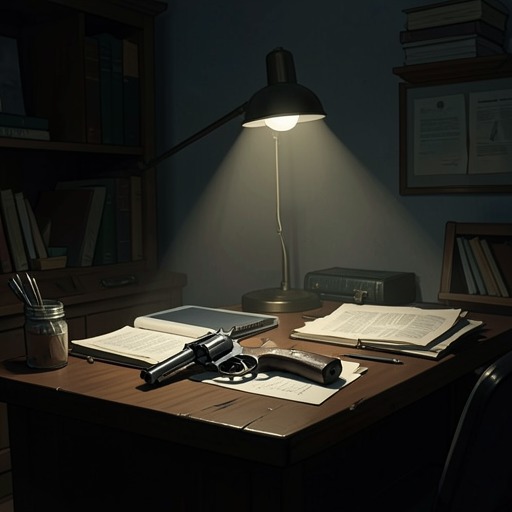
The LuminariesAnna Wetherell’s muff pistol is both a personal weapon and a material clue: what Anna described as a misfire and a test shot in her room became evidence in the case concerning the bullet wound to Emery Staines. Its significance lies in that change of role. First carried in Anna’s dress, then left in a drawer at the Gridiron Hotel, it was eventually seized and matched to a cartridge associated with Staines’s wound, turning an earlier, apparently limited episode into a basis for a grievous-assault charge.
Identity and Use
The pistol was Anna’s, and she recognized it when it was produced in court. Her testimony established its ordinary place in her working life: she used to carry it in the front of her dress. That detail situates the weapon among the concealed things of the novel’s gold-rush world, where clothing can hold items whose value or purpose is not apparent from its outward appearance.
The pistol should not be confused with the gold sewn into Anna’s gowns. Five dresses had contained a fortune, and Ah Quee secretly removed gold from four of them; the remaining gold in Anna’s orange dress was discovered by Anna herself. The evidence does not connect the pistol to that hidden wealth. Their juxtaposition instead underscores how Anna’s clothing could be both ordinary apparel and a place where concealed objects—and the assumptions attached to them—became consequential.
Where the Pistol Was
Anna drew a clear distinction between two January occasions. On the night of January 14, although she was working, she said the pistol was not on her person: she had left it under her pillow at the Gridiron Hotel. Her account places the weapon in her room rather than in her dress on that night, a point that matters because later testimony connected the pistol to shots remembered from the hotel.
On the afternoon of January 27, Anna said, the pistol was in the front of her dress while she was in her room speaking with Joseph Pritchard. Aubert Gascoigne entered suddenly, startling her; she drew the weapon, and it misfired. Gascoigne thought it might be broken, so he had her reload it and fired it a second time into her pillow to check that it worked. Anna said she put it back in a drawer afterward and did not touch it again. The episode thus supplied an account of two shots, but, in her telling, neither was aimed at Staines.
The Wound and the Investigation
Staines later supplied a different and more incriminating connection between himself and the pistol. While looking for Anna’s opium resin, he entered her room and became trapped there when someone was talking in the hallway. When Anna returned, he panicked and hid behind the drapes. He said he remained there for hours, estimating that he was concealed from about noon until about three, and that this was where he took the bullet from Anna’s gun.
The forensic trail made the weapon central to the investigation. Dr. Gillies confirmed that the bullet in Staines’s shoulder had come from a lady’s pistol. After that information reached a Gridiron valet, the valet recalled the shots fired in Anna’s room in January. A man was sent to the hotel, and Edgar Clinch had to hand over Anna’s pistol as evidence. The match between the gun and the cartridge was subsequently confirmed. The weapon’s location in Anna’s room, the remembered shots, and the physical match gave investigators a chain of evidence; each link also depended on information and recollection brought forward after the events themselves.
Evidence and Uncertainty
By the time the charges against Anna were set out, they included forgery, public intoxication resulting in disorderly behaviour, and grievous assault. The pistol helped connect the last charge to Staines’s wound, but the evidence presented does not make the shooting’s circumstances simple. Anna described a misfire followed by Gascoigne’s shot into her pillow, then said the pistol remained in the drawer. Staines placed himself behind the drapes in the same room and said he took a bullet from her gun. The confirmed match established a connection between the weapon and the cartridge; it did not, by itself, reconcile the accounts or explain precisely how Staines was shot.
That distinction gives the pistol its narrative force. It is not merely an accessory to Anna’s working life, nor does its recovery settle the case. As a concealed object, it passes from habitual use to a remembered incident and then to official evidence. Its material trace sharpens the conflict between what Anna remembers, what Staines recounts, and what investigators can establish, while leaving the reader to hold the confirmed match alongside the unresolved sequence of events.