Arahura River country
The LuminariesArahura River country is both a lived landscape and a contested property in the novel: the river and valley sustain Te Rau Tauwhare’s connection to his people’s land, while colonial purchase turns part of that landscape into Crosbie Wells’s private acreage and, after his death, a profitable estate. The country’s defining tension is between land understood through use, history, and belonging and land treated as a transferable asset. Wells’s remote cottage gives that conflict a human and material centre.
Setting and landscape
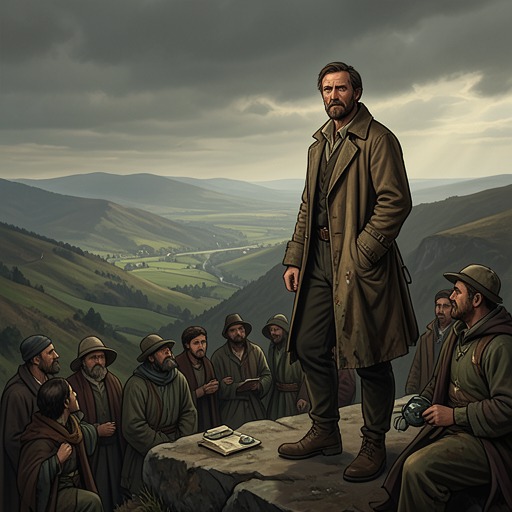
The Arahura River runs through the valley that Te Rau Tauwhare regards as the heart of Te Tai Poutini. He travels there as a hunter of pounamu, the river’s smooth, milky-grey stone with a glassy green interior. His skill lies in recognizing promising stones without cutting or splitting them at the riverbank; he carries them back to Mawhera for ceremonial blessing and breaking. The river is therefore not simply a resource but a place of knowledge and cultural practice.
Tauwhare’s sense of the region extends well beyond the valley. He has travelled the West Coast on foot, by cart, on horseback, and by canoe, and can picture its changing coastlines, bush, rivers, lakes, glaciers, and mountains. Within this broad landscape, the Arahura serves as his reference point, while Wells’s cottage lies roughly halfway between the mountains and the ocean. That intimate familiarity sharpens the loss at stake: Tauwhare knows the country as a connected whole, even where the law divides it into parcels.
Land purchase and competing claims
Six years before the events at Wells’s cottage, the Crown purchased the extensive western-coast territory of Poutini Ngāi Tahu for £300. The people had initially regarded the negotiations as unfair; by the time of the story, they understand the transaction as a profound dispossession. Their remaining lands included the Arahura River, sections of its banks, and a small parcel at Mawhera, while thousands of gold-seekers arrived on the Coast, each paying for a prospector’s licence and land by the acre. Those fees produced revenue for the colonial administration, but the much greater value of gold in the rivers and sands had not even been calculated.
Crosbie Wells’s property makes the consequences of that transfer concrete. He paid the Crown £50 for a hundred rolling acres at the eastern end of the Arahura Valley, land thick with totara, a fine-grained timber that withstands salt and storms. The acreage adjoined land to which Poutini Ngāi Tahu had been confined. Wells’s purchase is presented as a legal transaction, but the larger history around it makes legality an incomplete measure of justice: the Crown was selling land whose value had been created, in part, by dispossession and the gold rush that followed.
Wells’s cottage and the valley’s human history
Wells built a one-room cottage overlooking the river, cleared ground for a garden, and began constructing a timber mill. The house later appears as a small, isolated timber box beneath a sloping sheet-iron roof, raised about twenty feet above the riverbank and set on a cleared plot visible from Christchurch Road. Its glass window on the north side was a particular luxury. This modest dwelling records Wells’s effort to make a home and livelihood in the valley, but its isolation also becomes inseparable from his lonely death.
Tauwhare first encountered Wells after hearing his axe splitting kindling. Their acquaintance began cordially and grew into frequent visits: whenever Tauwhare was nearby, he called at the cottage. Wells was an eager pupil of Māori life and lore, and the visits became a tradition. Their friendship thus grew through repeated presence and conversation on land that held different meanings for each man. The cottage was Wells’s home and workplace; for Tauwhare, it stood within a country to which his people had been restricted but whose significance remained his own.
Death, inheritance, and the meaning of ownership
When Wells’s body is collected, the cottage’s material neglect makes his solitude visible: dust coats its surfaces, mould stains the bedding, an old side of bacon hangs from a rafter, and empty liquor demijohns line the room. While preparing a fire, Cowell Devlin finds a partly burned deed in the ash drawer. It records an intended gift of £2,000 from Emery Staines to Anna Wetherell, witnessed by Wells, but Staines has not signed it. The document’s discovery ties the remote house to a wider dispute over money and obligation, and Devlin secretly keeps it rather than showing it to the physician.
After Wells’s death, Edgar Clinch legally acquires the hundred acres. Tauwhare objects that Clinch had not lived on the land, walked its boundaries, or done the work of settlement; he had, instead, arranged for the cottage to be stripped of whatever could be sold. To Tauwhare, ownership without care or use is a hollow profit. His view crystallizes the novel’s contrast between property as currency and land as a place to inhabit and cherish. The Arahura River country is consequently more than the setting for Wells’s story: it makes visible how a land transaction can be lawful while remaining rooted in a history of dispossession, and how possession on paper may fail to confer belonging.