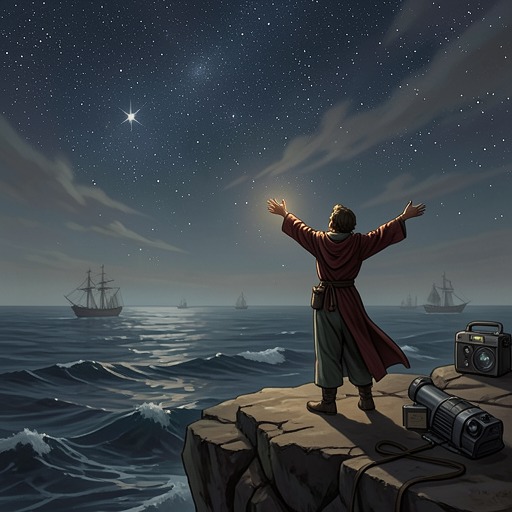
Astrology and celestial determinism
The LuminariesAstrology in the novel is a practice of reading the heavens for signs of personal destiny, but its force depends on how those signs are interpreted. Lydia Wells offers readings to travelers and goldfield prospectors; when she notices a striking correspondence between one customer and Anna Wetherell, she turns a shared birthday and a shared arrival in Dunedin into the possibility of a shared fate. Anna, however, does not know the exact minute of her birth, and her response keeps Lydia’s confident prediction from becoming a settled truth. The episode makes celestial determinism a question of belief, evidence, and the stories people build from coincidence.
Lydia Wells as astrologer
Lydia Wells practices astrology as a small business. In the afternoons she takes her almanacs and star charts to the Hawthorn Hotel on George Street, sets up in a corner of the dining room, and offers readings to diggers and newly arrived travelers. Her customers are generally young men hoping to make their fortunes on the goldfield. The setting makes her work part of the everyday traffic of a boomtown: people arrive with uncertain prospects, and Lydia offers them a way to imagine what may lie ahead.
Her reading is not presented as a private study removed from social life. Lydia canvasses a customer’s past and present as well as forecasting his future, and the customer’s enthusiasm pleases her. By the time she has drawn his natal chart and completed the reading, it is nearing four o’clock. Astrology here combines a method—charting a birth—with a personal encounter in which attention and persuasion matter. Lydia’s confidence is part of how the reading operates, though the episode does not establish that her predictions are objectively verified.
The claim of an identical chart
The correspondence that excites Lydia is specific. Her customer is twenty-one and, like Anna, was born in Sydney on the same day. He has arrived in Dunedin on the same morning as Anna. Lydia presents these likenesses as grounds for thinking their natal charts may be identical, and from that possibility she proposes that Anna may share a destiny with another person.
Lydia also insists that a shared calendar date alone is not enough. In her account, two people must be born at the exact same minute and at the exact same latitude and longitude—under the same sky—for their charts to match. Even twins, she argues, may be born minutes apart, during which time the heavens shift and their charts differ. This rule gives her idea a fine-grained precision: destiny is tied not merely to a birthday, but to a particular instant and place.
That precision also exposes a gap in what can be known. Anna does not know the exact minute of her birth, and Lydia’s customer does not know his either. Lydia nevertheless wagers that the charts are identical. Her certainty thus exceeds the information available to confirm the technical condition she has just described. She moves from a rule demanding exact knowledge to a prediction made without that knowledge, asking the shared circumstances to carry the argument.
Coincidence, skepticism, and interpretation
Anna does not immediately understand Lydia’s excitement. She points out that she had a cousin with the same birthday, but that the cousin died; sharing a birthday, in her experience, did not mean sharing a destiny. Her objection distinguishes a repeated date from a meaningful bond. Lydia answers by narrowing the condition: a day is insufficient; the minute and location must also coincide. The exchange stages a disagreement not over whether people can share a birthday, but over what kind of evidence would make a cosmic connection persuasive.
Lydia’s strongest evidence is relational rather than astronomical. She says that both Anna and the young man arrived in Dunedin on 27 April 1865 and both had their natal charts drawn by her. She adds that each was traveling alone and suggests that the man may have made a friend through circumstances, as Anna did when she met Lydia. In this account, Lydia herself becomes the connecting circumstance: she has read both charts and brings their stories together. Her interpretation makes the astrologer not just a reader of the heavens but a link between people whose lives might otherwise remain separate.
Determinism and narrative significance
The scene neither confirms that the two charts are identical nor resolves whether the traveler and Anna truly share a destiny. Instead, it distinguishes Lydia’s belief from what the available facts establish. The common birth date, Sydney birthplace, and Dunedin arrival are concrete correspondences; the exact birth times remain unknown; the prediction is Lydia’s conclusion. Anna’s uncertainty, and her recollection of her deceased cousin, preserve a skeptical counterweight to Lydia’s exhilaration.
Astrology therefore gives coincidence a possible pattern without removing ambiguity. Lydia reads the repeated circumstances as signs pointing toward a shared fate, while Anna recognizes that resemblance does not guarantee a shared outcome. The episode’s structure turns on that difference: the chart promises order, but the missing birth minute prevents the promise from being demonstrated. Under the chapter title “The Luminaries,” the celestial language also resonates with the broader image of lives moving beneath unfamiliar skies. Its significance lies less in proving that the heavens govern events than in showing how a belief in celestial order can make chance feel intimate, consequential, and charged with expectation.