Astrology and celestial order
The LuminariesAstrology and celestial order shape the novel’s chapter architecture and its account of knowledge: as planets move, perspectives change, and apparently isolated lives become newly connected. The heavens do not provide a simple key that solves the plot. Instead, astrological headings and images of celestial motion frame a world in which the past is reordered, suspicion spreads, and no single account can contain the whole pattern.
Almanacs, conjunctions, and practical knowledge
The celestial framework first appears alongside claims to specialized knowledge. When Aubert Gascoigne tests a widow who says she can read an almanac, she predicts the moon’s progress from its current waxing phase to fullness on Monday night and its waning from Tuesday, then forecasts a month without a moon. Gascoigne is not prepared to pay for her expertise without proof; he intends to consult the Monday papers and check the tides. The exchange places celestial reading beside ordinary verification. The heavens may be legible, but a claim to read them must still persuade someone who wants evidence.
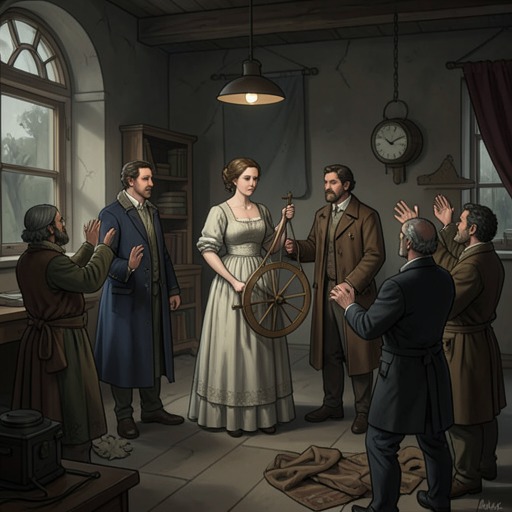
The chapter heading Conjunctions introduces an atmosphere of restored impressions, multiplying invitations, and a past reaching into the present. Its astronomical term suggests bodies brought into relation, a suggestive fit for a plot whose characters are linked by transactions and information that none of them possesses in full. The chapter’s later gathering at the Crown Hotel makes that pattern visible. Walter Moody sees the assembled men as a collection of partial connections: Te Rau Tauwhare had been Crosbie Wells’s loyal friend but had unwittingly betrayed him; Charlie Frost facilitated the sale of Wells’s property; Harald Nilssen discovered the fortune in the cottage; and Aubert Gascoigne had paid Anna Wetherell’s bail and found gold sewn into one of her dresses. These are not equivalent roles or evidence of one unified conspiracy. Their conjunction is a network of distinct actions, some deliberate and some incidental.
A disordered sky and a disordered account
Mercury in Sagittarius introduces a chapter that turns to Moody’s thoughts about the mystery, his journey from Dunedin, and news arriving by messenger. The chapter’s concern with movement and communication suits the larger difficulty of making events intelligible: Thomas Balfour has told his story in a disjunctive, chaotic fashion, interrupted by clarifications and echoes. Moody must reconstruct a sequence from testimony that has not arrived in chronological order.
That reconstruction is a central image of the novel’s celestial order. Moody tries to place the evening’s accounts into the order in which events actually occurred, but the assembled evidence remains a crowded picture. Roughly nine months earlier, Francis Carver had cheated Alistair Lauderback out of the Godspeed. A shipping crate containing about four thousand pounds in gold, sewn into the linings of five dresses by Lydia Wells, then went missing. Carver later advertised for its return in the West Coast Times under the name Crosbie Francis Wells, using a birth certificate to support the identity. At this point, the reasons for the alias and for Carver’s possession of the certificate remain unknown. The facts can be arranged into a sequence, but their relations still resist a complete explanation.
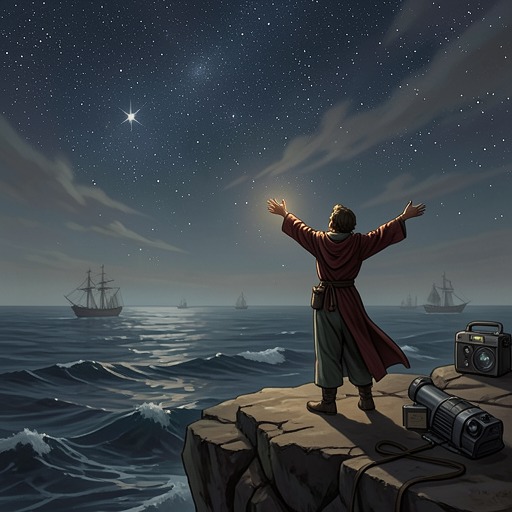
Moody’s own arrival gives this problem a bodily and spatial dimension. On the night of January 14, after disembarking at Dunedin, he looks for familiar northern constellations and finds them inverted: Orion hangs upside down, and Canis Major appears like a dead dog suspended from a butcher’s hook. He locates the Southern Crux but cannot recall how to use it to find the pole. In the antipodes, the familiar sky offers no equivalent marker. His disorientation is not merely a matter of unfamiliar stars; it unsettles the inherited measures by which he has tried to locate himself. The image anticipates the difficulty of locating a stable centre in the tangled account of Hokitika’s events.
Ecliptic shifts and changing judgment
Part Two begins under the headings Auguries and Ecliptic, making the change in celestial position a formal threshold. The narration describes the Sun advancing one-twelfth along its ecliptic path and associates that movement with a new order and a new perspective. Under the Sun in Capricorn, the earlier viewpoint had been reserved and exacting: people were fixed, their failures mourned and their gifts measured. The changed alignment turns attention outward, toward the world as people wish to perfect it and imagine inhabiting. The shift is not presented as a discovery of a final truth. Rather, it changes the terms by which people are seen.
That change matters because the Crown Hotel men begin to turn shared uncertainty into shared suspicion. Three weeks after their secret meeting, they greet one another with the familiarity of members of a guild. Their bond has formed less from common convictions than from common misgivings about figures outside their group, including Lauderback, George Shepard, Lydia Wells, Carver, Anna Wetherell, and Emery Staines. Yet no body has been tried and no new information has emerged. Their hypotheses grow more fanciful and less practical as suspicion takes on the qualities of superstition. The celestial framework therefore accompanies a warning about false order: people can connect scattered events, but the pattern they construct may reflect their shared mood rather than proof.
Chapter signs, memory, and relation
The later heading Aries in the Third House marks another point in the sequence of astrological chapter titles; Jupiter in Sagittarius marks another. These headings place the narrative within an ongoing celestial scheme, while their accompanying chapter descriptions keep attention on particular movements of information and relationship. One chapter follows Te Rau Tauwhare seeking employment and Benjamin Löwenthal’s suggestions being rejected; another describes Balfour’s lapse of discretion, revived subjects, and Lauderback’s letter of complaint. The heavens provide a recurring frame, not a substitute for the human actions the chapters narrate.
The framework’s strongest interpretive claim is that truth depends on relation. As celestial bodies move, the novel’s perspective moves with them, away from treating people as fixed moral objects and toward considering what they might become, or how they have changed themselves. That principle also clarifies why the narrative repeatedly revisits the same people and events from altered positions. Moody tries to impose chronology on Balfour’s account; the assembled men turn their partial knowledge into suspicion; and the chapter structure situates these acts of interpretation within a shifting sky. Astrology and celestial order thus give the novel a formal image for its central difficulty: connections are real, but their meaning changes with the vantage from which they are read.