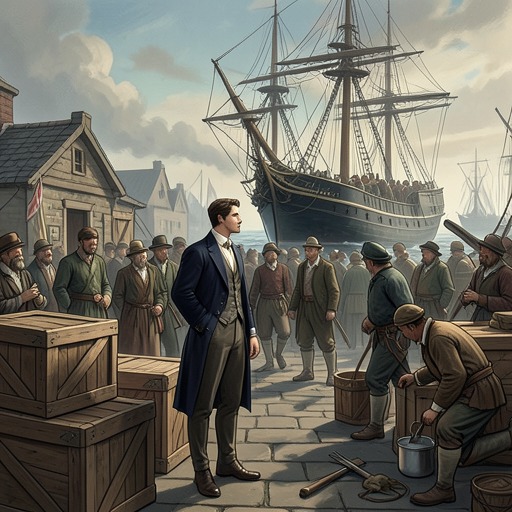
Cockatoo Island Penitentiary
The LuminariesCockatoo Island Penitentiary is significant less as a depicted setting than as a documentary trace of Francis Carver’s past. A prison letter establishes that Carver served time there before his release and departure for Dunedin, while Crosbie Wells later identifies the institution as the place where Carver was imprisoned. Together, these references make the penitentiary a link between Carver’s concealed history and the stolen identity at the centre of Wells’s account.
The prison letter and Carver’s trail
A letter from Cockatoo Island Penitentiary thanks Mr. Yongsheng for his inquiry and reports that, after leaving gaol, Francis Carver sailed for Dunedin aboard the steamer Sparta. Someone has added Hawthorn Hotel at the foot of the letter in darker ink. The document gives a destination and a possible address, turning Carver’s release into a trackable sequence rather than an unverified rumour.
The letter surfaces when a Chinese visitor arrives at Crosbie Wells’s door looking for Carver. Emery Staines, recalling Carver’s instruction, says that no one by that name is there and redirects the visitor toward the name Francis Wells. When the visitor produces the penitentiary letter, Staines learns that Carver was a former convict. The discovery strikes him, though he reflects that it is not wholly unexpected; he nevertheless denies knowing anyone called Francis Carver.
The institution as a concealed history
The prison’s significance emerges again when Crosbie Wells asks Lydia Wells whether she knows anyone who has served time at Cockatoo Island. She says no, and Wells answers that he does not either. Their brief exchange leaves the visitor’s question and its implications suspended: the institution is already connected to someone in their orbit, though neither acknowledges that connection.
Later, Wells tells Bill that Carver is an ex-convict who served time at Cockatoo Island. He insists that the miner’s right, certificates, and other papers kept in the safe at Cumberland Street were stolen, and that Carver is using his name. The penitentiary reference thus becomes part of Wells’s explanation for the identity theft: Carver’s past is not merely biographical information but a fact Wells invokes while trying to establish that the man acting under his name is an impostor.
Narrative significance
Cockatoo Island Penitentiary is presented through the records and testimony attached to it: a letter from the institution, the visitor who carries that letter, and Wells’s later accusation. These separate traces progressively give weight to Carver’s hidden history. The place also anchors a contrast between names and documents: Carver’s prison history can be written down, yet Wells’s own papers have been taken, allowing another man to claim his identity. The penitentiary therefore helps connect the record of Carver’s release with the larger struggle over who can credibly claim to be Francis Wells.