Crosbie Wells
The LuminariesCrosbie Wells is a former prospector who lives alone in a cottage in the Arahura Valley, apparently a poor and inconsequential hermit but in fact the keeper of a substantial fortune and a past bound up with several of the novel’s central mysteries. His death makes his hidden wealth available to others, while later discoveries reveal that his identity and family connections have been obscured as carefully as his gold. The contrast between his modest life and the elaborate claims made over his name, property, and money gives his story its force: long after he can speak for himself, other people continue to profit from, conceal, or reinterpret his history.
Identity and Background
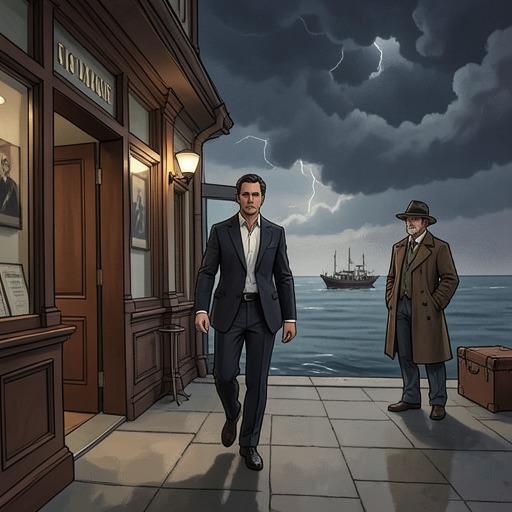
Wells is little known in Hokitika before his death. He has few acquaintances, and those who meet him do not take him for a wealthy or influential man. He is a former prospector who has more recently devoted himself to building a mill. His quiet life in the valley disguises the scale of his earlier success: several years before, he had made a major strike at the Dunstan goldfield, producing thousands of pounds. He apparently chose not to make that discovery public, and the resulting gap between his visible circumstances and his private wealth becomes the opening for other people’s schemes.
His identity is also less straightforward than his settled life suggests. In correspondence discovered later, the connection between Wells and Alistair Lauderback emerges as a family secret: they are half-brothers, with Wells the illegitimate son. The brothers have lived radically different lives. Lauderback has risen through the Provincial Council and into Parliament, while Wells has struggled in isolation on the other side of the world. Their shared parentage is not volunteered when Lauderback speaks about Wells’s death, and he does not disclose it to his friend Thomas Balfour. The family relation therefore remains not merely a biographical fact but a concealed piece of the estate mystery.
The Cottage, the Mill, and the Valley
Wells purchases one hundred acres at the eastern end of the Arahura Valley for fifty pounds, paying the Crown rather than Poutini Ngāi Tahu. The land is thick with totara, a timber valued for its fine grain and resistance to salt and storm. Wells is pleased with the purchase, builds a one-room cottage overlooking the river, clears a space for a garden, and begins constructing a timber mill. His dwelling and work embody a modest form of self-sufficiency: the cottage, garden, and mill are the visible results of his labor, while the gold fortune remains hidden inside the small home.
The life he makes there is also a life of companionship, though it appears to outsiders to be solitary. Te Rau Tauwhare and Wells are great friends. Their routine of exchange is simple and enduring: Tauwhare brings meat, Wells provides spirits, and both are satisfied with the arrangement. On the morning after Wells’s death, Tauwhare arrives with food as usual, unaware that the familiar household has already become a death scene. The cottage’s importance is thus not only legal or financial. It is a home within a friendship, and Tauwhare’s grief registers the human loss that the subsequent arguments over land and money threaten to obscure.
A Death That Opens the Estate
Wells dies at his kitchen table. When Alistair Lauderback and his aides stop at the cottage after nightfall, they find him slumped over, one hand curled around an empty bottle. Lauderback reports that the kettle is still boiling and has not run dry, suggesting that Wells has been dead only a short time. The account recorded by the duty sergeant attributes his death to drink. Later, Cowell Devlin is told that Wells died peacefully from age, infirmity, and alcohol, with no immediate reason to suspect homicide. The circumstances invite questions, however, because Francis Carver had also been seen entering the cottage before Lauderback arrived. Balfour reasons that Carver may have been there before Wells died, perhaps even witnessing his death, but the evidence does not settle what happened inside the cottage.
Tauwhare encounters the removal of his friend’s body the next morning. The physician, Dr. Gillies, and the chaplain Cowell Devlin are taking the body away beneath a folded blanket. Recognizing Wells’s boots and form, Tauwhare cries out and drops the food he has brought. Devlin offers him a place on the cart’s rear tongue so that he can accompany his friend to Hokitika for burial. The scene marks the change from private life to public matter: Wells’s body is removed, his property is handled by officials and purchasers, and his absence becomes the condition in which competing claims can begin.
The Hidden Fortune and Its Claimants
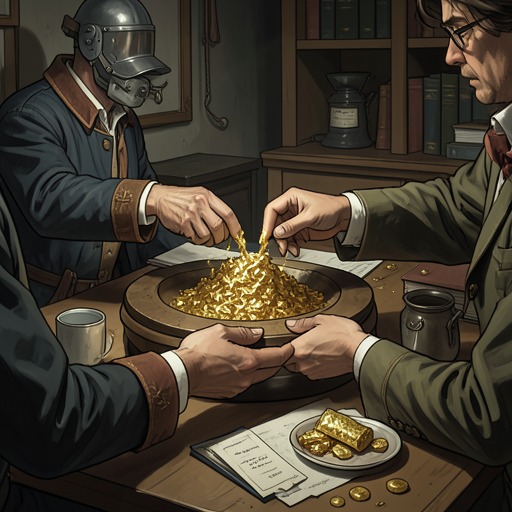
Wells leaves no will, known family address, or readily available birth certificate. With no identified heir, his land and cottage revert to the Crown and are sold. Edgar Clinch buys the property almost immediately. Clinch then employs Harald Nilssen to clear the cottage and dispose of its contents. In the single room, Nilssen discovers gold hidden in numerous places. Once purified by the bank, the ore is valued at a little over four thousand pounds. After Nilssen’s ten-percent commission, taxes, fees, and other costs, the remainder is held in escrow at the Hokitika Reserve Bank.
The speed and secrecy of the property’s transfer become as consequential as the discovery itself. Lydia Wells arrives from Dunedin after the funeral and produces marriage papers, identifying herself as Wells’s wife. Her appearance unsettles a sale already completed and challenges the assumption that Wells had no family. Balfour emphasizes how little had been known about her: no one had previously identified a wife, and the Crown had proceeded on the information available. Lydia appeals to revoke Clinch’s purchase, and the missing birth certificate becomes a central obstacle in the legal proceedings. The estate is therefore contested through documents that can establish or unsettle identity: a marriage paper makes a widow visible, while the absence of a birth certificate impedes resolution.
The fortune also acquires a public and political afterlife. George Shepard is accused of using money extracted from Wells’s cottage after Wells’s death to begin construction of the Hokitika gaol-house, without the consent of the relevant public bodies or the investor. The accusation describes the investment as having been made roughly two weeks after Wells died and demands a public clarification. What had seemed to be the private disposal of a dead man’s effects is recast as a question of public authority, consent, and the use of an estate whose ownership is still disputed.
Relationships, Documents, and Concealed History
Wells’s connections reach beyond the valley and the inheritance case. On 11 October 1865, a deed records that Emery Staines is to give Anna Wetherell two thousand pounds, with Wells as witness. The document places him in the history of Staines and Anna’s promised gift, linking his name to an obligation intended to provide for her. Its presence also complicates any picture of Wells as merely an isolated hoarder: he has witnessed a transfer meant to benefit someone else, even as much of his own wealth remains hidden and vulnerable to appropriation.
Wells’s relationship with Lauderback is more intimate and more painful. In letters that Walter Moody discovers, Lauderback’s connection to Wells is disclosed, along with the secret of Wells’s illegitimate birth. The correspondence indicates that Wells’s Dunstan wealth, not Carver’s own mining claim, supplied the fortune involved in the later blackmail. Moody concludes that Lydia disclosed Wells’s secret to Carver, helping them devise a plan to take the fortune and use Lauderback’s shame about his family connection as leverage. This reconstruction makes Wells a victim of betrayal by people who knew how to turn both money and kinship into instruments of control.
Moody’s response is personal as well as investigative. He imagines Wells alone in the cottage, abandoned by his father and betrayed by his brother, and recognizes parallels with his own history. After discovering the relationship, Moody tells no one. He believes the private correspondence should not be exposed without consent and that a man should not be made answerable for his family; he also feels a kinship with both Wells’s desperation and Lauderback’s pride. His silence preserves the secret but does not erase its significance. Instead, Wells’s story becomes a test of whether disclosure is always justice, especially when the dead cannot consent to the use of their letters.
Narrative Significance
Wells’s story is assembled from traces left behind: the empty bottle, the hidden gold, the missing certificate, the deed witnessed for Anna, and letters that reveal the half-brothers’ history. Each object changes the apparent meaning of the man. The cottage initially suggests poverty; its concealed gold turns it into an estate. The lack of family papers supports the Crown’s sale; Lydia’s marriage papers challenge it. The letters transform a suspected connection into a history of shared parentage, unequal fortunes, and deliberate concealment.
His death remains surrounded by incomplete knowledge. The official account is drink and infirmity; Carver’s presence before Lauderback’s arrival raises the possibility that more occurred, without proving it. Later, Emery Staines remembers approaching Wells’s cottage after his own shipwreck, though his recollection of that period is fragmented and dreamlike. Tauwhare, meanwhile, returns to the house and sees its iron roof rusting orange and its garden gone to seed, the visible decay of a place once sustained by labor and friendship. Across these different perspectives, Wells is never reduced to a single explanation. He is the concealed prospector, the friend whose ordinary hospitality mattered, the brother hidden behind a politician’s public identity, and the dead man whose fortune continues to shape the lives of the living.