Crosbie Wells estate gold
The LuminariesCrosbie Wells estate gold is the fortune discovered hidden throughout Crosbie Wells’s cottage after his death, valued by the bank at £4,096 and treated in the first instance as part of his estate. Its bars bore the name Aurora before the bank remelted them, and their later history tied a dead man’s property dispute to Ah Quee’s labor and Emery Staines’s concealment of the gold in the Arahura Valley. The fortune is therefore more than a cache: it is a material record whose changing locations, markings, and legal descriptions repeatedly unsettle the question of ownership.
Land, discovery, and concealment
The gold’s story unfolds against a larger dispute over land and the wealth extracted from it. Te Rau Tauwhare belonged to Poutini Ngāi Tahu, whose former territory had extended along the western coast of the South Island. Six years before the events described, the Crown had purchased that extensive land for £300, reserving only the Arahura River, parts of its banks, and a small area at Mawhera. The iwi had regarded the negotiations as unfair; in the intervening years, the influx of prospectors and the growing value of the gold made the scale of their loss unmistakable. Miners bought licences and land, while the wealth in rivers and sands acquired a value that had not yet been calculated.
Crosbie Wells, meanwhile, purchased a hundred acres at the eastern end of the Arahura Valley from the Crown for £50. He built a one-room cottage overlooking the river, cleared a garden, and began work on a timber mill. The eventual discovery of gold throughout this cottage transformed the apparently modest property into the centre of an estate dispute. Wells had been known locally as a solitary man with little apparent wealth; his earlier fortune from a strike at Dunstan had not been common knowledge. The hidden gold thus changed not only the value of his effects but the meaning attached to his life and property after his death.
Discovery and the bank’s record
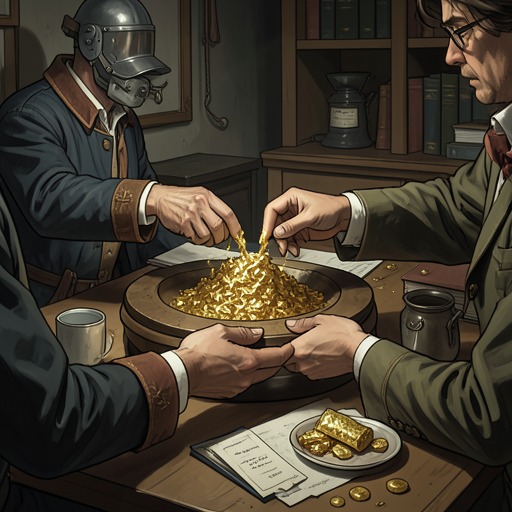
Edgar Clinch commissioned Harald Nilssen to clear the cottage and dispose of its contents. Nilssen found gold in an array of domestic hiding places, including a flour canister, a powder box, a meat safe, bellows, and the cracked basin of an old commode. The metal was heavy and already pressed into squares rather than left as dust or nuggets. After the bank purified and valued the ore, the estate inventory recorded £4,096 in gold.
Nilssen received a ten-percent commission of just over £400, a sum that briefly suggested the possibility of starting over. But the sale of the estate was appealed soon after Lydia Wells arrived and claimed that the property and effects belonged to her. The fortune was seized by the bank while the inheritance dispute proceeded. Nilssen’s commission was also at risk: if the appeal succeeded, he could be required to repay it in full. The gold’s discovery therefore brought him sudden wealth and an immediate legal and financial burden, while leaving Clinch’s purchase vulnerable to Lydia’s claim.
The bars also carried a clue that the bank’s ordinary process nearly erased. Charlie Frost explained that the gold had already been smelted privately before Nilssen brought it in. The bank nevertheless retorted it again to prevent adulteration and ensure uniform quality; by the time it could be examined in the vault, it had been poured into bars bearing the Reserve seal. Frost had inspected the squares before that second smelting and noticed that each had a word inscribed on its underside: Aurora. Although remelting removed the visible mark, Frost had recorded it in his book. That written record preserved a provenance the bullion’s new form concealed.
The Aurora connection and competing trails
The name on the bars connected the cottage gold to the Aurora claim, but the gold’s passage through other hands made its history difficult to read. Ah Quee had worked at the claim, and he secretly removed gold from Anna Wetherell’s gowns while she visited his hut in Kaniere Chinatown in an opium-clouded state. He retorted the recovered dust into squares and stamped them Aurora so that the proceeds would be credited to the claim, which by then belonged to Emery Staines. Ah Quee acted in the belief that he was countering Dick Mannering’s fraud, having previously been cheated by him.
The gold in the gowns formed a distinct but entangled trail. A trunk associated with Francis Carver’s dealings with Alistair Lauderback contained about £4,000 in gold sewn into five dresses by Lydia Wells. Ah Quee stripped four gowns over several months, leaving the gold in Anna’s orange dress untouched. Anna later discovered that remaining portion after waking in gaol with no memory of the preceding twelve hours; with Aubert Gascoigne’s help, she removed it and hid it in a flour sack. Neither the name Aurora on the squares nor the similar scale of the sums makes every cache identical. Instead, the overlapping routes of concealed gold help explain why characters repeatedly misread its source and ownership.
Testimony and the question of ownership
At Emery Staines’s trial, he gave the cottage gold a more specific history. He said the ore had been found at the Aurora claim by his employee Ah Quee, who retorted it into squares and submitted it to him as legal earnings. Staines admitted that he did not bank the bonanza against the claim, as the law required. Instead, he bagged it, carried it to the Arahura Valley, and buried it. His account connects the marked bars, Ah Quee’s mining work, and the gold found at Wells’s cottage, while also distinguishing possession from the legal duties attached to the Aurora claim.
The testimony complicates the estate label. The gold had been inventoried among the effects of Crosbie Wells and its discovery had helped trigger Lydia’s challenge to the sale, yet Staines’s account identified him as the person who took it to the valley and buried it. The bank’s valuation established its monetary amount, and Frost’s notes preserved the Aurora mark, but neither fact alone settled the competing claims. The gold’s narrative significance lies in that gap: each new record or confession makes the metal more legible as evidence while exposing how little its official description can say about labor, concealment, and rightful ownership.