Crown Hotel
The LuminariesThe Crown Hotel serves as more than an inn in Hokitika: it is Walter Moody’s temporary home, a meeting place for men connected to the town’s mysteries, and the setting in which recollections and physical clues begin to converge. Its smoking room gives the investigation a public, disputatious centre, while Moody’s private room shelters evidence whose significance he must decide how to handle.
Lodging and daily life
Moody lives at the Crown while trying to understand the events that have drawn him into Hokitika. The hotel gives him an ordinary routine amid the inquiry: on the morning of 20 March he rises before dawn, washes at his window, and goes down for hard-boiled eggs, toast, tea, and the West Coast Times. The paper’s notices and shipping news are part of the town’s daily information network, but a brief social announcement arrests his attention. It names a prospective groom and directs congratulations to the Palace Hotel, where the man is said to lodge each night.
The notice matters because Moody knows that Francis Carver’s apparent residence at the Palace is a fiction. Carver continues to keep his room there, leaves his clothes and trunk in place, eats breakfast in the dining room, drinks in the parlour, and pays for the room, although he sleeps elsewhere. Since the night of Lydia Wells’s séance at the Crown, he has been staying in a small room beside the Palace kitchen, with a clear view along the rutted road toward Kaniere. The false appearance of a stable address and the concealed room together make the hotel district part of Carver’s watchfulness and deception.
The Crown is also where Moody’s temporary residence becomes a vulnerability. When a trunk intended for Alistair Lauderback is delivered to his room, Moody opens it and finds Lauderback’s correspondence with Crosbie Wells. The letters are pertinent to the case, but their presence poses an immediate practical and ethical problem: Moody considers copying them, taking them to an authority, consulting friends, or sending them for publication. He ultimately reties the bundle, restores it to the trunk lining, and makes the room appear undisturbed. He then tells the maid that the wrong trunk has arrived. The hotel thus provides privacy for a discovery but no simple answer about what the discoverer ought to do.
The smoking room and the council
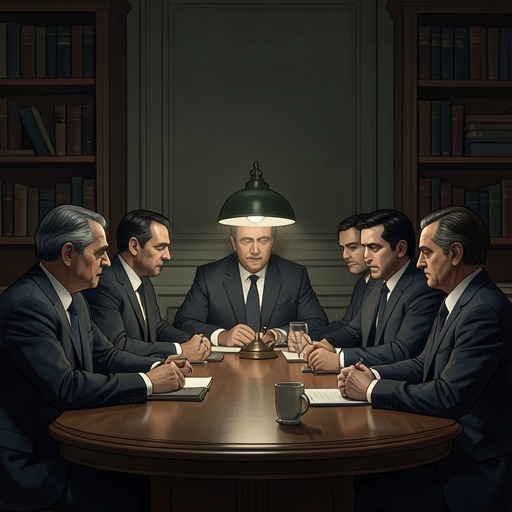
The Crown’s smoking room becomes a place where information is pooled rather than held by a single investigator. Charlie Frost reports that a group of men is to meet there after nightfall to compare what they know. The proposed gathering includes men who had been at Quee Long’s hut, Edgar Clinch, who bought Wells’s estate, and Joseph Pritchard, whose laudanum was found in Wells’s cottage. Harald Nilssen has vouched for Pritchard, and Frost for Clinch. The choice of invitees makes the meeting a practical attempt to connect separate lines of evidence, but it also raises the question of who has the right to participate.
Benjamin Löwenthal objects to the invitation’s narrowness. Although he has no authority to enlarge the council, he invites Te Rau Tauwhare and Cowell Devlin, partly to correct what he sees as Frost’s unjustifiable exclusion of them. Thomas Balfour welcomes the additions, and the others accept. Devlin arrives with a private matter on his mind: the deed of gift he removed from Wells’s stove is concealed in his Bible, between the Old and New Testaments. He resolves to bring the Bible and produce the deed if the conversation gives him the right occasion. The hotel therefore gathers not only people but also secrets that some of them have not yet decided to disclose.
By the time the meeting reaches its account of the January events, twelve men are present. Moody regards them as a peripheral gathering, bound together by their connection to 14 January, when Anna Wetherell nearly died, Crosbie Wells died, Emery Staines disappeared, Francis Carver sailed away, and Lauderback arrived in town. The people at the centre of those events are absent: so are Lydia Wells and Governor Shepard. That gap matters. The council must reconstruct the crisis from witnesses, objects, and second-hand accounts rather than from the principal figures themselves.
Recollections and the changing case
The smoking room turns the telling of the past into an event in the present. During the discussion, Benjamin Löwenthal is reminded of something he has not had reason to recall for months. He interrupts Balfour and recounts a visit to his Weld Street office in June 1865. A dark-haired man with a scar on his cheek had asked him to place a missing-crate notice in the West Coast Times. The stranger offered twenty pounds for the crate’s return, or fifty if it came back unopened, and said only that its contents had great personal value. Asked for his name, he had placed a birth certificate on the desk; Löwenthal copied the name Crosbie Francis Wells.
Löwenthal’s recollection supplies a troubling link between the name on the certificate and the scar associated with Carver. He remembers the man pressing a top hat between his palms as he spoke and is confident that the scar was sickle-shaped, but he also admits that he never knew the hermit Crosbie Wells and cannot picture the dead man’s face. His identification is therefore powerful without being conclusive. The new detail provokes a long exchange of interjections and speculation among the men at the Crown, changing what they can infer about Carver’s assumption of the Wells name without eliminating uncertainty.
The location matters to the way this information arrives. An earlier failure to recount Lauderback’s story had kept Löwenthal’s memory dormant and left Balfour’s investigation frustrated. In the Crown’s present-time conversation, the relevant account finally prompts the recollection. The hotel’s gathering does not merely store testimony; its sequence of speaking, listening, and interruption determines which past details become available to the group.
A temporary base and a point of departure
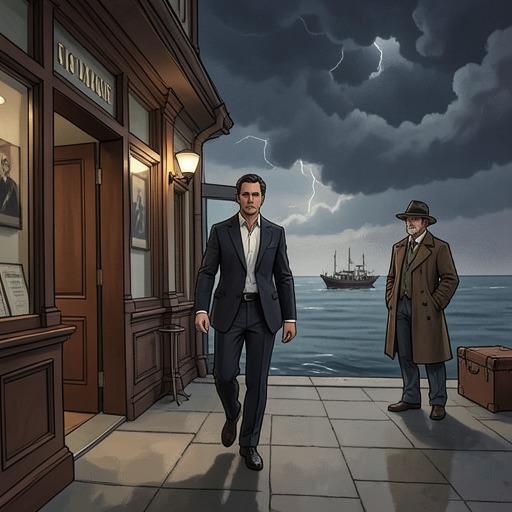
The Crown’s role extends beyond the council. After the legal proceedings, Moody prepares to leave the hotel with his belongings packed in his trunk. During his absence, he arranges for the trunk to be kept at Clark’s Warehouse on Gibson Quay and directs any private mail there. He leaves three silver shillings at the front desk to cover the arrangement, returns his key, and gives the maid a fourth shilling with thanks for three months of service and hospitality. The careful settlement of his account marks the end of his stay as clearly as the packing of his clothes.
From the hotel he takes the narrow path to the beach and walks north, carrying his swag and tent roll. Within two miles of Hokitika, he notices another man walking ahead and exchanges a nod with him before they speak. The Crown has been Moody’s base for observation, inquiry, and concealment; his departure turns the inn from a fixed centre of investigation into the place from which he resumes the road.
Narrative significance
The Crown Hotel brings together the novel’s public and private forms of knowledge. In the smoking room, men contest what the law, reputation, and personal testimony can establish; in Moody’s room, a misdelivered trunk exposes letters that he chooses not to reveal. Elsewhere in the hotel, Carver’s hidden lodging complicates the address he presents to the town. These uses of the building make it a setting where appearances are maintained even as evidence accumulates beneath them.
The hotel also gives the story a layered structure. Events from the past are not simply recounted in order: a conversation in the smoking room prompts Löwenthal’s delayed memory, and that memory alters the group’s understanding of an earlier identity and a missing crate. The Crown is consequently both a physical meeting place and a narrative hinge, where separate accounts become newly connected without resolving every doubt.