Deed of gift to Anna Wetherell
The LuminariesThe Deed of gift to Anna Wetherell turns a proposed transfer of £2,000 into a contested question of signature, inheritance, and proof. Its central complication is that the document bears Crosbie Wells’s genuine signature as witness but also carries a signature for Emery Staines that Anna Wetherell forged. The paper therefore serves two opposing purposes: it supports Anna’s claim to a gift while furnishing the authorities with evidence that undermines her account and strengthens a case against her.
Purpose and discovery
The deed purported to record a gift from Emery Staines to Anna, with Crosbie Wells as witness. In court, Walter Moody identified Wells’s signature on a deed dated 11 October 1865, specifying that £2,000 was to pass from Staines to Anna. The document concerned a defined sum, not the whole of the wealth associated with Wells’s estate or the gold sewn into Anna’s dresses. Its promise nevertheless connected Anna to the fortunes circulating among the men whose dealings had brought the papers and gold into dispute.
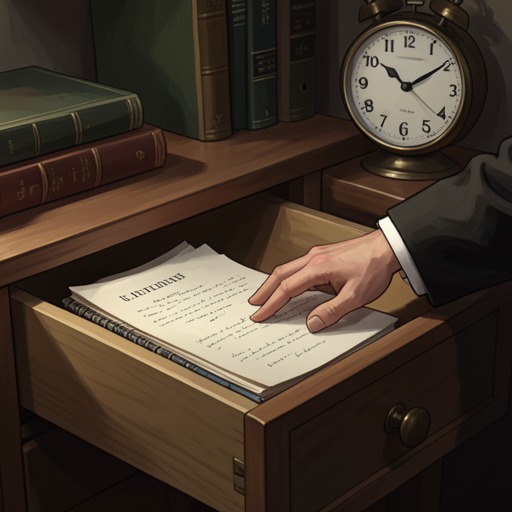
Cowell Devlin testified that he found the document in Crosbie Wells’s cottage the morning after Wells died. Alistair Lauderback had brought news of the death to Hokitika, and George Shepard had charged Devlin with helping collect Wells’s remains. Devlin said the deed was invalid when he first encountered it because Staines had not signed it. He had not witnessed any later signing. That distinction matters: the document’s presence in Wells’s cottage and his signature as witness did not establish that Staines had authorized the gift.
Anna later told Edgar Clinch that the document had been found in Wells’s stove and that someone had tried to burn it. She described the £2,000 as a present and treated it as proof that Staines loved her. Her account gave the paper both a material and an emotional value: it appeared to promise financial independence, but also to confirm a personal attachment. Neither the apparent generosity of the bequest nor the document’s survival in a stove settled whether its terms had been properly executed.
The claim and the altered document
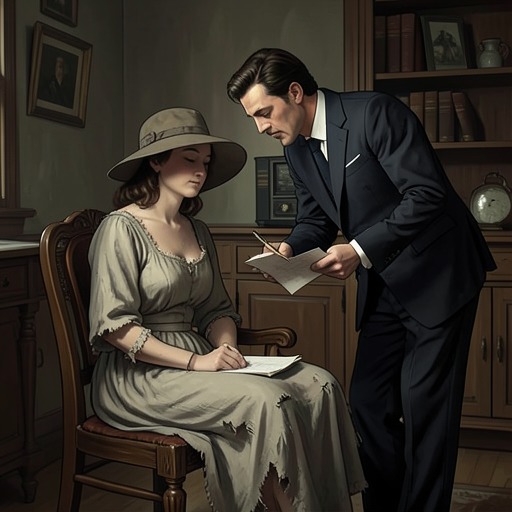
On 20 March, Anna said, Cowell Devlin brought the paper to the Wayfarer’s Fortune to show her. She took it to the Courthouse, where John Fellowes told her that the deed was a legal document and binding, and that she might have a claim on the fortune. Fellowes agreed to take it to the bank on her behalf. Anna returned to the Courthouse later that day as instructed, but fainted before their meeting could proceed. Her testimony thus set out a sequence in which the document moved from Devlin to her, then into legal and financial channels as the foundation of an inheritance claim.
The deed Anna presented to Fellowes was charred, but it bore a signature where Staines’s had previously been absent. Charlie Frost confirmed that the estate gold had already been retorted by Quee Long, who had worked Staines’s Aurora mine. Frost was then shown the deed; on seeing it, he remarked that it had been signed. The surprise registered by the banker underscored the significance of the altered state of the document: its apparent legal force depended on a signature that had not been present when Devlin found it.
Devlin eventually admitted to George Shepard that Staines’s signature had been forged by Anna herself. That admission transformed the deed from a possible instrument of gift into a piece of evidence against its claimant. The authorities could use it to argue that Anna had a reason to wish Staines dead, and could frame her assault charge as attempted murder. A paper she had relied on to establish a claim to money could therefore be turned into an account of motive. Its evidentiary force did not depend simply on what it said, but on who had added the signature and what that act allowed others to infer.
Signatures, identity, and corroboration
The document’s evidentiary role extended beyond Anna’s claim. In court, Moody compared the signature of Crosbie Wells on the deed with Wells’s signature on private correspondence to Lauderback and on the marriage certificate Lydia Wells had submitted. Moody said the three signatures matched. He contrasted them with the signature on the bill of sale for the barque Godspeed, submitted by Francis Carver, which did not resemble Wells’s hand. The comparison supported Moody’s conclusion that the ship’s bill of sale was forged.
This was a layered reading of the deed rather than a simple verdict on whether it was genuine. Wells’s signature could authenticate his role as witness while the signature attributed to Staines remained false. By distinguishing the marks on the same sheet, Moody used the document to separate a real connection to Wells from Anna’s fabrication—and to expose Carver’s different deception. The deed thus became a point of comparison among papers that had been used to claim money, establish relationships, and disguise identities.
The novel gives the document a history shaped by uncertain custody and changing interpretations: Devlin found it unsigned in Wells’s cottage; Anna received it from Devlin and presented it as a binding promise; its charred, signed version reached Fellowes and Frost; and, in court, its signatures were examined alongside correspondence and a marriage certificate. Each transfer changed what the paper could do. It began as an incomplete bequest, became the basis of a claim, then a forged exhibit capable of suggesting motive, and finally a tool for distinguishing genuine handwriting from impersonation. The deed’s power lies not in making the truth self-evident, but in showing how one document can contain both reliable evidence and deliberate fraud.