Dick Mannering
The LuminariesDick Mannering is a Hokitika goldfields magnate whose many businesses and local influence give him the power to present self-interest as ownership, employment, or justice. He is both a practiced profiteer and a participant in the conflicts over the Aurora gold: he once salted a worthless claim to deceive Quee Long, later suspects Quee of possessing gold stamped with the Aurora name, and eventually works to draw Emery Staines into his orbit. His story links the goldfields’ appetite for fortune to the debts and unequal relationships through which that fortune is pursued.
Identity and Public Standing
Mannering introduces himself to Walter Moody and Aubert Gascoigne as a man of the Prince of Wales Opera House, but that is only one part of his business life. He also earns money as a prostitution operator, card sharp, shareholder, and goldfields magnate. The breadth of his enterprises is matched by a talent for profit, especially profit made from other people’s trespasses. His identity is therefore less that of a single-minded prospector than a businessman who finds opportunity wherever the gold rush produces appetite, risk, or dependence.
The furnishings of his office make that wealth legible. The room has papered walls, oiled cabinets, a thick Turkish rug, and a Roman-style ceramic bust used as a bookend; a specimen box beneath the window displays three large black butterflies. The room’s cultivated display sits alongside the practical accumulation of his ventures. When Charlie Frost visits, Mannering’s collie rushes out from under the desk to greet him, a domestic detail that contrasts with the forceful commercial figure who occupies the office.
Mannering also knows how the goldfield’s money circulates. He tells Moody that many diggers spend their finds at hotels and shanties, and suggests that selling liquor can be a better business than heading into the hills. The observation is an explanation of his own approach: miners’ hopes and earnings are not merely the product of extraction, but also a market to be managed by those who own or control the services around it. He boasts that at one time or another he has owned much of the land between Hokitika and the Grey, a claim that presents territorial reach as another measure of his stature.
Business, Influence, and the Secret Council
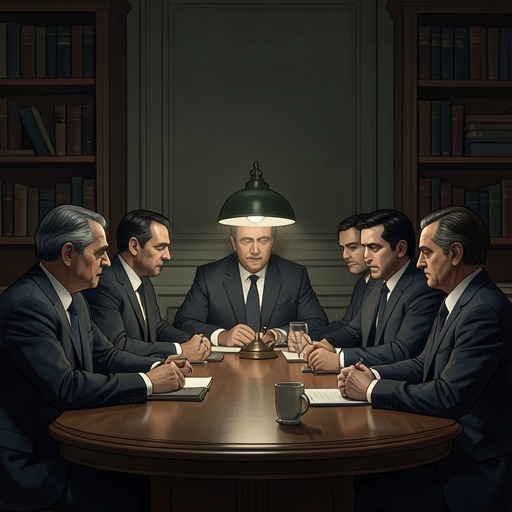
Mannering’s influence extends beyond his office and businesses into the town’s social arrangements. On the night Walter Moody unexpectedly enters the private gathering at the Crown Hotel, Mannering’s boy is posted outside with a bundle of free gallery tickets for a new performance at the Prince of Wales Opera House. The private function is carefully protected from interruption; the tickets and the boy’s presence place Mannering’s commercial resources at the edge of the gathering, even as the assembled men seek privacy. Mannering is enthusiastic about the idea of a secret council. He likes the prospect of a guild with its own history, ranks, and code, and appears drawn to the authority and belonging such an organization might confer.
His commercial reach also shapes his dealings with Anna Wetherell. When Edgar Clinch lets Anna leave without consulting him, Mannering protests that she owes him more than a hundred pounds in rent and other costs, and insists that she answers to him. He describes her as his best worker and objects to losing her services. His language of debt makes clear that he regards money owed as a claim over a person, not simply an account to be settled. Later, when Lydia Wells plans to send Anna to Hokitika, she says she has transferred the expenses Anna incurred over the previous two months to Mannering, who is to set her up as a camp follower. The arrangement makes his commercial authority part of the means by which Anna’s future is being directed.
The Aurora Claim and Quee Long
Mannering’s most revealing account of his mining methods concerns Quee Long, who worked for him at the Aurora. He describes their earlier dispute as a difference in their ways of doing business, while also acknowledging that he returned Quee’s weekly yield to the claim after it had been counted. His account then exposes a deliberate fraud: the Aurora was nearly worthless, so after buying it he scattered about twenty pounds’ worth of pure ore through the gravel and directed Quee to dig. Quee found the planted gold and took it to be weighed, as other miners did. Mannering refused to bank the metal, claiming he wanted to keep it pure, and used the apparent yield to support the claim’s credibility. The scheme depended on Quee’s labor and on the gold’s seeming to have come naturally from the ground.
Years later, after a fortune of four thousand pounds in smelted gold stamped Aurora turns up in a dead man’s house, Mannering identifies Quee as the person he wants to question. He regards the stamp as Quee’s signature and treats the gold’s association with the Aurora as reason to claim an interest in it. When he goes to the forge and finds Quee with Ah Sook, he arrives armed and accuses them of conspiring together, using a racist insult as he does so. He insists that the gold is his and demands a yes-or-no answer about whether it came from the Aurora. The urgency of his demand is sharpened by his own earlier deception: Mannering helped make the claim’s name a mark that could be attached to gold, and then uses that mark to assert authority over a fortune whose history is contested.
Mannering’s account of the Aurora also gives him a personal vocabulary for judging goldfield conduct. He tells Staines that fraud is the gravest crime on a goldfield because it mocks a digger’s hopes; he distinguishes between salting a claim and falsely declaring a claim worthless. Yet Mannering himself has salted the Aurora. The principle he announces thus condemns a practice he has already used, revealing how readily his moral standard changes when his own advantage is at stake.
Anna Wetherell and Quee Long
Mannering’s relationship with Anna is shaped by both commercial possession and intermittent claims of concern. When he learns that she has been allowed to leave without his permission, his immediate emphasis is the debt and the loss of his most valued worker. He later says that he has kept his distance for three weeks and wants the chance to speak with her, describing himself as having lost his best worker. The appeal to respect does not undo the earlier insistence that Anna answers to him; rather, it shows how affection, business, and control remain entangled in his account of their relationship.
The debt also becomes a practical issue in the plans made for Anna after Staines reappears. Frost proposes that Staines take on her debt to Mannering and have it repaid from his share of the bonanza, so that Anna will have money to live on while Staines is in prison. The proposal recognizes Mannering’s claim as an obstacle that must be addressed before Anna can have financial security. The scene does not establish that the plan is carried out, but it places Mannering’s debt within the wider effort to protect her from being left without means.
Mannering’s dealings with Quee are similarly unstable. He first exploits Quee’s labor in the Aurora fraud, later accuses him of possessing the stamped gold, and then intervenes when two men are attacking Quee in a coffee house. Mannering fills the doorway unarmed, and the attackers retreat. He declares that Quee is working for him again and recalls the earlier days when Quee’s skill with a crucible brought him gold dust. The intervention offers Quee immediate protection, but Mannering frames their renewed connection as employment and ownership. His conduct can defend Quee in one moment while reinstating a relationship in which Mannering claims the authority to define what Quee owes.
Change and Narrative Significance
Mannering’s later efforts to court Staines’s friendship extend his influence from old mining disputes toward a possible alliance. Over the course of a month, he arranges a long luncheon and behaves in a mayoral fashion, as though goldfield successes are his to judge and endorse. He tells Staines that a true goldfield crime is fraud, while the history of his own salted claim gives the pronouncement an unmistakable irony. He is not simply ignorant of the code he invokes: his success has depended on knowing which expectations miners trust and how those expectations can be manipulated.
In the final arrangements for Anna’s return to Hokitika, Lydia presents Mannering as the acquaintance who will decide how Anna is established there, while transferring Anna’s recent expenses into a debt to him. This projected future recalls Mannering’s earlier control of Anna through rent and employment, even as Staines’s proposed repayment offers a competing possibility: the debt might be discharged from the hidden fortune rather than used to bind Anna further. The evidence leaves that outcome open. Mannering remains a figure whose protection and assistance are difficult to separate from the power he derives from money owed.
As a character, Mannering embodies the gold town’s conversion of hope into business. He understands that miners spend what they find, that appearances can make a claim seem productive, and that a stamped piece of gold can become the basis for an assertion of ownership. His confidence in fraud as the goldfield’s worst offense sits beside his own manipulation of Quee and his claim over Anna’s debts. Those contradictions make him more than a wealthy background figure: he demonstrates how easily a self-serving interest can borrow the language of fairness, employment, or moral principle when backed by money and local influence.