Dunstan goldfield
The LuminariesThe Dunstan goldfield, an Otago field in Central Otago, is the source of Crosbie Wells’s concealed fortune and one of the novel’s most important links between past prosperity and present suspicion. By the time the story’s characters discuss it in Hokitika, Dunstan is past its prime and worked by company dredges. Yet the field’s earlier strike still governs the search for Wells’s history: a fortune made there was transported away, kept secret, and only later recognized as evidence that the supposedly obscure man had been wealthy all along.
A Goldfield Recalled from Hokitika
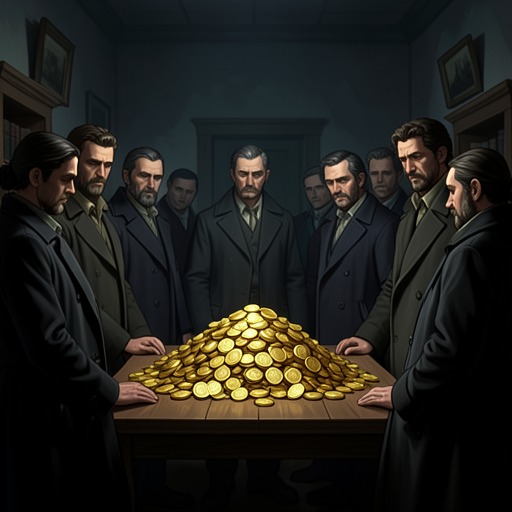
When Ah Sook identifies Dunstan as the place where Wells had been, the revelation initially disappoints Dick Mannering. Dunstan is not an obscure destination to him: he had been there, as had much of Hokitika. The field’s name therefore carries two meanings at once. It points to a specific secret in Wells’s past, but also to a familiar shared history among people who had moved through Otago in search of gold.
Walter Moody notices that Dunstan has come up twice in the conversation. His attention turns a repeated place-name into a clue. Ah Sook then explains that Wells made a major strike there, finding many large nuggets. The account changes the apparent scale of Wells’s life: he had not simply lived in isolation in the Arahura Valley, but had once acquired wealth on a scale that could explain the gold later found associated with him.
Wells’s Strike and the Fortune’s Departure
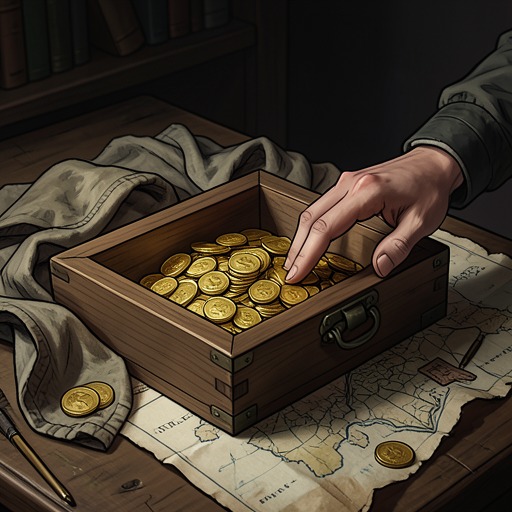
Wells’s Dunstan discovery was substantial enough for him to hire Gracewood and Spears to escort the resulting gold from the field. The detail gives the strike a material history: the wealth was not merely a private sensation of luck, but a consignment requiring organized transport. In Hokitika, the characters realize that Wells’s money had been his own, although they had not previously understood that he possessed a fortune.
The discovery remains shadowed by the secrecy surrounding Wells. Ah Sook’s account arrives years after the strike, and Moody’s reconstruction places Wells among the little-known people whose apparent lack of consequence concealed a much richer past. The goldfield thus functions as both a point of origin and a gap in the record: the fortune can be traced back to Dunstan, but Wells’s reasons for concealing his success remain uncertain.
Gold, Claims, and Competing Accounts
Dunstan belongs to a wider goldfields culture in which a discovery was not necessarily announced to fellow miners. Ah Quee argues that secrecy about a find was ordinary practice on the fields; Ah Sook counters that the gold he disputes was not simply discovered in the ground but taken from a woman’s clothing, raising a question of purpose and prior possession. Their disagreement exposes the moral ambiguity that surrounds gold in the novel: customs that can protect a prospector’s discovery can also be invoked to defend taking wealth whose history is disputed.
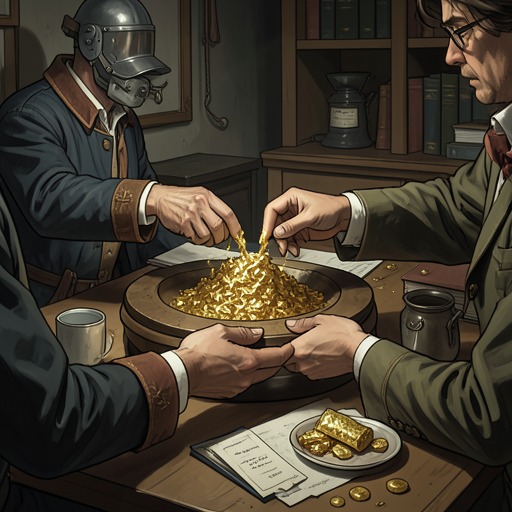
That uncertainty matters when Ah Quee’s account of gold hidden in Anna Wetherell’s dresses enters the investigation. He removes gold from four dresses, retorts the dust into squares, and stamps them with the name of the Aurora mine so that their value will be credited to his claim. The evidence connects this gold to a tangled chain of concealment and mining claims, but does not establish that it is the same fortune Wells struck at Dunstan. The two strands meet in the characters’ efforts to determine where wealth came from, who handled it, and what evidence can establish its rightful owner.
The Field and the Politics of Land
The gold rush also gives Dunstan a broader colonial context. The Crown had purchased the extensive lands of Poutini Ngāi Tahu for three hundred pounds, leaving the people with the Arahura River, parts of its banks, and a small parcel at Mawhera. In the years that followed, prospectors bought licenses for a pound apiece and land for ten shillings an acre, while the value of the gold in rivers and sands remained beyond calculation. The prosperity associated with fields such as Dunstan therefore sits within a system in which wealth generated from land did not accrue to the people who had once held it.
Te Rau Tauwhare’s connection to the Arahura Valley makes that history personal and immediate. Wells had bought one hundred acres there from the Crown for fifty pounds, built a cottage, and begun work on a timber mill. Tauwhare, who travelled the valley in search of stone, later objected to land being treated as a source of profit rather than a place to live upon and care for. Dunstan and the Arahura are not the same location, but Wells’s movement from a successful goldfield to land purchased in a dispossessed territory joins the novel’s private mystery of hidden wealth to its larger questions about who gains from the gold rush.
Narrative Significance
Dunstan is revealed through recollection and inference rather than through a scene set on the field. Its past enters the Hokitika gathering in fragments: Ah Sook’s discovery, Mannering’s recognition of the place, and Moody’s effort to order the clues. That delayed disclosure mirrors the movement of the gold itself, from a strike to an escorted shipment, then into concealment and later disputes over identity and ownership.
The field’s significance is consequently larger than the fact of Wells’s good fortune. Dunstan supplies a missing part of his biography, while its former prominence contrasts with its later decline into company dredging. It is also a point of comparison for other gold claims, where secrecy can be custom, strategy, or an excuse. In the novel’s web of uncertain fortunes, Dunstan names the place where a hidden past began to acquire a value that others would continue to pursue.