Edgar Clinch
The LuminariesEdgar Clinch is a Hokitika hotelier whose investments and personal entanglements draw him into the disputes surrounding Crosbie Wells’s estate and Anna Wetherell’s precarious life. His role is significant because he becomes both an opportunistic buyer of Wells’s property and an uneasy witness to the concealed gold sewn into Anna’s clothes. With Anna, his kindness repeatedly turns into injured expectation and attempted authority; with the estate, he acts on information supplied by others without fully understanding the scheme around him.
Identity and Position in Hokitika
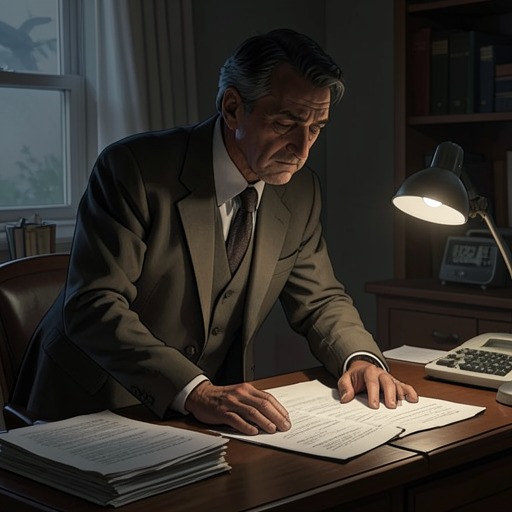
Clinch is described as forty-three, tall, and carefully groomed, with sandy hair parted in the middle, greased hair and moustache, apple-shaped cheeks, a reddish nose, and a blunt profile. His deep-set eyes nearly disappear when he smiles, a frequent expression that gives him a pleasant, apparently harmless manner. When first described in detail, however, he is frowning. The contrast between his amiable presentation and his capacity for anger anticipates a character whose good intentions do not reliably become good conduct.
He is identified as an hotelier and is associated with the Gridiron, later established as Anna’s residence. His business places him among the town’s property owners and intermediaries: he can offer rooms, demand rent, and pursue investments in land. He is not presented as an investigator or as a person with command of the larger intrigues. Instead, information reaches him through acquaintances, while his own business decisions make him visible to people trying to understand what happened to Wells’s property and fortune.
Purchase of Crosbie Wells’s Estate
After Alistair Lauderback finds Crosbie Wells dead at his cottage, he tells Benjamin Löwenthal of the death. Löwenthal infers that the property will soon be sold and informs Clinch the next morning, knowing that he is looking to invest in land. Clinch takes a deposit to Charlie Frost’s bank, where Frost facilitates the purchase. The speed of the transaction later attracts scrutiny: Wells’s land and mill had been sold before the wake was over, and Clinch became the buyer shortly after the bank reclaimed the land.
The purchase is legal, but its timing appears suspicious to those reconstructing the estate’s history. Harald Nilssen considers that Clinch must have received a tip and suspects that Frost knows about it as well. Nilssen does not believe Clinch took part in Emery Staines’s murder, although he understands why Joseph Pritchard suspects the people involved in handling the estate. Nilssen’s own position is compromised by having discovered the gold, recorded the laudanum phial among the effects to be sold, and stood to receive four hundred pounds from the transaction. Clinch’s acquisition therefore sits within a chain of interests where apparently ordinary business activity can resemble collusion.
Clinch later tells Löwenthal that the idea of buying land came from Frost, who presented it as a way to prevent questions. He says Frost informed him that Wells’s estate would soon be for sale; Clinch then brought his deposit the following morning. He describes this as the extent of his part. That explanation does not establish that he knew the full purpose behind the advice, and his later account suggests that the investment has become a liability rather than the secure opportunity he expected. When Wells’s widow challenges the sale, Clinch anticipates that the appeal will succeed and that the sale will be revoked, leaving the cottage to Mrs. Wells and returning his deposit.
Anna Wetherell: Care, Expectation, and Conflict
Clinch’s relationship with Anna begins when she arrives from Dunedin. He is deeply affected by her vulnerability and resolves that she should be loved. He gives her his best room and pampers her as far as he can. But he expects her to recognize his efforts; when she does not, he feels wounded, and when she fails to notice his hurt, he becomes angry. His anger does not sustain him. It leaves him feeling diminished and more ready to love, a cycle that makes his affection sincere but also emotionally demanding for Anna.
That attachment does not prevent him from using his position as landlord to pressure her. Anna tells someone that she is three months behind on rent and that Clinch has given her notice. He later explains that he had insisted she pay her debts before leaving the sex trade, and that an argument led him to threaten to turn her out of the hotel. His concern for her therefore coexists with a demand that she meet obligations on his terms. When Lydia Wells pays Anna’s six-pound debt, Clinch reports that Anna has moved to the Wayfarer’s Fortune indefinitely and has taken up a new profession, rejecting the identity imposed on her by prostitution. The banknote beneath Clinch’s hands makes that change concrete: Lydia’s payment settles the debt, while Anna’s departure ends his immediate authority over her lodging.
His feelings also shape his response to the dangers Anna faces. In one outburst, Clinch protests that she is being supplied with the very drug that is harming her and that it is being sold to her. Later, he deduces that Anna’s deteriorating health is connected to a new dependence encouraged by her employer, Richard Mannering. He tries to exercise authority on her behalf and sees Mannering as taking advantage of her, but Anna’s determination is stronger than Clinch’s insistence and she does not accept his intervention as a command. The episode repeats the imbalance of their earlier relationship: Clinch may identify a real danger, yet concern does not give him control over Anna’s choices.
The Gold in Anna’s Dress
Clinch’s connection to the hidden-gold plot begins in a private moment the previous winter, when he carries Anna upstairs and lowers her into a bath. After picking up her muslin dress, he notices that it is unexpectedly heavy, despite the removal of its crinoline and other layers. Feeling a row of weights beneath the hem, he loosens a thread and finds a pinch of pure gold concealed in the seam. The discovery is physical and specific, but it does not give him a clear understanding of how the gold reached the dress or who is directing the larger plan.
He keeps the discovery to himself for a long time. When he finally mentions it, the strain of concealment sharpens his anger, and he remains convinced that a wealthy man is involved in some scheme, though he has never worked out exactly what it entails. Later he explains that, after Anna left, he encountered a different dress and learned that the other dresses had been stripped of their contents. What he had felt as a row of stones were leaden weights. He concludes that the plan has failed, leaving him with land he does not want and no money of his own. His account connects the dress, the estate purchase, and his financial disappointment without showing that he understood or controlled the entire operation.
The gold discovery also complicates his attachment to Anna. He has watched over her and handled her clothing, yet the dress becomes evidence of a secret she has not shared with him. He reacts not as someone who has solved the mystery, but as a man who has held back an important fact while trying to interpret other people’s concealed intentions. His silence makes him part of the story’s web of withheld information, even as his confusion keeps him distinct from those who knowingly direct the schemes.
Later Encounters and Narrative Role
After Anna leaves the Gridiron, Clinch continues to appear as a point of contact between her former lodging and her new life. When Ah Sook arrives seeking an audience with Anna, Clinch recognizes him from the secret council and considers him decent and reasonable. He explains that Anna now lodges across the street at the Wayfarer’s Fortune, leads Ah Sook outside, points out the hotel, and helps him identify her through a movement at the window. Ah Sook retrieves the shilling he had offered for the meeting and goes to the other hotel. Clinch’s assistance is practical and matter-of-fact; he neither keeps Anna’s whereabouts secret nor treats Ah Sook with suspicion.
Clinch also remains attached to the Gridiron’s ordinary business. He invites Walter Moody to move from the Crown Hotel into Anna’s former room, praising its view across Hokitika’s rooftops to the snow-covered Alps. Moody declines, partly because he has grown fond of the Crown and partly because he does not want to be too closely associated with Clinch while the Wells fortune may still go to trial. That reservation records the lingering public suspicion around the estate transaction, whether or not Clinch understands its full causes.
In another later encounter, Clinch warmly welcomes a visitor, takes her hands, and offers tea and biscuits before asking about her mistress and destination. The scene emphasizes his sociability and his instinct to extend hospitality, qualities that coexist with his ability to threaten Anna with eviction. Near the novel’s closing events, after Anna opens her eyes, Löwenthal stands over her holding a cloth and a jar of laudanum, with Clinch beside him, white-faced. The moment places Clinch at Anna’s side during another crisis, but does not establish what he has done or what happens next. Across these encounters, he remains neither a simple villain nor an uncomplicated protector: his attentiveness is real, his judgment limited, and his care repeatedly entangled with business, expectation, and authority.