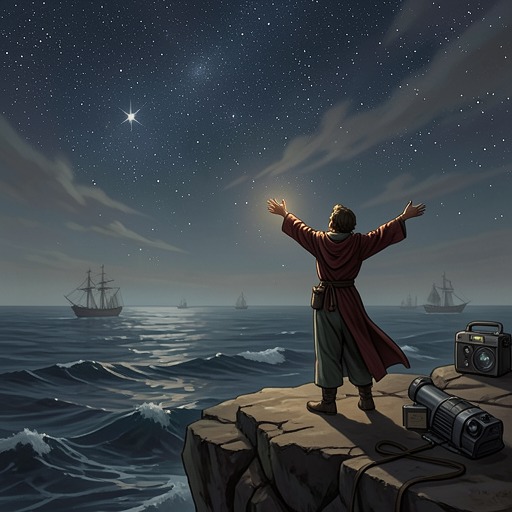
February without a full moon
The LuminariesFebruary without a full moon is the rare interval Lydia Wells predicts while speaking with Aubert Gascoigne. Her explanation turns the shortness of February into a calendar puzzle, while the exchange tests whether Gascoigne will treat her knowledge as expertise or merely as fortune-telling.
The calendrical pattern
Lydia explains that February will contain no full moon because one will occur just before the month begins and the next just after February 28. The moon, she says, will therefore never wax completely full during the month itself. She describes the pattern as rare, occurring only once in about twenty years.
The forecast and its evidence
Lydia grounds her prediction in an almanac and in the moon’s current phase. She says it is waxing above the cloud and will be full on Monday night, then begin to wane on Tuesday. From that sequence she concludes that the following month will be without a full moon. Her confidence rests on a specific timetable rather than on a vague omen: the calendar dates and the moon’s change of phase are her evidence.
Expertise, skepticism, and payment
Before giving the prediction, Lydia asks Gascoigne to take her as seriously as he would a man. She presents the coming moonless February as a fact, then offers to explain what it prophesies in exchange for a shilling. Gascoigne declines to pay until he has tested her ability, proposing to check the Monday papers and the tides. The conversation thus leaves her forecast poised between asserted knowledge and external verification: Lydia claims authority through the almanac, while Gascoigne reserves judgment.