Francis Carver
The LuminariesFrancis Carver is a former convict and sea captain whose defining instrument is an assumed identity. Known at different times as Francis Wells and Crosbie Francis Wells, he uses names, documents, and other people’s secrets to seize property and evade scrutiny. His schemes tie together Crosbie Wells’s death, a missing gold shipment, the transfer of the Godspeed, and the fortunes of Anna Wetherell and Lydia Wells. Carver’s identity is never merely a label: it is a means of access, concealment, and coercion, until the evidence that makes it useful also helps bring his crimes into view.
Identity and Background
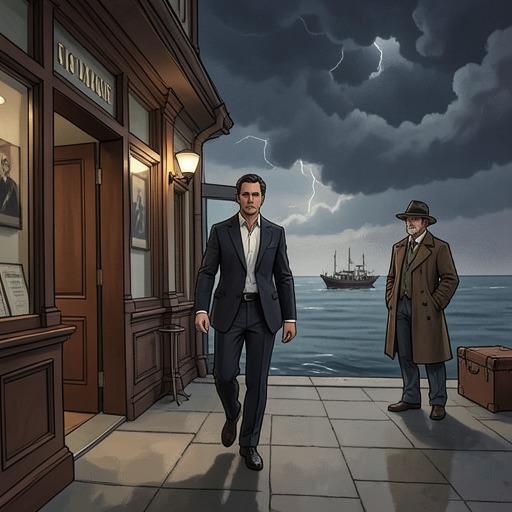
Carver first enters the account as the captain of the Godspeed, the vessel on which Walter Moody arrives at Hokitika. The ship’s dangerous passage south is associated with deaths at sea, and Moody hears that Captain Carver has watched many inexperienced passengers drown from the quarterdeck. The early impression is of a man accustomed to command and to the hazards of the coast, though Carver himself is then known only through the perspective of others.
Later descriptions identify him by his considerable build, brooding appearance, and thin pale scar on his cheek. When a witness connects the captain’s name with the man under suspicion, these details help establish that Francis Carver and Captain Carver are the same person. The scar also belongs to an earlier history: Crosbie Wells struck Carver with a poker, leaving a lasting mark. It is a visible trace of the conflict between the two men, even while their different surnames initially obscure the relationship between them.
Carver has roots in Hong Kong. His father was a financier involved in merchant trading, but Carver is no longer associated with a family firm and operates independently as a trader. Benjamin Löwenthal considers the possibility that Carver’s separation from his father followed his conviction. The account confirms Carver’s former-convict status and the poor reputation attached to it, but also distinguishes that reputation from Joseph Pritchard’s personal dealings with him: Pritchard finds Carver courteous and fair in business. Carver is the source from whom Pritchard obtains opiates, which Pritchard sells only through his own business rather than directly to Chinese customers.
The Godspeed, Gold, and Assumed Names
Carver holds a half-share in the Aurora goldmine and is, in practical terms, a partner of Emery Staines. His commercial position connects him to the mine’s returns, but his activities extend well beyond mining. He has access to the Godspeed and to the networks through which gold and other valuable goods move. At one point he leaves the ship’s mooring unexpectedly, at night and on a Sunday, after the shipping news has already appeared. Because the departure is not scheduled, it is absent from the customhouse log and the newspaper’s shipping record. The omission makes the vessel’s departure appear not to have happened and draws the Harbourmaster’s anger toward those responsible for the records.
Carver’s assumed identity becomes central to his dealings with Alistair Lauderback. He uses the name Francis Wells when acquiring the Godspeed, retaining his given name while replacing his surname. Lauderback later insists that he sold the vessel to a man who called himself Wells, not to anyone named Crosbie Wells. The distinction is legally important, but Carver turns the confusion between Francis Wells and the dead Crosbie into a weapon. Moody notices that the signature on the purchase document has been written so that its large initial flourish can be read as either an F or a C. A small mark between the letters further suggests that Carver made the ambiguity deliberate, allowing the name to resemble C. Francis Wells.
That ambiguity supplies the private leverage Carver uses against Lauderback. Lauderback believes that the false surname may imply that Carver and Crosbie Wells were brothers, perhaps sharing a mother. Carver exploits the possibility without establishing that it is true; the suggestion is enough to make Lauderback vulnerable to the supposed family connection. The novel thereby makes the alias more than a disguise: it is a carefully shaped uncertainty that another person can be made to fear.
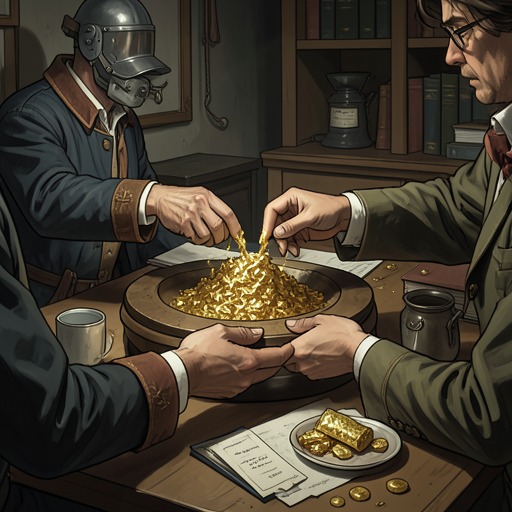
The missing shipping crate gives Carver another reason to appear in Hokitika under a borrowed name. The crate contains valuable goods and is associated with a shipment of gowns sent between Lauderback and a dressmaker in Melbourne. Carver intercepts it, removes the gowns, and hides a fortune beneath them. Lauderback understands that if the shipment were discovered offshore, the papers connecting it to him could expose him to accusations involving theft and evasion of duty. Carver uses that danger to force Lauderback to hand over the Godspeed. The transaction is presented as a meeting between men, but its substance is blackmail: Lauderback sees no safe way to refuse.
After the crate is lost, Carver travels to Hokitika, apparently supposing that it has been delivered there by mistake. He advertises a substantial reward for its safe return in the West Coast Times, this time using the name Crosbie Francis Wells and producing a birth certificate to substantiate that identity. He is otherwise known as Francis Carver. The document’s authenticity and its route into Carver’s possession remain unresolved. So does the precise reason he adopts an alias in connection with Lauderback. The uncertainty matters: the evidence shows the mechanics of his deception more clearly than it explains every motive behind it.
Crosbie Wells and the Cost of Deception
Carver’s assumed names overlap with the story of Crosbie Wells in ways that make the dead man’s identity a prize as well as a mystery. Te Rau Tauwhare tells Carver, for two shillings, where Wells is living. Tauwhare does not believe he is putting his friend in danger: rewards for information about missing prospectors are ordinary, and Carver presents his inquiry in a familiar form. Later that evening, Tauwhare sees Carver approach Wells’s cottage and enter it. He does not initially understand what that visit may mean.
The timing becomes significant after Wells’s death. Tauwhare’s account places Carver at the cottage before Alistair Lauderback arrives. Lauderback remembers that the kettle was still boiling when he entered, suggesting that he came not long after the death. From the sequence, Thomas Balfour reasons that Carver was at the cottage before Wells died and may have witnessed his death. This is a serious inference, not a confirmed account of precisely what Carver saw or did. The novel lets the gap remain consequential: Carver’s presence is established, while his role in the final moments is left uncertain.
The conflict between the men had already left its mark. In an earlier encounter, Crosbie Wells attacked Carver with a poker, striking him several times before Carver collapsed. The attack explains the scar that later helps identify Carver, but it also reverses the apparent balance of power: the man who will steal another’s name and fortune once found himself physically overpowered by Wells. Their connection is further complicated by Lauderback’s belief that they might have been half-brothers, a possibility Carver’s alias encourages but the evidence does not prove.
Carver’s later dealings repeatedly make Crosbie Wells’s name usable. He advertises for the missing crate as Crosbie Francis Wells, while the Godspeed purchase is signed Francis Wells. In the dispute over the wreck, he also presents himself as acting for the dead Wells. This lets him pursue funds for the vessel’s removal while keeping the question of ownership entangled with the false identity he has constructed. The result is a pattern in which a dead man’s name can both obstruct the truth and provide Carver with a legal-looking route through it.
Anna Wetherell and Lydia Wells
Carver’s relationship with Anna Wetherell brings his violence into the private sphere as well as the financial one. Anna is carrying his child before she arrives in Hokitika. In the spring her pregnancy begins to show, but it does not reach a birth. In mid-October, Carver returns to Hokitika, confronts her, and beats her; the child does not survive. Anna later tells Edgar Clinch that Carver killed the child deliberately. Benjamin Löwenthal, who found Anna afterward, condemns the way Carver treated her, particularly because she was pregnant and close to giving birth. The episode makes the harm of Carver’s control concrete, while also showing that Anna’s account and the consequences of the assault are carried into other people’s judgments of him.
Carver’s association with Lydia Wells is bound up with the same network of concealment and property. Lauderback had been keeping Lydia in high fashion during their affair, sending gowns to Melbourne for alteration and using the Godspeed to carry the shipments. Carver’s interception of one such trunk turns their concealed arrangement into leverage against Lauderback. Lydia and Carver later become partners in schemes and eventually marry. Their alliance joins personal intimacy to calculation: the same people whose affairs and secrets can be used against them may also cooperate in acts of deception.
Exposure and Ending
The Godspeed’s wreck does not end Carver’s interest in the vessel. He arranges for its remains to be dismantled and auctioned through Glasson & Rowley Salvage, instructing that no parts be sold beforehand and directing correspondence to him at the Palace Hotel. He acknowledges that the operation will leave him a thousand pounds out of pocket. Yet the ship’s sale and wreck also open another possible source of money: protection and indemnity cover associated with Lauderback’s shipowning arrangements.
Aubert Gascoigne investigates the relevant arrangements through Balfour Shipping, newspaper archives, the Harbourmaster’s office, and the Reserve Bank. Lauderback’s ships are covered through a mutual shipowners’ association, and each vessel has nearly a thousand pounds available in credit. Carver can legally seek those funds toward the cost of removing the wreck from the Hokitika spit if he files before the middle of May, when a year will have passed since the sale and Lauderback’s obligation concerning the Godspeed will expire. Carver appears, on paper, to be acting for Wells, who is dead, and Gascoigne observes that Lauderback has no evidence that the arrangement is unlawful. The legal appearance of the claim is another product of the identity fraud, not proof that the underlying story is true.
Lauderback eventually identifies Carver before Walter Moody and explains how the false name, the intercepted shipment, and the transfer of the ship fit together. The revelation clarifies why Lauderback gave up the Godspeed: Carver had placed him in danger of exposure over the shipment of gowns and the hidden fortune. The explanation also reinterprets earlier clues, including the ambiguous signature and the repeated use of Wells’s name. Carver’s deceptions have depended on separating facts from one another; once connected, the names, documents, crate, and ship form a pattern.
Carver is eventually arrested and brought out with his hands cuffed behind him. During transport, his wrists are secured again inside the carriage. He is murdered while being conveyed in custody. The conclusion is starkly opposed to the apparent durability of his aliases: although he has repeatedly used names and legal arrangements to shift responsibility and claim property, he cannot use either to escape the final consequences of the violence and betrayals accumulated around him.
Narrative Role
Carver functions as both a criminal presence and a test of how reliably Hokitika can know anyone. His former-convict reputation invites suspicion, but it does not by itself explain his conduct; the more decisive evidence lies in the records, signatures, testimony, and material objects that link him to particular schemes. The novel distributes those clues across shipping news, a birth certificate, a purchase document, a missing crate, and recollections of the cottage. None alone settles every question. Together they expose a man who treats identity as something to be assigned, borrowed, and strategically blurred.
His story also binds personal harm to commercial fraud. The lost child, Lauderback’s compromised position, Crosbie Wells’s death, and the disputed wreck funds are not separate strands: Carver moves among them by converting vulnerability into leverage. The recurring name Wells is especially charged. It can suggest kinship, support a false claim, or conceal the person who is actually acting. Carver’s power comes from making those meanings overlap; his downfall begins when witnesses and documents make the overlap legible.