George Shepard
The LuminariesGeorge Shepard, governor of Hokitika Gaol, embodies the authority Hokitika seeks to establish on a frontier where private bargains and public law continually overlap. He organizes the construction of a new prison at Seaview, but the project depends on concealed money from Crosbie Wells’s estate; his pursuit of Ah Sook, meanwhile, reveals how personal grievance hardens into racial prejudice. The severe gaoler who was once praised for impartiality becomes an agent of law whose judgments are compromised by secrecy and resentment.
Identity and Office
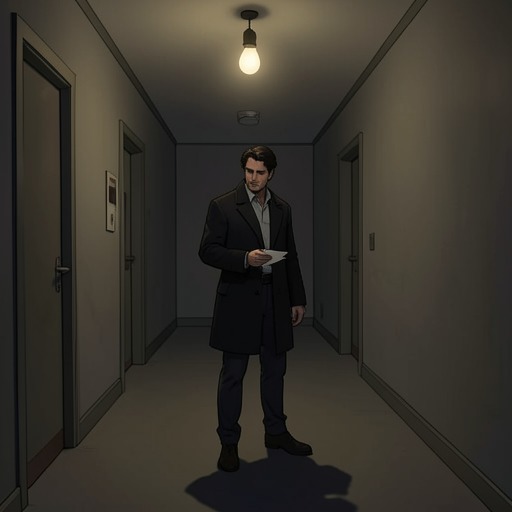
Shepard’s appointment as governor of Hokitika Gaol meets little opposition from the men living and working within his jurisdiction. He is described as cold and formidable, broad-shouldered and deliberate in movement, with a rich, august voice that he seldom uses. His humourless manner is not especially likable, but voters regard severity as appropriate to his profession. At the time of his appointment, his strongest public credential is that no charge of bias or prejudice has been made against him.
The scale of his authority is plain in the temporary Police Camp gaol. When Cowell Devlin arrives, Shepard quickly puts him to work assisting with its daily management. The prison houses two women and nineteen men, and Shepard expects Devlin to teach its inmates religious fear and respect for the law. Devlin’s approach to that task will differ markedly from Shepard’s, suggesting that the governor’s preferred discipline is not simply pastoral instruction but institutional authority enforced through confinement.
Shepard also appears in the first response to Anna Wetherell’s detention. After a sergeant brings her unconscious to the camp, Devlin finds her there the next morning with a swollen cheek and a bruise at her temple. He has no time to investigate how she came to be injured: Shepard tells him that Crosbie Wells has died and describes the death as peaceful, caused by age, infirmity, and drink. At that stage, Shepard says, there is no reason to suspect homicide. His account initially presents Wells’s death as an ordinary matter for the gaol’s authorities, before the tangled claims on Wells’s property unsettle that appearance.
The Seaview Prison and Its Funding
Shepard’s central public ambition is a new gaol-house on the terrace at Seaview, away from the Police Camp. With the Commissioner’s endorsement, he proposes using convict labour, following the precedent of convicts clearing the Hokitika road. The scheme joins the practical needs of a growing settlement to his conviction that order should be made visible in a substantial institution.
Its financing, however, is far less straightforward than its official purpose. Shepard learns that Cowell Devlin received a commission worth many hundreds of pounds for closing Crosbie Wells’s estate. He proposes that Devlin invest the entire amount in the prison immediately, while expecting the estate sale to be successfully repealed only later. Thomas Balfour subsequently tells Alistair Lauderback that the gaol-house was funded in part by money from the fortune found in Wells’s cottage. The investment was made at Shepard’s instigation two weeks after Wells’s death, and Shepard is anxious to keep the arrangement quiet.
Harald Nilssen provides a further four hundred pounds toward construction, promising not to disclose the investment. Shepard makes a written agreement with Nilssen to keep that contribution secret. When he discovers that Nilssen has told someone about their arrangement, Shepard confronts him over the broken promise and announces that he will remove Nilssen from all duties connected with the project. The dispute is more than a question of loyalty: Shepard has relied on secrecy to protect a public work whose financial sources are already entangled with a contested estate.
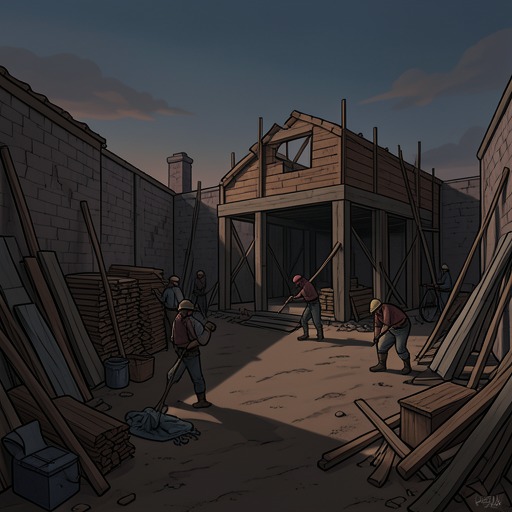
The prison advances rapidly. By 20 March, after two months of work, its walls and chimneys are up, and fortified doors have been fitted in steel frames. Some essentials remain unfinished: the lamps have not arrived, the kitchen has no stove, the gaoler’s cottage lacks window glass, and the pit beneath the gallows has not yet been dug. Shepard is supervising deliveries as the complex takes shape, with Nilssen’s contribution and later public funding credited for the speed of construction. The building makes his administrative purpose tangible even as controversy shadows the money that supports it.
Public Conflict and Concealed Evidence
The project draws Shepard into a public dispute with Lauderback, who accuses him of diverting money from Wells’s estate to build the prison. Shepard responds in the newspaper, defending himself against Lauderback’s allegations and framing them as attacks not only on his own conduct but on the public bodies associated with the work. The exchange makes the prison’s financing a matter of civic reputation as well as private confidentiality. A later remark that Shepard has received a reprimand suggests that the controversy has consequences for his standing, though the episode does not erase the prison’s progress.
Shepard’s involvement in the estate dispute also leads him to inspect evidence concealed by Devlin. He asks the reverend for his Bible, then produces a deed apparently showing that Emery Staines intended to give Anna Wetherell exactly half of the fortune. Shepard reasons that Staines’s disappearance on the day of Wells’s death, alongside Wells’s supposed lack of means, points to Staines as the fortune’s source and to Wells as its custodian. He treats the document as pertinent to the case, connecting a personal gift to the legal contest over the gold.
After Devlin leaves, Shepard destroys his own copy of the confidentiality contract with Nilssen. He lights the paper, holds it until the signatures are obscured, and lets the burning sheet fall before kicking its ashes aside. The gesture does not undo the investment or the disclosure; it removes the written record of the promise. In a novel crowded with deeds, letters, and names that determine claims to wealth, Shepard’s destruction of a contract makes his preference for control over an accountable record especially pointed.
The Pursuit of Ah Sook
Shepard’s most consequential conflict with Ah Sook grows from the killing of his brother, Jeremy Shepard. George believes a Chinese man killed Jeremy after Jeremy had kicked and humiliated him. In George’s account, the man used Margaret’s pistol and was arrested after trying to flee; the trial was scheduled for six weeks later. The larger narrative identifies Margaret as Jeremy’s true murderer, making George’s certainty a painful instance of how an apparently settled account can conceal the truth closest to home. The available evidence does not establish what George knows about her guilt.
His relationship to Ah Sook is also marked by an earlier history: Ah Sook knows him as the brother of the man he was accused of murdering and as Margaret’s husband. As time passes, Shepard’s personal hatred of Ah Sook expands into hostility toward Chinese men generally. When Quee Long brings a complaint before the law, Shepard declines to honour it and feels no compunction either at the time or afterwards. His conduct gives concrete form to the difference between his original reputation for impartiality and the discriminatory justice he comes to exercise.
Shepard actively seeks Ah Sook. He has previously arranged for a watch to be kept on him; later, at Seaview, he instructs Everard to return to Hokitika and spread word that Shepard is looking for a man called Sook. Anyone who sees him is to send for the governor at once. Shepard says that he has no deputy, emphasizing how directly he intends to control the search. When Ah Sook later faces him in an alley, Shepard stands with a long-handled pistol while Ah Sook looks from the weapon to the governor’s face. Their confrontation ends with Ah Sook shot dead by Shepard, closing the pursuit through an act of state power that is inseparable from private animosity.
Authority, Family, and the Closing Image
The narrative places Shepard beside Lauderback as a man who delegates: others carry out his wishes and shield him from their fullest consequences. It also links the two through their private histories. Lauderback has a past with Lydia Wells; Shepard has a past with Francis Carver, who was once his prisoner in Sydney Gaol. These parallels situate Shepard within a wider pattern in which public authority and personal entanglement are never fully separate.
A later episode gives the conflict with Ah Sook a quieter, more unsettling counterpoint. Ah Sook, now living in Kaniere Chinatown, comes into Hokitika to buy hardware. Shepard recognizes him in the shadow of the unresolved family history. In the encounter, Shepard takes a paper sack of goods from Ah Sook and waits while the latter counts; Ah Sook then gives the price as a shilling and sixpence. The ordinary transaction does not reconcile them, but places commerce and routine briefly beside the pursuit that has defined their relationship.
At the novel’s closing sequence, Shepard sits in the gaol-house with a rifle laid across his knees as several other characters approach their own reckonings. The image leaves him within the institution he has worked to build: watchful, armed, and still defined by the uncertain boundary between public duty and private grievance. His prison stands as an achievement of administration, but the secrecy behind its funding and the prejudice governing his pursuit of Ah Sook complicate any simple claim that order is the same as justice.