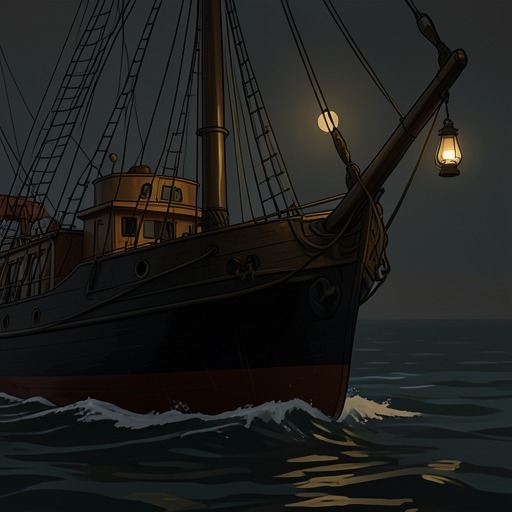
Godspeed bill of sale signed under the name Francis Wells
The LuminariesThe Godspeed bill of sale signed under the name Francis Wells turns an assumed identity into a legal claim. Francis Carver bought Godspeed himself, using the name Wells, but the signature on the bill can be read as either Francis Wells or C. Francis Wells. That small, cursive ambiguity matters because Crosbie Wells’s middle name was Francis and no other surviving document can establish what Crosbie Wells’s signature looked like. The bill therefore does more than record a transfer: it helps Carver present himself as acting for a dead shipowner, while making Alistair Lauderback’s eyewitness accusation difficult to prove.
Creation and Ambiguous Signature
The bill surfaced among papers Francis Carver had forwarded to Garrity as evidence supporting his claim. Aubert Gascoigne examined the copy and initially read its signature as Francis Wells. On closer inspection, he noticed that a large loop beside the F could be a C, with a dot of ink fortuitously placed between the letters. The marks make the name appear to be C. Francis Wells, though the linked cursive leaves room for the shorter reading. Gascoigne concluded that the uncertainty had been built into the false name with a future purpose in mind.
The ambiguity joins two identities without making them identical on the page. Francis Carver signed under the name Francis Wells; adding the possible initial makes the signature resemble C. Francis Wells, matching the name of Crosbie Wells, who did exist and whose middle name was Francis. When Gascoigne later presented the document to Alistair Lauderback, he explained that he had first taken it to read Francis Wells and had only discerned the additional letter by leaning closer. The close inspection does not produce a clean, decisive signature. Instead, the evidence rests on how the same cursive stroke can be interpreted.
From Private Copy to Public Claim
The bill was part of a packet Carver had sent to Garrity to support his request for money connected to Godspeed’s wreck. The surrounding papers included the harbourmaster’s assessment, a balance sheet of debts incurred, and receipts and testimonials. Among them, the bill of sale supplied the crucial link between the ship and the name Wells: Carver’s papers represented him as settling the matter for a deceased shipowner rather than simply pursuing expenses arising from his own purchase.
Carver had a direct financial reason to seek payment. He told Gascoigne that he expected to be a thousand pounds out of pocket, because the visible costs were accumulating at his expense. The ship’s protection and indemnity cover offered a possible source of funds for wreck removal. Gascoigne explained that P&I was a mutual pool funded by shipowners’ annual fees, intended to meet certain liabilities that ordinary insurers would not cover. Although ownership had changed, Godspeed could still fall within Lauderback’s protection and indemnity arrangements.
Gascoigne’s inquiries established that Lauderback belonged to the Garrity Group, a shipowners’ cooperative, and that each of his ships had nearly a thousand pounds in credit. Carver was legally entitled to seek those funds toward removing the wreck from the Hokitika spit, provided he filed his appeal before the middle of May. After a year had passed since the sale, Lauderback’s legal obligation in relation to Godspeed would end. The bill thus operated within a narrow window: its disputed attribution could support a claim whose value depended on timely action.
The Challenge and Its Evidentiary Limits
Lauderback recognized the signature as Francis Carver’s. He told Gascoigne that he had watched Carver sign the document with his own eyes and insisted that Crosbie Wells had never bought the ship. Yet when Gascoigne asked whether the transaction had been witnessed, Lauderback said nothing. His direct recollection might explain what happened, but the scene supplies no independent witness or surviving comparison document to reinforce it.
That absence is decisive in the legal argument. Gascoigne observed that no official or unofficial documentation of Crosbie Wells’s hand survived, leaving the law no grounds to doubt the signature on that basis. Lauderback accused Carver of forgery and called the transaction a setup, but Gascoigne judged the charge very difficult to prove. On the documents available, Carver could appear to be acting as Crosbie Wells’s proxy, settling the affairs of a shipowner who could no longer do so. Lauderback’s certainty about what he had seen could not, by itself, undo the paper’s plausible reading.
Narrative and Legal Significance
The bill makes the story’s conflict over identity material rather than abstract. A name is written down; a letter may or may not be there; a dead man’s middle name offers the bridge between a false identity and a real one. The signature’s uncertainty is not resolved by a decisive document elsewhere, because the record that might have tested it does not survive. Its persuasive force instead comes from that gap, allowing the paperwork to outlast Lauderback’s accusation in the immediate dispute.
The document also reveals how the wreck’s costs and the ship’s insurance arrangements become entangled with Carver’s deception. The P&I fund was not simply a general reward for claiming ownership: it covered specified liabilities, including wreck removal, and Carver’s right to seek it depended on the terms and timing of the former owner’s protection. By presenting himself as Wells’s representative, Carver could pursue that money while Lauderback faced a shrinking period in which to contest the claim. The bill’s most consequential feature is therefore its capacity to make an invented identity function as legal evidence, even when the person who recognizes the deception cannot readily establish it in court.