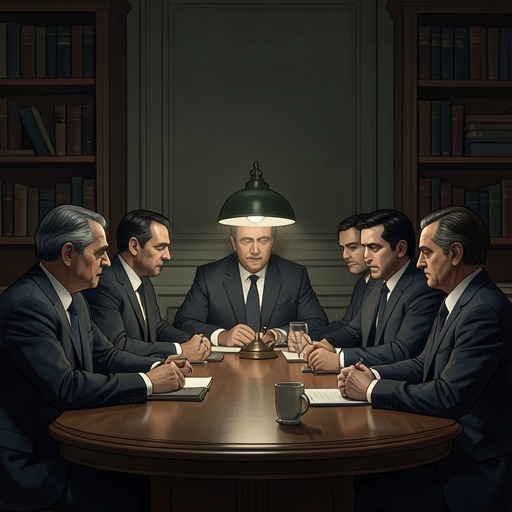
Harald Nilssen
The LuminariesHarald Nilssen is a commission merchant whose work among contracts and bills of lading places him at the practical center of the dispute over Crosbie Wells’s estate. His ten per cent fee for clearing the estate makes him a beneficiary of the fortune’s discovery, while his later agreement with George Shepard to put that fee toward a gaol-house entangles him in a secret political arrangement. When the estate sale is challenged, Nilssen’s commission becomes both a legal liability and a test of his word. His story joins the novel’s mysteries of hidden wealth to its conflicts over secrecy, public duty, and the value of a promise.
Identity and Habits
Born in Oslo and formerly of Bath, Nilssen is introduced as an undefeated player of three-card brag and a self-professed fine shot. He boasts of carrying a muzzle-loading Enfield musket, the only firearm he has ever deigned to touch. The account presents these claims with comic emphasis: the self-assurance belongs to a man whose ordinary life is shaped less by adventure than by office routine, sociable argument, and carefully observed mealtimes.
At midday on Saturdays he can generally be found in his office before a stack of contracts, wills, and bills of lading. Every ten minutes or so, he pats his breast to check the silver pocket watch that marks the approach of his regular luncheon at the Nonpareil. He recommends the meal’s dark gravy, pastry, and ale as if his personal regimen were sound medical counsel, and treats his habits as examples for others to follow. His orderly appetite and punctuality provide a comic counterpoint to the disorderly transactions that increasingly occupy him.
Nilssen also relishes argument, provided it is hypothetical and preposterous. He builds elaborate abstractions from the narrow circle of his own tastes, and his friends affectionately regard him as vivacious. That fondness for speculation is not merely decorative characterization: when the Wells affair begins to implicate a widening circle of people, Nilssen himself starts assembling theories about who knows what, and whose interests lie behind the apparent facts.
The Estate Commission and the Gold
Nilssen is among the men drawn into the investigation surrounding the gold found at Wells’s cottage. He discovers the substantial fortune there, along with a half-empty, corked phial of laudanum bought at Joseph Pritchard’s drug hall. The discovery makes Nilssen more than a professional intermediary: he has encountered objects that connect the dead man’s estate to the wider web of suspicion.
His role in the estate’s clearance is financial as well as evidentiary. Nilssen receives a ten per cent commission on the sale of Wells’s effects. When the will is disputed, he recognizes that the payment is void and that he must return the money; in his view, the property ought not to have been sold. The commission is therefore not simply an incidental profit. It binds him to a contested transaction and makes the subsequent handling of the estate’s proceeds a matter of personal consequence.
As suspicion focuses on the gold’s route, Nilssen joins Dick Mannering and Charlie Frost in going to Kaniere Chinatown to question Quee Long. Mannering arrives loudly and accuses Quee of playing them for fools, while Nilssen’s presence reveals that he shares the purpose of the visit. Frost, meanwhile, remains silent under Nilssen’s suspicion because he engineered the sale of Wells’s estate. The men’s overlapping inquiries do not produce an immediate, unified explanation; their different interests and assumptions complicate the interview. Nilssen leaves room for the possibility that someone beyond the men assembled at Quee’s hut is involved, rather than treating the gold’s appearance as a problem with a single obvious culprit.
The gold’s significance becomes clearer when the inquiry is reconstructed. Quee had removed gold from Anna Wetherell’s gowns, retorted it into squares, and stamped it with the name Aurora so the profit would be banked against the claim owned by Emery Staines. Separately, a remaining portion had been found by Anna and hidden with Aubert Gascoigne. Nilssen’s discovery at Wells’s cottage thus belongs to a larger movement of gold through concealed clothing, a mining claim, and an estate sale. His professional encounter with one part of the fortune places him among the people whose accounts can later make the scattered transactions intelligible.
A Secret Arrangement with Shepard
George Shepard proposes that Nilssen invest the entire commission in the construction of a gaol-house. The arrangement is presented as a way for Nilssen to profit legally: he would receive his standard commission on the labour, iron, timber, nails, and other supplies. It turns the money from the estate into a private investment in a public project, with Shepard’s proposal making the commission merchant both financier and supplier.
Nilssen’s agreement is constrained by a secrecy oath. He considers whether to disclose Shepard’s proposition to the group gathering to discuss the Wells affair, since it concerns a percentage of the fortune under investigation. He also suspects that Shepard’s hostility toward Alistair Lauderback concerns more than convict labour, gaol-houses, and roads. Because Lauderback was the first to find Wells’s body, Nilssen reasons that Shepard may be involved in the wider conspiracy. These are Nilssen’s suspicions, not established conclusions: he wonders what Shepard knows, whether Lauderback knew about the cottage fortune, and whose interests Shepard might serve beyond his own.
The strain of keeping the arrangement secret prompts Nilssen to write urgently to Pritchard. He closes his quayside office, writes without revising or rereading, seals the note with the circular stamp of Nilssen & Co., and sends it by messenger to Pritchard’s drug emporium. The haste contrasts with his usual office routine. He has not yet decided what to tell the evening assembly, but the letter shows him seeking counsel as the private deal begins to collide with the group’s investigation.
Broken Confidence and Public Consequences
Shepard eventually confronts Nilssen over a breach of their agreement. He summons him on a Sunday afternoon, interrupting Nilssen’s tea, sugared biscuits, and reading. Nilssen arrives expecting some minor question about the gaol-house’s foundation, plans, wages, receipts, or salvage. Instead, Shepard asks whom Nilssen told about their arrangement and announces that he will remove him from all duties connected with construction. Shepard’s stated reason is that he will not employ a man who breaks his word.
Nilssen admits that he disclosed the arrangement. Under pressure, he explains that Lauderback had been blackmailed and that Wells took the ransom home; the fortune in Wells’s cottage, he says, came from that ransom. He also reveals that there was a deed of gift in Wells’s stove, partly burned as if someone had tried to destroy it. The chaplain Cowell Devlin found the document while collecting the body but concealed it, telling neither Shepard nor Dr. Gillies. Nilssen’s disclosure adds a concealed document and a possible motive to the case, while exposing his own failure to keep the investment secret.
The breach has a lasting effect on Nilssen’s relationship with Balfour. When he later visits Balfour, dressed in an imperial-blue vest and visibly resolved to ask a difficult question, he says that Lauderback somehow knows about the commission and plans to publish a letter attacking Shepard. Nilssen insists he did not tell Lauderback and believes that only the twelve men who swore the oath know of the investment. He also explains that the agreement was private and that Shepard holds the sole copy of the deed. Having doubted Balfour because of his connection to Lauderback, Nilssen apologizes for springing the question on him. His suspicion has made him cautious, but he recognizes the cost of allowing suspicion to govern a friendship.
The public account of the gaol-house project recasts Nilssen’s payment. He donates approximately four hundred pounds to the Council for public good, identifying it as the commission he received for honest employment. Lauderback’s account maintains that Nilssen was legally entitled to the sum for services satisfactorily rendered. It also stresses the distinction between a donation and an investment: a donation does not create a debtor-creditor relationship and need not be repaid. The money that began as a commission on Wells’s disputed estate is thus presented as a gift to the community, rather than a loan tied to the gaol-house’s future returns.
Witness, Intermediary, and Narrative Role
Nilssen’s connections make him one of the many figures gathered into the account of Wells’s death and fortune. At the Crown Hotel meeting, he is identified among the men whose separate histories and dealings have brought them into the same room. The gathering includes people connected to the estate sale, the missing gold, Anna’s gowns, and the laudanum phial. Its tangled composition reflects the case as Nilssen has experienced it: not one simple chain of action, but intersecting transactions, loyalties, and suspicions.
The meeting’s account is not initially chronological. Balfour’s narrative proceeds through interruptions, clarifications, and echoes, and Walter Moody must try to arrange the recounted events in the order in which they occurred. Nilssen’s own tendency to construct theories from partial knowledge belongs to this same atmosphere of uncertainty. He can identify connections and ask useful questions, but his conjectures about Shepard and Lauderback remain vulnerable to the limits of what he knows.
When the court hears testimony about the fortune, Nilssen is among the witnesses called alongside Mannering, Quee, Benjamin Löwenthal, Edgar Clinch, and Frost. He describes how the gold was hidden in Wells’s cottage; the testimony presents the retorted gold as though it had been discovered on the Aurora. The witnesses do not mention Anna’s gowns or the wrecked Godspeed, leaving important parts of the fortune’s history outside the account offered in court. Nilssen therefore occupies an uneasy position between disclosure and omission: he helps establish the cottage gold’s path while participating in a version of events that leaves other concealed movements untold.
His significance lies in this mixture of routine respectability and compromised knowledge. Contracts and bills of lading are his everyday materials, yet the most consequential matters he handles are shaped by hidden identities, concealed documents, and an oath he does not keep. The precise habits of the commission merchant cannot stabilize the story’s shifting truths; nor does his breach simply resolve them. Instead, his fee travels from disputed estate proceeds into a civic donation, while his testimony and suspicions remain part of a larger effort to make the gold’s many histories legible.