Hokitika Police Camp
The LuminariesHokitika Police Camp is the setting where the town’s temporary gaol brings together official custody, religious ministry, and the unfolding cases of Anna Wetherell and Crosbie Wells. Before the new gaol at Seaview was completed, the camp became Cowell Devlin’s improvised workplace: a place where his impulse to care for prisoners met George Shepard’s administration of confinement, and where two apparently separate mysteries came into close proximity.
The temporary gaol and Devlin’s arrival
When Devlin arrived in Hokitika aboard the Virtue, he reported to the Police Camp, where Shepard quickly put him to work. Devlin’s formal duties as chaplain were not due to begin until the new gaol-house at Seaview was finished, but in the meantime Shepard assigned him to help with the daily management of the temporary gaol. At that point it held two women and nineteen men. Devlin was expected to provide religious instruction and encourage respect for the law, though the two men differed sharply in their ideas about how prisoners should be taught.
Devlin asked whether he could lodge in the gaol-house, sleep among the prisoners, and share their bread. Shepard did not welcome the proposal. He warned Devlin that his Irish accent might draw partisan reactions from English residents and expectations of Catholic sympathy from Irish ones, advising him to be careful about his companions and speech. Devlin did not follow that advice. Unable to afford months in a hotel and unwilling to organize his life around Shepard’s pessimism, he pitched a standard miner’s tent about fifty yards from the beachfront, then went to a crowded hotel on Revell Street to introduce himself to Englishmen and Irishmen alike. The camp was therefore his workplace, but not his residence: his place in town remained deliberately more open than Shepard recommended.
Ministry within the camp
On the rainy night of 14 January, Devlin was sitting on the floor of the gaol-house, speaking with inmates about Paul. He had stayed late because he hoped the rain might pass, not yet knowing how persistent the weather could be on the Coast. The prisoners had first listened politely to his sermon and then engaged with it more actively, offering their own testimonies and views. This exchange illustrates Devlin’s pastoral approach: he sought conversation with the people in custody rather than treating them only as objects of the gaoler’s discipline.
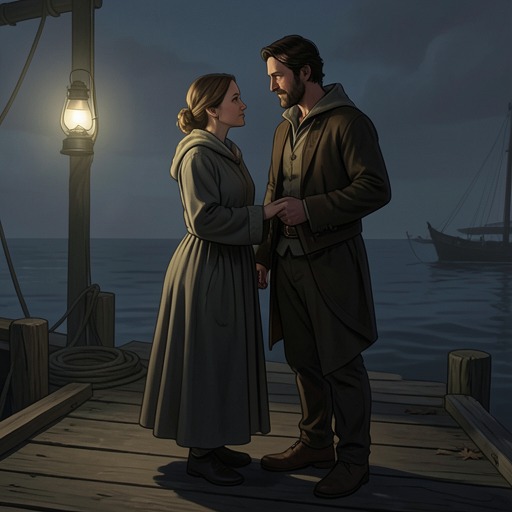
A shout from the courtyard interrupted the gathering. Shepard came out of his study carrying a rifle, and Devlin followed him to the entrance, where duty sergeant Ellis Drake arrived with Anna Wetherell. Drake reported that she had been found incapacitated and that opium might be involved; he could not determine whether the circumstances involved intoxication or deliberate self-harm. Devlin wanted to approach her and check on her condition, but waited for Shepard to decide what to do. Shepard had her placed against a wall and shackled, while checking that she could breathe. Devlin left when the gaol was secured for the night, dissatisfied with how she had been settled but not in a position to overrule Shepard.
Anna Wetherell and Crosbie Wells
When Devlin returned the next morning, Anna was still unconscious. He noticed signs that she might have been injured, but had no opportunity to investigate before another duty intervened: a man had died, and Devlin was asked to accompany Dr. Gillies to the Arahura Valley to help collect the remains and offer a prayer. Shepard identified the dead man as Crosbie Wells and said that, at that stage, there was no reason to suspect homicide. Devlin thus left the camp on a religious and practical errand connected with Wells, while Anna remained in its custody.
After the return to the Police Camp, Wells’s body was brought inside. A commotion there drew Devlin’s attention away from the deed of gift he had concealed during the visit to Wells’s house. Anna was beginning to revive, and Devlin knelt beside her, held her hands, and called for water. When she woke, she did not respond to him and soon drifted back to sleep. His attention to her was personal and compassionate, but it did not resolve the circumstances of her arrest or the document he had kept from the physician. The camp made these matters adjacent without making them transparent: Wells’s death, Anna’s condition, and Devlin’s withholding of the deed all occupied the same institutional space, while remaining partly obscured from the people responsible for one another’s care.
Release and narrative significance
At the end of the day, a clerk from the Magistrate’s Court arrived to collect bail. Anna managed to produce coins from her clothing and pay the required amount; Shepard was then obliged to release her. Devlin did not attend her court appearance the next day because he had been assigned to dig Wells’s grave. He later learned that she had declined to plead and paid the fine imposed on her. The sequence makes the camp a threshold between detention and release, rather than the site of a final judgment: Anna’s immediate freedom depended on money she could produce, while Devlin’s work carried him onward from the gaol to Wells’s burial.
The Police Camp’s importance rests in this convergence of procedures and lives. Shepard manages custody; Devlin moves between ministry, observation, and burial; Anna passes through confinement and bail; and Wells’s remains return to the camp after the journey to the Arahura Valley. The temporary gaol is not merely a backdrop to these events. Its crowded rooms place religious concern beside coercive authority and connect the treatment of a living woman to the handling of a dead man whose estate and identity will become consequential. Devlin’s silence about the deed further complicates the camp’s role: the institution gathers people and evidence, but cannot guarantee that either will be made known.