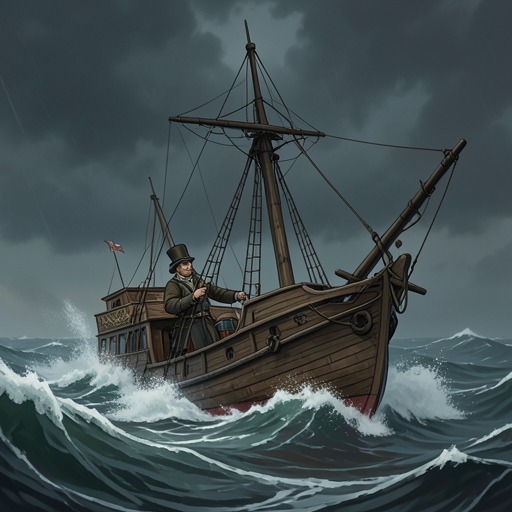
James Raxworthy
The LuminariesJames Raxworthy is a decorated naval officer and captain of the Godspeed. Though he appears only briefly, his command links the ship’s former ownership to its takeover by Francis Carver: Raxworthy sails on schedule, then returns to find that both the vessel and his position have changed hands.
Identity and introduction
At a dinner hosted by Lydia Wells, Raxworthy is introduced as a naval hero who holds the Victoria Cross. Lydia presents his presence as a novelty for her as a hostess and anticipates asking him about his service, hoping he will wear his decoration. The exchange gives him a public identity before he enters the ship’s more consequential history: he is known for naval distinction, although the account supplies no details of how he earned the medal.
A projected-departure notice in the Otago Witness places him in command of the Godspeed, bound for Port Phillip. The crew list names Raxworthy as captain and Francis Carver among the seamen. The notice makes their later reversal of rank especially sharp: Carver begins as a member of Raxworthy’s crew, not as its commander.
The Godspeed changes hands
Raxworthy’s punctuality affects the timing of the transfer. After being injured on the night of May 12, Carver is too incapacitated to join the Godspeed’s scheduled departure the following afternoon. Raxworthy sails on time despite having a severe headache, and Carver, left behind at Port Chalmers, can only wait for the barque’s return. His absence prevents him from informing Raxworthy that the ship’s ownership has changed.
When the Godspeed returns from Port Phillip on June 14, Carver meets Raxworthy and tells him that the ship has been sold and that its new owner, a man named Wells, has ordered Carver’s promotion to captain. The change gives Carver the authority to disband Raxworthy’s crew and assemble a new one. The meeting is long and distinctly unfriendly; Raxworthy is not merely displaced from command but confronted with a transfer already made without his participation.
Conflict over the ship’s inventory
The strained meeting also exposes a separate dispute. Carver finds that an item has been removed from the Godspeed’s inventory, apparently after a trunk was recalled the previous month. He appeals to Raxworthy, who shrugs and sees no breach of regulation or protocol in the item’s removal. The account does not establish that Raxworthy took the trunk or knew where it went; his response is a limited judgment about procedure, not an explanation of the item’s fate.
Carver reacts with fury that turns to anguish. He searches the customhouse, shipping firms along the quay, and sailors’ lodging houses, but learns nothing. His later search for the missing shipping crate is undertaken under the identity of Crosbie Wells, using Wells’s birth certificate and miner’s right. Raxworthy’s encounter with Carver therefore sits at the edge of a larger chain of concealment: he can neither resolve the inventory discrepancy nor prevent his former subordinate from taking control of the vessel.
After the dismissal
Carver later reports that Raxworthy is getting drunk on Cumberland Street, when Alistair Lauderback asks where the captain is. This is presented as Carver’s belief, not as an independently confirmed account of Raxworthy’s circumstances. It nevertheless contrasts with the earlier image of the punctual commander: after losing his ship and position, he is absent from the practical dispute over the Godspeed.
Raxworthy’s narrative importance lies in this sharply bounded role. His punctuality leaves Carver stranded; the return voyage enables Carver to announce the new command; and his shrug leaves the missing inventory item unexplained. He is not shown directing the subsequent struggle over the Godspeed’s ownership or wreck costs. Instead, his removal registers how quickly authority aboard a ship can be reassigned—and how the formal change of command does not clear away the unresolved losses that accompany it.