John Fellowes
The LuminariesJohn Fellowes is a lawyer who advances the gold and identity investigations through questions, summonses, and the presentation of documents. His importance lies in connecting evidence held by the bank, the mining world, and witnesses to the Magistrate’s Court; the final comparison that exposes Francis Carver’s forged signature, however, is made by Walter Moody.
Role in the Investigation
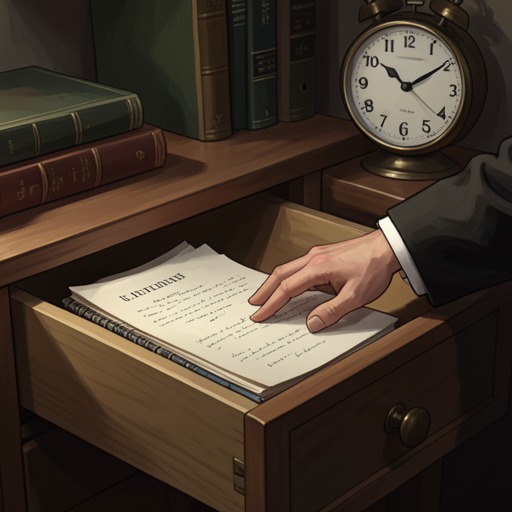
The evidence presents Fellowes through his professional work rather than through a personal history. He questions Charlie Frost about the fortune found on Crosbie Wells’s estate, recording Frost’s confirmation that the gold had already been retorted and that the smelting had been done by Quee Long, then the sole digger employed at Emery Staines’s The Aurora. Fellowes writes down Frost’s information in his pocketbook and, after thanking him, produces the charred deed of gift Anna Wetherell has given him. Frost notices that the document has been signed, making its damaged condition a question of evidentiary significance rather than merely a physical detail.
The financial background makes those inquiries consequential. The gold hidden in Wells’s cottage was only one part of a much larger fortune: four thousand pounds in gold had been sewn into five dresses, and Quee Long had removed the gold from four of them and retorted it. Anna had recently found the remaining gold in her orange dress after waking in gaol with no memory of the twelve hours before her arrest. Fellowes’s inquiries connect the retorted gold to Quee Long’s work at The Aurora and bring Anna’s charred deed into the same investigation, where the questions of ownership, mining records, and signatures overlap.
Witnesses and Documents
Fellowes also has Quee Long summoned to the Magistrate’s Court on behalf of the lawyer. When the messenger explains that the summons concerns a fortune dug up at The Aurora, Quee initially mishears the mine’s name as Arahura. The exchange places him in the formal legal process as a witness whose work may clarify the origin and handling of the gold.
After leaving the Hokitika Reserve Bank, Fellowes visits Harald Nilssen, who is preparing a balance sheet on George Shepard’s behalf. Fellowes shows him a charred contract bearing the signatures of Emery Staines and Crosbie Wells. Nilssen’s face drains of colour at the sight of it, and Fellowes asks whether he has seen the document before. The evidence does not state Nilssen’s answer here, but the encounter shows Fellowes testing a document against the knowledge of a man connected to the financial accounting surrounding Shepard and the gold.
The Deed’s Chain of Custody
At Staines and Anna’s trial, Fellowes questions Cowell Devlin about how the deed of gift first came into his possession. Devlin says he found it in Crosbie Wells’s cottage the morning after Wells’s death, after Alistair Lauderback brought news of the death to Hokitika. Devlin had been sent by George Shepard to assist in collecting Wells’s remains. Fellowes’s question therefore establishes the document’s reported route from the cottage into the investigation and tests the circumstances in which it was recovered.
The deed’s significance rests on both its wording and its signature. Walter Moody tells the court that the signature on Crosbie Wells’s private correspondence to Lauderback matches the signature on the deed, dated 11 October 1865, which provides for Emery Staines to give Anna Wetherell two thousand pounds, with Wells as witness. Moody also compares it with the signature on the marriage certificate submitted by Lydia Carver, formerly Lydia Wells. Those signatures do not resemble the signature on Carver’s bill of sale for the Godspeed, and Moody argues that the contrast proves the bill of sale was forged. Fellowes supplies and examines evidence within this proceeding; Moody makes the signature comparison explicit.
Narrative and Legal Significance
Fellowes’s actions give dispersed material evidence a path into court. The pocketbook entry, the charred deed, the contract shown to Nilssen, and the questions put to Devlin each address a different point: who retorted the gold, whether a document had been seen before, and where the deed was found. Together, these inquiries make the fortunes and competing claims legible as matters of testimony and documentary provenance.
His role also marks the boundary between gathering evidence and interpreting it. Fellowes’s investigation brings documents and witnesses forward, but the distinction between Crosbie Wells’s authentic signature and Carver’s ambiguous one is articulated by Moody. The court’s case thus depends not on a single revelation by Fellowes, but on evidence moving through several hands and acquiring meaning through comparison.