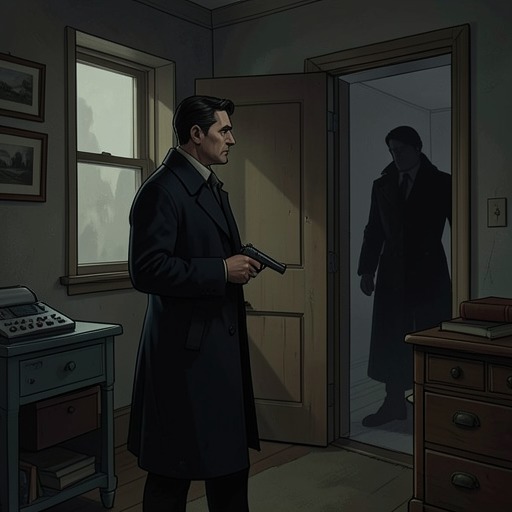
Kerr Patent pistol
The LuminariesThe Kerr Patent pistol is the weapon Walter Moody directs Ah Sook to buy for his intended attack on Francis Carver. Its importance lies not only in its military design but in the practical steps that bring it within reach: Ah Sook has gold, Moody names a suitable model and fair price, and a shopkeeper loads the purchased weapon for him. The exchange converts a private plan into an armed and increasingly urgent possibility, though the available account does not establish what Ah Sook ultimately does with the pistol.
Intended Use
Ah Sook tells Walter Moody that he plans to buy a pistol that day. Moody understands the purpose to be killing Francis Carver, and asks what Ah Sook will do afterward: surrender himself or attempt to escape. The weapon is therefore discussed from the outset as an instrument for a specific act, with its purchase inseparable from the consequences Ah Sook may face once that act is done.
Ah Sook initially intends to buy from Tiegreen’s Hardware and Supply. The shop appeals to him partly because it stands beside the Palace Hotel, but chiefly because its proprietor is sympathetic to Chinese men. Ah Sook hopes the shopkeeper will load the pistol there, allowing him to carry out the deed that same day. He has never fired a pistol, although he believes he understands its basic mechanism and assumes that little practice will be needed. His plan is determined, but his unfamiliarity with the weapon leaves him dependent on someone else’s practical help.
Choosing the Weapon
Walter Moody warns that Tiegreen’s is not the right place to obtain a pistol. He distinguishes a military weapon from a fowling piece or rifle and cautions that not every kind of shot will kill a man. His advice is unsettlingly specific: he treats the choice of firearm and ammunition as matters of effectiveness, not merely purchase. To him, a pistol is not interchangeable hardware; its suitability depends on what Ah Sook intends to do with it.
Moody sends Ah Sook to the outfitters on Camp-street, beside the Deutsches Gasthaus, and names Brunton, Solomon & Barnes as the proprietors. He tells him to ask for a Kerr Patent and not to accept another model. He describes it as a sound British military piece and gives its price as five pounds, warning that any higher charge would be excessive. The directions make Moody an active intermediary in the acquisition: he supplies both the choice of weapon and the knowledge needed to avoid being overcharged.
The price matters because Ah Sook has brought gold but does not know how much a pistol should cost. He had been quoted twice the amount Moody names. Hearing the lower figure, he looks down at the gold in his purse and repeats the model’s name to remember it. In the exchange, the Kerr Patent becomes a concrete purchase within his means, rather than a vague intention dependent on an unknown cost.
Purchase and Preparation
Before the conversation about the pistol, Ah Sook has been digging beneath the coals of his fire. His stick strikes something hard; he levers it onto the grass and reveals a little tin tea caddy, black with soot. Still hot, it must be picked up with his sleeve wrapped around his hand. Inside are golden flakes, which Ah Sook pours into his palm. Walter Moody realizes that Ah Sook had buried the caddy in the earth beneath the fire to protect it from theft overnight.
That hidden gold supplies the immediate means for the purchase. The caddy’s concealment also gives the transaction a material tension: wealth that has been kept out of sight is now brought into the open as Ah Sook reaches for his purse and prepares to buy a weapon. Gold shifts from guarded savings to the means of arming himself; the sequence links the pistol to both the danger Ah Sook anticipates and the danger he intends to create.
A later report to George Shepard confirms that a Chinese man bought a pistol that morning from Mr. Barnes’s establishment and that Barnes loaded it for him in the store. This corresponds to Moody’s directions to Brunton, Solomon & Barnes and to Ah Sook’s stated desire to have the weapon loaded at the point of sale. The pistol is thus not merely acquired: it is made ready by the shopkeeper, while Ah Sook himself has acknowledged that he has never fired one.
Narrative Significance
The pistol’s acquisition is shaped by several kinds of knowledge that Ah Sook does not possess equally. He knows why he wants the weapon and has brought gold, but he lacks experience firing a pistol and initially misjudges where to buy one and what it should cost. Moody fills those practical gaps by directing him toward a military model and explaining its price and purpose. Barnes supplies the final preparation by loading it. The chain of assistance makes the weapon’s readiness a consequence of other people’s choices as well as Ah Sook’s intent.
The episode also keeps the distinction between intention and outcome clear. Ah Sook states that he will buy a pistol; Moody advises him; and the later report confirms a purchase and loading. Those facts establish preparation for violence, not the pistol’s eventual use. Its narrative force comes from that narrowing gap between a plan and an available, loaded weapon, while the question Moody raises about surrender or flight places the anticipated act within a future of legal consequences.