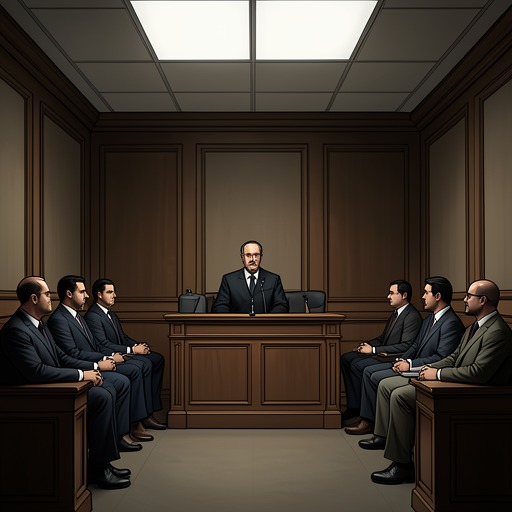
Lawrence Broham
The LuminariesLawrence Broham is a barrister for the plaintiff in two connected court proceedings, first against Anna Wetherell and later against Emery Staines. His courtroom role is to make their actions legible as public offenses: he presents Anna through the language of addiction and alleged forgery, then portrays Staines’s prolonged absence as a source of loss and false hope for others. Against Walter Moody’s defense, Broham gives each case a moral frame as well as a legal one.
Courtroom Role
At Anna Wetherell’s trial, Broham appears for the plaintiff, assisted by Roger Harrington and John Fellowes of the Magistrate’s Court; Walter Moody represents the defendant. Justice Kemp cautions counsel to keep their questioning appropriate and restricts the terms they may use for Anna’s former employment. The instruction sets a boundary around the spectacle of the trial, but Broham’s opening statement still makes her personal history central to the case.
Broham also appears for the plaintiff when Emery Staines is tried. In that proceeding, Justice Kemp identifies Moody for the defendant and Broham for the plaintiff, again with Fellowes and Harrington assisting. Broham’s repeated presence across the two cases makes him a continuing adversary to Moody in court, though the proceedings concern different allegations and different defendants.
Case Against Anna Wetherell
Broham’s opening statement presents opium as both a destructive drug and a social danger. He casts Anna’s dependence as evidence of personal weakness and connects her collapse on March 20 with an earlier attempted suicide, suggesting that both incidents drew public attention. His argument thus places her condition, and the publicity surrounding it, within the plaintiff’s case rather than treating the collapse as an isolated episode.
He devotes substantial attention to Anna’s forgery of Emery Staines’s signature on the deed of gift. Broham questions the document’s validity and emphasizes that Anna stood to gain from it. The focus on her possible financial motive turns a disputed signature into a challenge to her credibility and claim.
On the assault charge, Broham invokes the dangerousness of opium addiction and describes Staines’s gunshot wound in such frank detail that a woman in the gallery has to be escorted from the courtroom. The moment shows the forceful, potentially disturbing character of his advocacy: the injury becomes evidence, but its description also affects the audience physically. Broham’s account is set against Moody’s role for Anna, while Justice Kemp’s warning about appropriate questioning marks the court’s attempt to prevent the case from becoming mere prurience.
Case Against Emery Staines
When Staines faces charges arising from his absence and the resulting neglect of his mining claims, he pleads guilty to the charges put to him, including dereliction of duty after an absence exceeding eight weeks. Broham then gives a statement designed to discredit him. Rather than presenting the absence only as a breach of claim requirements, he stresses the trouble it caused and singles out Lydia Wells, whose expectation of a possible inheritance had been raised by the circumstances.
Broham frames that expectation as a harm: Wells, he argues, had reasonably believed that a windfall might form part of her late husband’s estate. He broadens the point into a warning about wealth’s corrupting effects and characterizes fraud and embezzlement as calculated crimes. Moody’s response is markedly narrower. He acknowledges that Staines understands the trouble his extended absence caused and says that Staines is willing to pay the resulting damages or debts. The exchange places Broham’s emphasis on culpability and injured parties against the defense’s emphasis on compensation.
Advocacy and Narrative Function
Across both proceedings, Broham builds cases by connecting individual conduct to wider moral anxieties. In Anna’s trial, opium, public reputation, and the disputed deed converge; in Staines’s, absence, financial responsibility, and the expectations surrounding an inheritance become grounds for reproach. His statements extend beyond the formal charges to ask what kind of person the defendants are and what their actions have cost others.
Broham is shown principally through courtroom advocacy rather than through a personal history or private relationships. The evidence establishes the content and posture of his arguments, but not his life outside court or his private motives. His narrative importance lies in the pressure his adversarial accounts place on Moody’s defenses and in the way the trials make moral judgment part of the legal contest.