Luck and chance
The LuminariesLuck and chance are not presented as a single, stable force. They are at once a fortune-teller’s uncertain subject, a prospector’s hope of striking gold, and a word Dick Mannering uses to explain how contracts bind people after opportunity has passed. Across these different settings, the novel tests the boundary between accident and choice: a prediction may affect the future it describes, hard work may yield no more than subsistence, and a signed agreement may carry consequences long after luck has apparently moved on.
Fortune and the act of telling
Lydia Wells refuses to treat fortune-telling as proof of supernatural foresight. When challenged to demonstrate that she can see what will happen, she distinguishes giving a fortune from proving her own ability beyond doubt. In her account of the discipline, nothing about the future is incontrovertible because a person’s fortune changes in the telling of it. A forecast is therefore not merely a report about a fixed outcome; it may enter into the chain of events that produces one.
To explain this, Lydia imagines a jockey asking whether he is likely to prosper in a coming race. A gloomy forecast might leave him dejected and cause him to ride poorly, while a favorable one might give him confidence and help him do well. The example makes chance partly responsive to expectation: the teller cannot guarantee an outcome, but what she says may affect the person who acts under its influence. It also marks a limit. Dick Mannering offers a concrete wager, five pounds on a mare called Irish, but Lydia judges that gaining or losing that sum would not greatly alter his fortunes. She recognizes that he is still asking for proof, and invites him into the parlour rather than supplying an incontrovertible prediction.
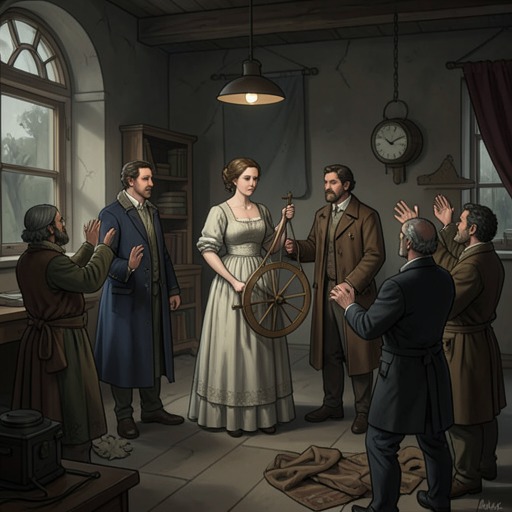
The exchange takes place in a commercial setting. When Dick Mannering enters the parlour, he recognizes Ah Sook and Ah Quee, who are seated on opposite sides of the hearth with their faces painted for the séance. Lydia explains that Ah Sook had agreed to return after visiting earlier that day, and had brought Ah Quee with him; she values the pair as a symmetrical arrangement in the room. She also acknowledges that Dick Mannering’s Sensations from the Orient gave her the idea of using an Oriental element to attract ticket buyers. The scene places the language of fortune alongside its staging and sale: a prediction can be a matter of belief, but the séance is also deliberately arranged as a public attraction.
Deserving a fortune
Walter Moody approaches luck from a different direction. In conversation with Lydia Wells, he considers the contrast between rich men who work little and plan nothing, and people who try to make their way through effort. Lydia asks whether he does not wish to be lucky as well. Moody answers that he wants to be able to call himself deserving of his lot, because, in his view, luck is undeserved. Lydia calls the answer honorable, while Moody adds that he hopes it is truthful. Their exchange frames his concern as ethical as well as practical: he does not simply want a favorable result but wants to understand whether it can be called his own achievement.
His days as a prospector give that distinction material weight. Moody stakes a claim near Hokitika so that he can continue boarding at the Crown Hotel, although the arrangement cuts substantially into his weekly earnings. Having tried sleeping in a tent once and found it uncomfortable, he accepts a long walk instead: it takes an hour and twenty minutes to reach his creekside claim, and he is at his cradle before nine each morning, hauling water, whistling, and shoveling sand.
Moody is not especially skillful at prospecting. He hopes for nuggets rather than concentrating on dust, and ore-bearing gravel often slips through the cradle’s netting and washes away. Sometimes he empties the cradle twice without finding a flake. His output is only what the diggers call pay dirt: his weekly income approximately matches his weekly expenses. That narrow balance cannot continue indefinitely, and the possibility of a richer strike remains uncertain rather than earned in any straightforward way.
The customary answer would be to work with a mate or join a party. Moody knows that partnership doubles the chance of striking rich, and that larger parties of five, seven, or nine offer still greater chances. Pride keeps him working alone. He repeatedly pictures the nugget that would buy him a future life, while his night dreams begin to glister and flashes of light appear in unlikely places. The contrast is pointed: he understands the practical arithmetic of shared risk but refuses its advantage, staking his hope on solitary effort and a discovery chance may or may not deliver.
Chance, contracts, and control
Dick Mannering gives luck a harder, more transactional meaning when he encounters Ah Quee after the Aurora claim has returned to the bank. Ah Quee’s indenture certificate describes his apparent age rather than his actual age, records the ship from which he arrived rather than his birthplace in Canton, and lists attributes as a worker. The document marks his indenture as five years and bears the Company seal. In the employment box, Aurora has been scratched out and Dream of England written in its place. The paperwork makes the change in his circumstances visible: the claim that had defined his work is replaced by another assigned site.
Mannering responds by asserting that the new claim belongs to him and that Ah Quee is working for him again. He recalls their earlier dealings on the Aurora, including Ah Quee’s use of a crucible and the extraction of dust from Anna Magdalena, and says that Ah Quee has tried to bet against him twice: once over the Aurora and once over Anna. Ah Quee, who is massaging his ribs, answers that Mannering is unlucky; Mannering turns the question around, asking whether the luck has fallen on Ah Quee or on himself. Ah Quee does not understand the question, and Mannering laughs before explaining his view of indenture: a person signs away the chance to get lucky.
For Mannering, luck happens once, accidentally. What follows is not luck but the return of contracts, investments, and obligations. A contract must eventually come around on itself; paperwork makes consequences durable in a way that a lucky break is not. He extends the principle to business strategy, arguing that a person hoping to make a fortune should not sign a document he did not write himself. His own advantage, he says, lies in having avoided that mistake. The maxim makes chance sound fleeting and business control lasting, while the indenture certificate shows how unequal that control can be: Ah Quee’s work and destination are recorded by others, under a five-year agreement.
Mannering nevertheless assures Ah Quee that Dream of England is sound, though Ah Quee slyly asks whether it is a duffer. Mannering denies that it is and says it has already been raked for nuggets but still contains dust in the tailings. He expects Ah Quee to do adequately, not to make a fortune. The reassurance is therefore qualified: this is a better prospect than a worthless claim, but it is no promise of sudden wealth. Ah Quee nods, and Mannering tells him to return to Kaniere.
The competing meanings of fortune
These episodes set three meanings of luck against one another. Lydia’s fortune-telling concerns uncertainty that may be altered by the act of prediction; Moody’s prospecting turns chance into a question of labor, pride, and deservingness; Mannering’s business philosophy treats luck as a single accident whose aftermath is governed by investment and contract. None provides a simple formula for controlling outcomes. Lydia cannot offer proof, Moody’s work barely covers his expenses, and Mannering’s confidence depends on documents and arrangements that place power unevenly between employer and indentured worker.
The motif also distinguishes a favorable outcome from a just one. Moody’s wish to deserve his lot does not make his solitary claim more productive, while Mannering’s command of contracts allows him to describe another person’s constrained prospects as a matter of signed-away luck. The language of fortune can thus console, challenge, or disguise material conditions. In the novel, chance is never only what happens by accident: it is also what people say about the future, the risks they accept or refuse, and the obligations that determine who gets to act when opportunity arrives.