Quee Long
The LuminariesQuee Long is a goldsmith and indentured worker in the Kaniere goldfields whose extraction of gold from Anna Wetherell’s dresses links a private grievance to the novel’s wider tangle of fortunes, claims, and missing evidence. His effort to convert the hidden metal into legitimate mine returns is at once practical and retaliatory: he hopes to escape an exploitative contract, but the gold he has carefully processed vanishes from the camp station vault before it can secure his freedom.
Identity and Background
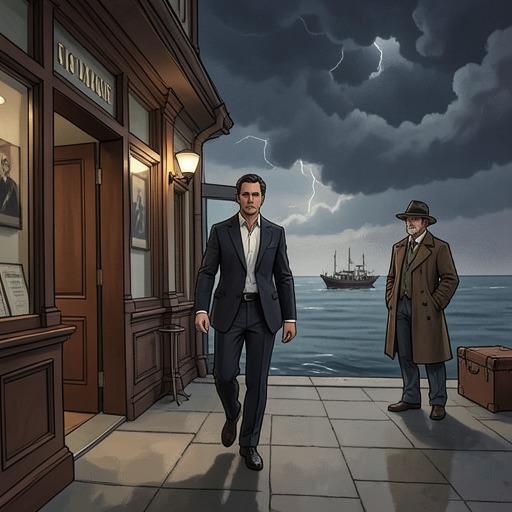
Quee Long lives among a small Chinese community in Kaniere Chinatown, a cluster of tents and stone cabins upriver from the claims rather than a substantial township. His dwelling is also his workshop. A miniature forge occupies the centre of its single room, with a brick oven and a handsome fired-clay chimney; the clay shelf above the oven serves as his bed, warmed by the bricks retaining the day’s heat. The equipment is used for smelting his weekly yield, although the firebox is filled with slow-burning wood when Dick Mannering and the others arrive to question him.
He came to New Zealand under contract, exchanging the cost of his return passage from Kwangchow for an agreement to surrender most of his goldfield earnings to a corporate purse. The terms leave him poor and offer little flexibility, but he works diligently. His imagined future is precisely measured: he wants to return to Kwangchow with 768 shillings, a sum chosen for its auspicious Cantonese sound and because a definite target helps him keep working. The modesty of the goal makes the arrangement’s severity plain: even the return to his former home must be earned under conditions that give him little control over his own proceeds.
Quee Long’s father, Quee Zuang, was a city watchman in Kwangchow, responsible for patrolling the wall and overseeing the opening and closing of the gates. The occupation had once seemed respectable to his son. That pride was damaged when British forces captured the city in 1841, overwhelmed its defences, and released Quee Zuang only after Kwangchow agreed to open its port to trade. Quee Long’s shame at his city’s repeated defeats was intensified by his father’s humiliation; Quee Zuang died after facing British rifles three times. This family history gives his later encounters with colonial authority a personal inheritance of defeat as well as a material context of indenture.
Character and Working Life
Quee Long is described as physically capable, quick-witted, and notably self-deprecating. His humour can be caustic, but the picture he makes of himself as inept conceals a vulnerable self-conception. He measures his actions against a private ideal of perfection, so that even diligent work rarely satisfies him; alongside the melancholy and cynicism is a dogged persistence in the service of standards he considers beyond reach. His compatriots understand these qualities, while the British characters who share only a small common vocabulary with him largely miss them.
That limited English matters when the gold dispute becomes a confrontation. Quee Long recognizes key words such as gold, Aurora, and thousand, and understands that Mannering wants something recovered, but cannot readily give a full account in English. Under pressure, he searches for words and describes the situation as unlucky. The word is an understatement for a man whose careful work has failed to change either his legal position or his financial prospects.
The Gold in Anna Wetherell’s Dresses
Quee Long discovers that gold has been sewn into Anna Wetherell’s clothing. He takes this hidden fortune to be connected with Mannering’s dealings, and the discovery revives his earlier grievance against the goldfields magnate, who had cheated him before. Quee Long believes Mannering’s actions have left him tied to the Aurora, a claim yielding no usable gold. The concealed metal offers a chance both to retaliate and to earn his freedom.
He invites Anna to his hut on repeated occasions when she is heavily affected by opium and likely to fall asleep. While she sleeps on the warm brick shelf, he uses needle and thread to remove the gold from her dresses. To conceal the change, he replaces the nuggets around the hems with leaden weights; if she stirs, he encourages her to drink strong liquor. The method is sustained rather than sudden: the work takes months, and he removes the metal a seam at a time. Anna does not wear her orange dress when she visits Chinatown, so that garment retains its gold after Quee Long has emptied the other four.
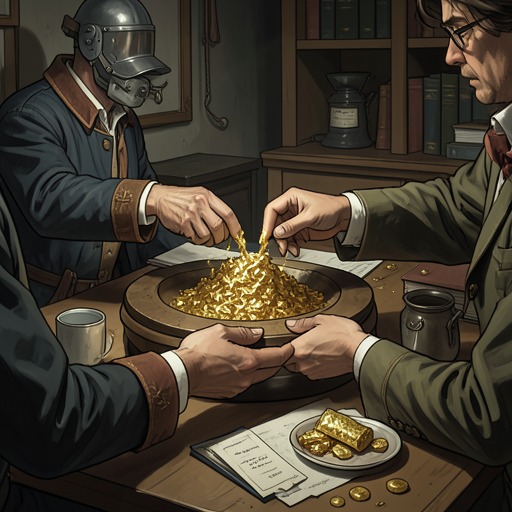
He smelts the recovered metal into square blocks and stamps each with the name of the Aurora claim. This marking gives the gold an apparent mining provenance: as an indentured worker, he can earn a profit only from ore lifted from the claim to which he is bound. He delivers the blocks to the camp station to be weighed and banked. In the first week of January, however, the Aurora’s quarterly return shows no corresponding deposit. The gold has been stolen from the station vault, and Quee Long’s attempt to turn it into recognized earnings has left him with neither the money nor the freedom he sought.
Confrontation and Uncertain Responsibility
When Mannering confronts him about thousands of pounds in missing Aurora gold, Quee Long initially understands the demand through the gold he took from Anna’s dresses. Mannering’s questions conflate several strands of the case: the hidden clothing, the supposedly barren Aurora, and the large fortune associated with Crosbie Wells’s cottage. Quee Long knows that the mine name stamped on his blocks does not mean the gold was actually mined there. His account makes clear that he placed the processed metal at the camp station, where someone else removed it from the vault.
The later reconstruction of events distinguishes Quee Long’s removal of the gold from its subsequent theft. Walter Moody concludes that Quee Long had been cheated by Mannering and tried to secure the proceeds against the Aurora claim, by then purchased by Emery Staines. Yet the gold was not banked as the claim’s return, and its disappearance remains unexplained. Moody considers Staines a possible thief but also notes that the young prospector appears to have had no evident reason to steal from his own indentured worker. The evidence therefore establishes Quee Long’s actions and the missing deposit without resolving who took the blocks.
Narrative Role and Significance
Quee Long’s story is disclosed within a crowded account of interlocking transactions rather than as a self-contained confession. At the gathering in Hokitika, Thomas Balfour’s disordered narrative and the assembled men’s interruptions prompt Moody to arrange events retrospectively. Quee Long is one of the people whose presence in that room connects the investigation to a less visible history: the gold in Anna’s dresses passed through his hands, was converted into marked blocks, and entered a camp system that failed to credit it to the claim.
The objects carry the force of the episode. A needle, a dress seam, a smelted square, and a vault record each assign the same gold a different meaning: concealed wealth, a means of escape, apparent mine yield, and missing property. Quee Long’s story also resists an easy division between legitimate and illegitimate fortune. His labor is constrained by an unfair contract, but his solution depends on removing another person’s hidden property without her knowledge; his attempt to turn that act into a lawful return is then defeated by a theft he cannot identify. The result is neither a clean triumph nor a settled accusation, but another broken link in the novel’s chain of ownership and obligation.