Spiritualism and séances
The LuminariesSpiritualism and séances in the novel occupy an unstable ground between performance, business, and the possibility of contact with the dead. At the Wayfarer’s Fortune, Lydia Wells presents herself as a medium and fortune-teller, but she also argues that the future cannot be proved in advance; later, her séance for the missing Emery Staines produces a startling sequence that neither confirms nor entirely dispels the supernatural explanation. Its ambiguity becomes useful to Lydia’s enterprise, even as it leaves the men who witnessed it without a settled answer.
The Wayfarer’s Fortune and its claims
The Wayfarer’s Fortune announces its new purpose through deliberate changes to its public face. Its sign depicts a traveller beneath a starry sky, while the polished door knocker, washed windows, fresh doormat, and card identifying Lydia Wells as a medium and spiritist give the establishment a newly prepared appearance. The advertised promise of uncovered secrets and told fortunes places spiritualism alongside commercial services: clients are invited to treat hidden knowledge as something that can be sought out at the door.
Dick Mannering visits hoping that Anna Wetherell will receive him. Instead, his conversation with Lydia turns to what a fortune-teller can actually claim to know. Mannering, who acknowledges his own involvement in swindling, dismisses fortune-telling as a falsehood because Lydia cannot give him verifiable answers about a future wager, a card game, or a race. His challenge makes predictive certainty the test of her profession.
Lydia does not claim that she can meet that test. She distinguishes telling a fortune from providing incontrovertible proof of a medium’s ability, describing the latter as a demand for a logician’s demonstration rather than a fortune-teller’s work. Her answer rests on the instability of the future: a person’s fortune changes in the telling of it. The exchange defines the practice less as a source of guaranteed predictions than as an interpretation whose telling may itself alter what it describes.
Preparing to summon Staines
The séance takes place in the Wayfarer’s Fortune’s front room, three weeks after the clandestine gathering at the Crown Hotel. That earlier party of twelve had become thirteen after Walter Moody arrived; now eleven people gather in search of a twelfth presence. Lydia leads the ticket holders into the parlour, where Ah Sook and Ah Quee sit beside the hearth in greasepaint. The contrast between the earlier council and this paid gathering makes the séance a public-facing venture built around a private uncertainty: whether Emery Staines, whose fate is unknown, can be reached through the dead.
The room is arranged to shape attention. The curtains are drawn, most of the paraffin lamps are extinguished, and the remaining light warms attar in a tin dish. Lydia places five candles in a star pattern and seats the guests in a circle. She asks them to remain receptive, still, and quiet, and warns that even a small disturbance could affect the proceedings. Charlie Frost, watching Lydia under Joseph Pritchard’s instruction, observes the care with which the environment and the guests’ expectations are managed.
Before beginning, Lydia describes several possible forms of manifestation: moving furniture, a breeze, speech through a living person, or a token left by the dead. She also relates an account from a séance in Sydney. In her version, a suspicious death had gone unresolved after the woman’s dog was shot before its nature could be established legally. Months later, a servant brought the case to a medium, and a séance was held in the room where the woman had died. A spiritist’s pocket watch, reportedly wound before the gathering, made a whirring sound and stopped at three minutes past one, although its mechanism was said to be broken. Lydia says the case was reopened with two clues: the woman had been killed by a Colt Army handgun, and the watch indicated the precise time of her death. The account offers the guests an example of a token that might carry evidentiary meaning, but it remains Lydia’s story within the scene.
The séance and its uncertain manifestation
Lydia invites the assembled men to inspect the room and her person for tricks. Frost keeps his attention on her as she turns to show that she is concealing nothing in her skirts. Yet the seating is not quite circular: it forms an ellipse whose long axis points toward the door, with Lydia at the far end. When Anna Wetherell enters, the guests turn toward the doorway and away from Lydia. Frost suspects that Lydia uses that moment for a sleight of hand, though he cannot establish what it is; he also thinks the Chinese men may have seen it and resolves to question them afterward.
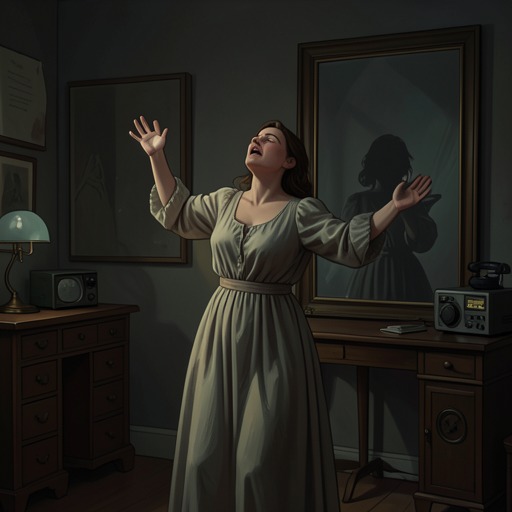
The gathering joins hands. After nearly twenty minutes of silence, Lydia begins humming, then develops the sound into indistinct words and phrases before repeatedly calling for the shade of Emery Staines. Frost later struggles to describe what follows, using terms such as a fit, seizure, or prolonged convulsion while recognizing that none captures both the theatrical quality of the performance and his own embarrassment at witnessing it. Lydia’s agitation builds as no answer comes. Then her eyes open with an expression Frost has never seen on her before; she appears to look past him toward Ah Sook, and speaks in a voice Frost does not recognize as hers.
At the same moment, Lydia falls to the floor and a paraffin lamp lurches onto the plate of candles. The globe does not break and the paraffin does not spill, but the table catches fire and the sudden light exposes the room. The coincidence of Lydia’s collapse, the unfamiliar voice, and the lamp’s movement gives the gathering a dramatic apparent manifestation, but the scene supplies no final proof of what caused it. When asked whether Lydia had spoken Chinese, Ah Quee does not understand the question; Ah Sook answers that she spoke Cantonese. The exchange identifies the language but does not provide a translation or settle whether the voice came from a spirit, from Lydia’s performance, or from some other source.
Failure, publicity, and continued uncertainty
Lydia does not hold another séance for the same audience. The narration connects this decision to the entertainer’s practical rule against repeating a trick before the same crowd. When people take the absence of a second performance as evidence that she is a charlatan, she laughs and answers publicly in an open letter to the West Coast Times. She acknowledges that the attempt to communicate with Emery Staines was unsuccessful, calling the failure unprecedented in her professional experience. She proposes that the afterlife may have been unable, rather than unwilling, to produce him, and concludes that Staines may not be dead.
That conclusion converts an apparent failure into a fresh promise. Lydia expresses confidence that Staines will eventually return, while the men associated with the Crown Hotel are confounded by her statement. The letter also improves the business: the Wayfarer’s Fortune begins trading well, serving inexpensive brandy and speculative conversation in the evenings and offering private fortune-telling appointments in the afternoons. The séance’s uncertainty does not diminish the enterprise; it supplies a new reason to wonder, and therefore a new subject for customers to discuss.
Anna remains out of public view, leaving the Wayfarer’s Fortune only for daily exercise with Lydia. Their morning walks along Revell Street, conducted arm in arm, form a quiet counterpoint to the establishment’s public promises of revelation. Lydia’s spiritualist business flourishes, but the person whose appearance in the parlour was supposed to prepare the séance is not presented as an openly available attraction.
Narrative significance
The spiritualist episodes make the boundary between knowledge and performance part of the plot. Mannering demands a prediction that can be tested; Lydia replies that the future cannot be made incontrovertible without ceasing to be a fortune. At the séance, the audience receives neither a clear message from Staines nor a reliable explanation for the voice and the burning table. Frost’s attention to the room’s layout and possible sleight of hand encourages suspicion, while the events he witnesses resist a complete explanation.
Lydia’s later letter preserves that uncertainty rather than resolving it. She admits that the séance failed to bring Staines, yet interprets the failure as evidence that he may be alive. Spiritualism thus operates at once as a claimed route toward the unseen and as a practice whose meanings depend on how events are narrated. The séance’s consequences are practical as well as metaphysical: an unanswered summons becomes a public story, and the story sustains Lydia’s business while keeping Staines’s fate open.