Te Rau Tauwhare
The LuminariesTe Rau Tauwhare is a greenstone hunter, a member of Poutini Ngāi Tahu, and one of Crosbie Wells’s closest friends. His story links the mystery of Wells’s death to a wider conflict over land: the Arahura Valley is at once the setting of their friendship and part of a country whose Indigenous owners have been dispossessed through Crown purchase and settler development. Tauwhare’s paid disclosure of Wells’s whereabouts becomes a source of guilt, but his later actions toward Emery Staines show that he is more than a witness to other men’s schemes: he sets his own terms, chooses whom to help, and understands friendship as an obligation.
Identity, work, and the western land
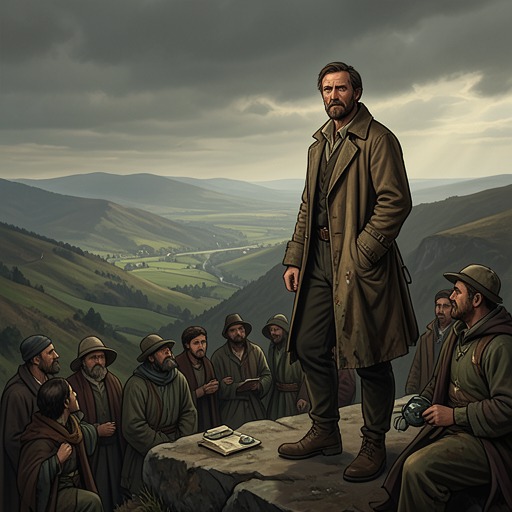
Tauwhare belongs to Poutini Ngāi Tahu, whose territory once extended along the western coast of the South Island. Six years before the principal events, the Crown purchased a vast tract for three hundred pounds, leaving the iwi only the Arahura River, parts of its banks, and a small parcel at Mawhera. The rapid arrival of gold-seekers made the injustice more apparent: prospectors paid for licences and land, and the Crown collected the returns, while Poutini Ngāi Tahu had been left with a fraction of its former country. The novel gives this history specific economic proportions rather than treating dispossession as an abstraction.
Wells’s cottage stands within this contested landscape. He had paid the Crown fifty pounds for one hundred acres at the eastern end of the Arahura Valley, where he built a one-room cottage, made a garden clearing, and began a timber mill. Tauwhare, by contrast, continues to regard the valley as his own, despite its purchase and transfer under settler law. He resents land being bought for profit rather than used, and questions the purpose of Edgar Clinch’s acquisition: Clinch had not settled on the land, worked its soil, felled its timber, or developed it. The distinction is not simply between two competing claims to a deed. For Tauwhare, the land is a place of use, attachment, and inherited relationship; for the purchaser, ownership can be acquired on paper and held for advantage.
Tauwhare works independently. He spends a month with surveyors in Deception Valley, earns enough to fill his purse, and hunts greenstone. On his way down the Arahura River he carries a fine slab of kahurangi pounamu in his satchel. This work and his direct negotiation with others give him a practical place in the region’s economy, but they do not erase his sense of belonging to the country or his anger at the terms on which it is being transferred.
Friendship with Crosbie Wells and the fatal disclosure
Tauwhare and Wells have an established routine of mutual hospitality. The morning after Wells’s death, Tauwhare brings meat to the cottage; Wells customarily supplies the spirits. Their arrangement is familiar and reciprocal, a small domestic practice that contrasts with the transactions surrounding the dead man’s land and fortune. When Tauwhare arrives and sees Wells’s body under a blanket in a cart, he cries out and drops his food in shock. Cowell Devlin invites him to accompany the body back to Hokitika for burial. Tauwhare’s distress is sharpened by his view that Wells has received a shamefully inadequate funeral.
His connection to the death is complicated by an earlier exchange. On 14 January, Francis Carver had offered money for news of Wells. Tauwhare accepted two shillings and told him where Wells lived. Such requests were ordinary on the goldfields, where men used word of mouth to find missing relatives, debtors, partners, or friends; Tauwhare did not understand the payment as placing Wells in danger. That evening he saw Carver approach the cottage and enter. He had not realized that the information he sold would bring a threatening visitor to his friend’s door.
Later, when speaking with Balfour, Tauwhare explains that he had set a trap for birds and, from a ridge, could see Wells’s house. He reports seeing four men enter that night. Balfour recognizes him as Wells’s mate and asks about the death, but Tauwhare reads the merchant’s gestures as superficial sympathy and an attempt to profit without giving anything in return. His perception makes him guarded rather than simply forthcoming: he understands the question, but also assesses the purpose behind it.
The burden becomes explicit when Tauwhare returns to the place where Wells was buried. He imagines the dead man’s room and bed, then wonders whether to confess that he had led Wells to his death. He places his palm carefully over the earth covering Wells’s heart. The gesture does not resolve responsibility: Tauwhare did not know what Carver intended, yet he recognizes that his own small payment helped make the encounter possible. Friendship here carries both the comfort of shared routine and the pain of an unintended consequence.
A broker who sets his own terms
Tauwhare’s dealings with Carver show both the limits and the uses of information in a community shaped by movement and mistrust. Months before the central events, Carver had offered him a reward for news of Wells. After taking the money, Tauwhare and Carver went separate ways; by chance, Tauwhare later met Wells and became his friend. When Carver returns to Hokitika, the two meet again. Tauwhare does not tell Wells about his earlier interaction with Carver, an omission attributed to both his private nature and his calculation that the next encounter might earn him another shilling. His discretion is therefore not presented as simple virtue: affection, silence, and financial self-interest coexist.
He also refuses to be treated as a source of miscellaneous labour. When Balfour wants access to his knowledge, Tauwhare makes clear that he will not do odd jobs, but can teach language and other things when that is what is needed. The exchange establishes a boundary and a form of expertise. Others may approach him for information, but he defines what kind of assistance he offers and what it is worth. That agency complicates the assumption that he is merely a helper attached to the European characters’ investigations.
The perspective of other characters sometimes reduces him to a conspicuous figure: Balfour recalls a young man with a large green pendant, while Ah Sook observes him bargaining with Carver from a distance. Yet the narrative also gives Tauwhare his own judgments and deliberations. He identifies the greed in Balfour’s manner, reflects on the consequences of the land sale, and makes decisions whose costs he feels personally. His role is not confined to supplying clues; he interprets the motives of those who seek them.
Finding Emery Staines and choosing to stay
Tauwhare’s later encounter with Emery Staines provides a counterpoint to his earlier disclosure about Wells. After returning from work with the surveyors, he finds Staines in a dangerously weakened state. Tauwhare considers going to Hokitika to alert Dr. Gillies and hire transport, but calculates that the round trip would take at least three hours. He remembers that his sister’s final illness had resembled Staines’s condition and fears that leaving may mean the young man will not survive. Unsure what he can accomplish by staying, he chooses not to leave and says a prayer for Staines’s recovery.
Staines is brought to the gaol-house in a trap, with Tauwhare sitting beside him and holding the young man in his arms. The sight surprises Devlin, who had not expected Staines to be so young. Tauwhare’s presence continues during the following month: although Devlin turns away the many visitors seeking access to Staines, he makes an exception for Tauwhare. Their visits improve Staines’s mood and health, and Devlin comes to look forward to them. Tauwhare’s care is thus shown not as a single rescue but as sustained companionship during a serious illness and detention.
The contrast with Wells’s death is pointed. In the earlier episode, Tauwhare’s decision to accept payment has consequences he did not foresee; with Staines, he confronts uncertainty directly and stays. The novel does not suggest that one choice cancels the other. Instead, the parallel makes visible a character who must live with an unintended harm while continuing to act on the responsibilities he recognizes.
Land, memory, and narrative role
Tauwhare’s account of the valley gives the land a meaning that official ownership cannot contain. He understands the Arahura River as a dividing line through the western territory and Wells’s cottage as a central point in the valley. Yet he cannot claim the cottage or the surrounding hundred acres under the law that governs the sale. Before Wells is buried, the property has already passed to a profit-minded purchaser. The timing binds personal loss to dispossession: a friend’s death and the transfer of land unfold together, while the people most attached to the country lack the recognized means to prevent the transaction.
His presence also joins otherwise separate strands of the plot. He has seen Carver enter Wells’s cottage, knows how Carver found it, and later becomes Staines’s rescuer and visitor. At the courthouse, he watches proceedings from the rear of the room, sombre and against the wall, though he has not been called to testify at either trial. He then leaves with the others and approaches the duty sergeant beside the armoured carriage waiting to return the prisoners to gaol. The evidence leaves that brief action unresolved, but his return to the edge of the legal process is characteristic: Tauwhare remains close to events without being made their official interpreter.
A later account of Tauwhare’s acquaintance with Wells gives his name in a British writer’s approximation and describes their growing friendship. Against that imperfect rendering, the story preserves Tauwhare’s own introduction of himself and his capacity to judge those around him. He is at once a hunter, worker, negotiator, friend, and witness to an unequal system of land ownership. His arc does not end in a public vindication. It rests instead on the contrast between what he could not foresee when he gave Carver Wells’s address and the deliberate care he later offers Staines.