The Godspeed apparition
The LuminariesThe Godspeed apparition is the unexplained encounter Walter Moody recalls from the final leg of his voyage to Hokitika. It marks a break in his confidence that experience can be assessed through ordinary suspicion and probability: the memory persists, but for a time he cannot fully understand or narrate what he saw.
The encounter and its unresolved details
Moody’s memory returns in fragments while he is in a hotel smoking room. It centers on a bloody cravat, a clutching silver hand, and the name Magdalena, repeated in the darkness. The recollection comes upon him unbidden, rather than as a story he has deliberately chosen to tell. Its fragmentary form reflects the limits of his own memory: even after the scene returns, he remains unable to recall the apparition in full.
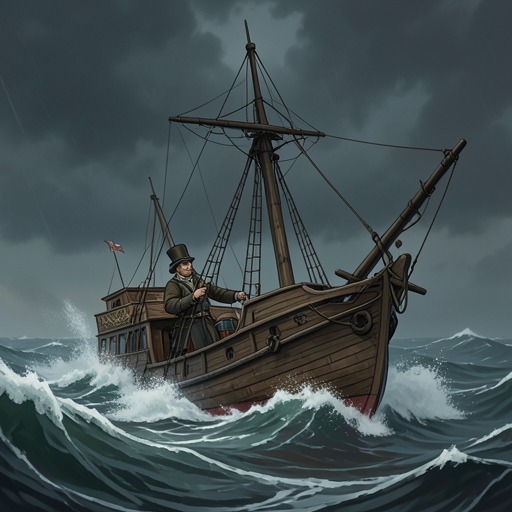
The account places the encounter on the Godspeed’s last leg toward the West Coast. Eight passengers had boarded when the barque left the harbour at Dunedin; by the time it reached the Coast, there were nine. The narration rules out an ordinary birth, a stowaway, or a person rescued from the water, while withholding an explanation of how the additional passenger came to be aboard. That imbalance makes the apparition a precise mystery within the voyage rather than a settled supernatural fact.
Moody’s memory and the narrative frame
The episode is presented as a recollection, and the narrative explicitly leaves the full account of the voyage’s final leg to Moody himself. Yet he cannot at first supply that account: he cannot wholly recover the apparition in his own mind, much less shape it into a narrative for someone else. The reader therefore encounters both the event and the uncertainty surrounding its telling.
Moody is characterized as skeptical of ghosts and not generally prone to fanciful explanations. Before coming to New Zealand, he had known calculated doubt, but not the deeper loss of confidence that comes when a person can no longer trust his own ability to judge what is real. The apparition exposes that gap between intellectual skepticism and an experience that resists rational control.
Reframing the experience
Later, as Moody watches a secret message pass among the men at a meeting, his attention shifts from the haunting memory to the new mystery before him. In that context, he can think about the earlier scene more clearly. The image of a dead man rising, the wounded throat, and the cry still horrifies him, but now seems more like a sensational tale and, crucially, more explicable. The change does not resolve what happened aboard the Godspeed; it changes how Moody can hold and interpret the memory.
The apparition thus connects two kinds of uncertainty in Moody’s arrival: the private disturbance of an experience he cannot fully narrate, and the public intrigues he begins trying to interpret in Hokitika. As he becomes a reader of other people’s secrets, the unexplained event remains a measure of the limits of his own certainty.