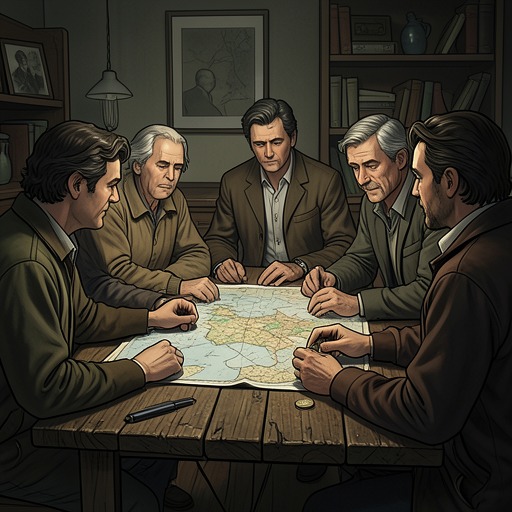
The West Coast Gold Rush
The LuminariesThe West Coast Gold Rush turned a remote, rain-beaten shoreline into a crowded frontier whose new wealth moved through rivers, claims, shipping offices, and contested deeds. Hokitika grew with striking speed, but the rush was not simply a story of prospectors arriving to seek their fortunes: it unfolded on land already inhabited and valued by Poutini Ngāi Tahu, and its profits depended on a colonial system that had sharply restricted their access to that land.
The Coast before the rush
Before the rush, Hokitika was a small settlement at the mouth of a river, between the Tasman Sea and the sudden rise of the Alps. The landscape that later drew prospectors could appear forbidding: rain and mist obscured the township, surf battered the coast, and a shifting sandbar made entry to the port dangerous. Ships waited in the river mouth for safer weather, while the wrecks scattered along the bar testified to the risks of reaching the goldfields by sea.
The riches that drew people inland were not confined to the beaches. The Arahura River country held gold, and its waters and sands belonged to a region with a much older significance for Poutini Ngāi Tahu. Te Rau Tauwhare travelled the Arahura Valley to find pounamu, the stone he could recognize by its potential even when its exterior looked dull. The gold rush thus intensified pressure on a landscape that was already a source of livelihood, knowledge, and cultural value.
Land, purchase, and dispossession
Six years before the events recounted in the novel, the Crown purchased a vast stretch of the western South Island from Poutini Ngāi Tahu for three hundred pounds. The lands reserved to the iwi were reduced to the Arahura River, sections of its banks, and a small parcel at Mawhera, at the mouth of the Grey River. The purchase had seemed unfair during negotiation; in retrospect, Poutini Ngāi Tahu recognized it as theft. The prospecting licenses and land sales that followed made the imbalance measurable: thousands of diggers paid a pound each for licenses and ten shillings per acre for land, before the immense value of the gold itself was even counted.
The consequences appear in the contrast between legal title and lived relationship. Crosbie Wells paid fifty pounds to the Crown for one hundred acres at the eastern end of the Arahura Valley, built a one-room cottage overlooking the river, cleared a garden, and began a timber mill. His purchase was legally recognized, yet the land adjoined territory to which Poutini Ngāi Tahu had recently been confined. Te Rau Tauwhare later resented that the property had been bought for profit and stripped of saleable effects without its owner doing the work of living on or caring for it. For him, land was not another form of currency; it was something to inhabit and love. The rush’s legal order could validate a sale without resolving the deeper question of belonging.
Hokitika becomes a gold town
The influx of prospectors rapidly altered Hokitika’s scale and commercial life. On a busy Saturday, diggers returned to town in such numbers that the population reached about four thousand. Revell Street’s hotels and lodging houses filled, the Magistrate’s Court was burdened with petty claims and mining-right disputes, brokers handled pledges, and merchants received orders from the wealthy alongside requests for credit from the poor. At Gibson Quay, new timber buildings and stores seemed to appear hour by hour. The town made the risks of the goldfields visible: some men were rising, others already prosperous, and still others falling into loss or exhaustion.
The rush also redirected people and businesses already established elsewhere. Before the West Coast boom, Thomas Balfour ran a shipping agency from Dunedin’s harbour front. When the Otago boom had passed its prime, he left in January 1865, bought land near the mouth of the Hokitika River, put up a tent, and began building a warehouse. His firm became Balfour Shipping as Hokitika grew around him. His move shows how the rush created not only mining work but demand for the infrastructure that connected the Coast to other settlements: land, warehouses, ships, supplies, lodging, and credit.
Gold in motion
The wealth produced by the goldfields did not stay in the ground or in the hands of the people who first uncovered it. It travelled through commercial networks and sometimes disappeared into private hiding places. One later account describes a trunk holding about four thousand pounds in gold, sewn into the linings of five dresses; the shipment became entangled with a lost crate, a ship transfer, and a false identity. Elsewhere, Ah Quee removed gold from dresses worn by Anna Wetherell, retorted the dust into squares, and stamped the bars with the name of the Aurora claim. The episodes show how the rush’s wealth could be concealed, transported, relabelled, and disputed long after its extraction.
Gold also changed the apparent fortunes of individual claims. Ah Quee’s retorted gold, if it had been properly banked against the Aurora, would have changed that mine’s standing from a duffer to a homeward-bounder. Instead, the bars were stolen from the camp-station vault, leaving the claim’s accounts and the gold’s destination in doubt. The sequence links mining production to labor, record-keeping, banking, and legal obligation: a discovery became wealth only through systems that registered, transported, and assigned it, and those systems could themselves be manipulated.
A frontier built on unequal claims
The West Coast Gold Rush made Hokitika a place of sudden growth and conspicuous possibility, but its prosperity was inseparable from the inequalities that enabled it. The population surge filled streets and courts; commercial migration built the town’s warehouses and services; gold passed through claims, clothing, banks, and disputed estates. Beneath that mobility lay a transfer of land from Poutini Ngāi Tahu to the Crown and then into settler ownership. The rush’s central tension is therefore not simply that fortune could turn quickly. It is that the same landscape could be treated as an opportunity for extraction by one legal and commercial order, and as a living inheritance by the people whose relationship to it that order had diminished.