The supernatural and rational skepticism
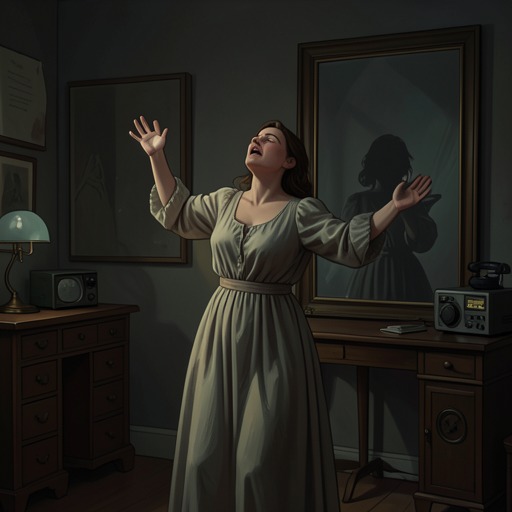
The LuminariesThe supernatural and rational skepticism form a deliberate tension between public claims of contact with the dead and a private experience that resists explanation. Lydia Wells presents spiritualism as an art and an entrepreneurial opportunity, while Walter Moody tries to interpret a strange sight in the Godspeed’s hold through the standards of reason. Neither the planned séance nor Moody’s account supplies simple certainty; together, they make the boundary between deception, perception, and the supernatural difficult to settle.
A commercial vision of spiritualism
Lydia Wells introduces the séance as part of a plan to convert her new establishment into a business. She describes herself as an experienced entrepreneur, with years of business in Dunedin and earlier experience in Sydney, and expects Aubert Gascoigne to recognize her in her element. Her proposal is not merely a private belief: she points to an advertised séance whose date and location are still to be confirmed, connecting spiritualism to publicity, entertainment, and commercial calculation.
Gascoigne’s response expresses a skeptical view of the proposed enterprise. He treats table-turning and communication with spirits as foolish entertainment rather than a reliable business, warns that people may resent paying for what they perceive as a trick, and adds that the Church disapproves. His objections combine doubts about truth with concerns about practical consequences and religious authority. The exchange therefore makes skepticism more than a simple denial that spirits exist: Gascoigne questions whether the performance can be trusted, whether it can fairly be sold, and whether it should be pursued at all.
Lydia rejects the assumption that spiritualism is necessarily a swindle. She insists that the paranormal is not a trick and that the ether is not fraudulent, treating the possibility of another realm as a serious subject rather than a parlour deception. Her position is presented through an entrepreneur who intends to profit from the séance, so conviction and commercial interest occupy the same scene. The evidence does not establish that her business is either genuine or fraudulent; instead, the disagreement leaves open how her claims should be understood.
The séance as public spectacle
The advertisement for the Wayfarer’s Fortune makes Lydia’s project more elaborate and public. Printed prominently in the Saturday paper, it announces the establishment’s first opening to the public and identifies Lydia as a celebrated medium and the widow of Crosbie Wells. It promotes Hokitika’s inaugural séance as a restricted gathering for an elite audience, with tickets allocated on a first-come basis, while inviting the wider public to attend an evening of drinks and speculation beforehand. Spiritualism is thus framed both as an exclusive event and as entertainment offered to a broader audience.
The advertised purpose is to investigate spiritual tremors through Lydia as a sensitive instrument, opening communication between the living world and the next. The intended spirit is Emery Staines, who has not returned to Hokitika and whose body has not been found after five weeks of absence. The advertisement presents the proposed séance as a way to ask about his death, though the question of what Lydia will ask is left unspecified. Its promotional confidence contrasts with the unresolved facts surrounding Staines: his absence gives the event its subject, but does not itself prove that he is dead or that a medium could establish what happened to him.
The announcement turns uncertainty into the séance’s attraction. The missing man is a possible object of communication precisely because his fate is unknown; the event promises inquiry while also relying on speculation to draw an audience. That mixture does not settle whether spiritualism is revelation or performance. It shows instead how claims about the dead can acquire a public and commercial life before the underlying mystery has been resolved.
Moody’s encounter and the limits of reason
Walter Moody’s experience in the Godspeed’s hold supplies a contrasting test of interpretation. When he later discusses the injury he saw, he says it did not seem natural. He is embarrassed by the conclusion he is approaching and describes himself as unsure whether the figure in the shipping case was alive at all. In the uncertain light and shadows, he cannot confidently call it a man; he considers the possibility that it was an apparition, a vision, or a ghost.
The narrative places this hesitation alongside Moody’s strong faith in analysis. He trusts reason and believes that truth can be made perfect, clear, and beautiful. Because he has no religion, he does not readily find truth in mystery or the inexplicable. The account of the hold therefore unsettles not a casual guess but his preferred way of understanding the world. His struggle is epistemic as well as supernatural: if reason is to produce certainty, he must decide what to do with an experience that he cannot confidently classify.
Moody also acknowledges the possibility of an ordinary failure of perception. He has not experienced hallucinations before, but he allows that he may have imagined the figure and what he saw. At the same time, he explains that if the figure was real and was Emery Staines, then Staines and Francis Carver may still be aboard the Godspeed, offshore beyond the river mouth as they wait for the tide. Moody did not return to the hold, and after reaching Hokitika the passengers went ashore by lighter. His lack of further observation leaves the sight unverified rather than disproved.
Sustained uncertainty
The two episodes give different social forms to the same uncertainty. Lydia’s séance advertises a channel to the dead, turning doubt about Staines’s fate into an occasion for gathering and speculation. Moody’s account is private and reluctant: he does not make his experience into a confident supernatural claim, and he remains prepared to accept another explanation if compelling proof is offered. Her public presentation and his hesitant testimony consequently differ in tone and purpose, even as both depend on what cannot yet be known.
The contrast also prevents skepticism from serving as an automatic explanation. Gascoigne has practical and religious reasons to distrust the séance; Moody has a reasoned commitment to clarity, yet still cannot explain what he believes he saw. Conversely, the possibility of an apparition does not validate Lydia’s mediumship or prove that a séance can establish Staines’s fate. Across these scenes, the supernatural remains a possibility under pressure from ordinary explanations, while rational inquiry encounters a limit in the observer’s uncertain evidence. The resulting tension is not a settled verdict for belief or disbelief, but a distinction between what characters claim, what they perceive, and what the evidence allows them to know.