Thomas Balfour
The LuminariesThomas Balfour is a shipping agent whose business gives him access to the people, records, and rumors linking Hokitika’s major disputes. A practical and opportunistic intermediary, he investigates Francis Carver, explains the circumstances surrounding Crosbie Wells’s estate, and helps make sense of a missing crate. His connections are useful precisely because they cross boundaries between commerce, politics, and private loyalty; they also leave him caught between a promise of secrecy and his friendship with Alistair Lauderback.
Identity and Background
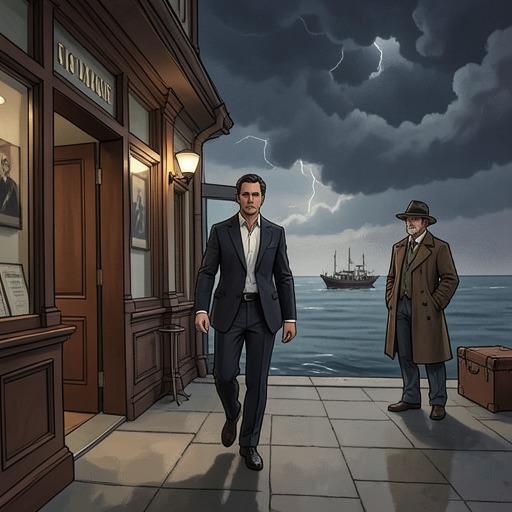
Before the West Coast gold rush, Balfour lived in Otago and operated a shipping agency from a small, shingle-roofed building on the Dunedin harbourfront. The business traded as Balfour & Harnett, Shipping Agents, under a calico sign. Its position beside the central wharf and its view towards the harbour entrance helped attract distinguished customers. Harnett, who had owned a third of the venture, later left for retirement in Auckland, leaving Balfour identified with the agency and its commercial relationships.
In Hokitika, Balfour introduces himself by his first name, Thomas, and presents the agency as Balfour Shipping, located near the stockyards on Wharf Street. His explanation of how people address one another in the gorge marks him as a participant in the informal culture of the diggings, rather than a visitor insisting on metropolitan formality. The combination of easy familiarity and commercial self-presentation recurs throughout his dealings: he is sociable, but attentive to what a conversation might yield.
His manner is not simply genial. When Walter Moody arrives among the men gathered in secret, Balfour happens to be seated near him and is assigned the task of assessing the newcomer. Though blustery and expansive, he is also tenacious and adept at turning a situation to his own advantage. The others want Moody to leave without exposing the assembly, so Balfour must manage the encounter while protecting the meeting’s secrecy. His position at the fire makes him an accidental gatekeeper to a gathering whose purpose cannot be openly acknowledged.
An Agent of Information
Balfour’s shipping work makes him a natural point of contact for people trying to trace movements and establish identities. He asks whether Francis Carver has ever held a miner’s right in New Zealand, an inquiry that connects his commercial world to the more obscure question of Carver’s past. When an unnamed stevedore suggests that the gaoler might provide information discreetly, the exchange also shows Balfour pursuing leads beyond the ordinary channels of his business.
His knowledge of Crosbie Wells’s death and property is similarly practical. Balfour explains that Wells left no will and that, because no one knew whether he had family or where to contact them, the land and cottage reverted to the Crown. The property went on the market and sold the following day. Only after the sale did Lydia Wells appear with marriage papers and claim to be the dead man’s wife. Balfour’s account gives the sequence that turns a death into a contested estate: the absence of a will and identifying documents enables a rapid sale, while the late appearance of a claimant unsettles what seemed settled.
Balfour also passes on information about the last people known to have visited Wells. Te Rau Tauwhare, Wells’s friend, had seen Carver enter the cottage on the day Wells died. Lauderback arrived later and found Wells dead at the kitchen table; the kettle was still boiling. Balfour does not know whether Carver was inside before or after Wells’s death, but he reasons from the order of the visits and Lauderback’s account that Carver was present before Wells died, and may have witnessed the death. The distinction between what Balfour knows and what he infers matters: he contributes a consequential possibility, not a witnessed certainty.
Friendship, Secrecy, and the Crown Meeting
Balfour’s friendship with Lauderback is one of his most consequential ties. While in Hokitika, he visits the West Coast Times office and asks Benjamin Löwenthal about notices placed on behalf of the missing Emery Staines. He has also heard that Carver’s unscheduled departure aboard the Godspeed caused trouble: the ship left at night on a Sunday, after the shipping news had already appeared, and its departure was not entered in the customhouse log or reported in the paper. The omission made it appear, in the records, as though the ship had never left its mooring. Balfour’s account reveals how irregular departures and gaps in routine reporting can become part of the larger mystery.
At a later gathering, Balfour agrees to attend a meeting arranged by Löwenthal, alongside Te Rau Tauwhare and Cowell Devlin. Devlin arrives with an undisclosed document in mind: the deed of gift he had taken from Wells’s stove and hidden inside his Bible. Balfour’s ready agreement places him within the circle of men whose knowledge overlaps, even when they do not all know the same things.
Balfour’s own account at the meeting is difficult to follow. He tells it out of chronological order, with interruptions, clarifications, and repetitions. Moody observes that the narrative has nevertheless accounted for the presence of the men in the room, then tries to arrange the events into their actual sequence. This presentation makes Balfour more than a source of facts: his disordered telling becomes part of the novel’s method for showing how a crowded web of partial knowledge must be reconstructed. His version has informational value, but it does not arrive as a clean, complete chronology.
The Prison Funds and a Broken Confidence
Balfour’s loyalty to Lauderback conflicts with a promise he has made to Harald Nilssen. He tells Lauderback that the new gaol-house was financed from a portion of the fortune found in Wells’s cottage. He also says that the investment was made at George Shepard’s instigation, two weeks after Wells’s death, and that the gaoler wants the arrangement kept quiet. Balfour does not explain how the arrangement came about or identify the person who told him. Even in disclosing the essential fact, he withholds some of its chain of transmission.
The disclosure has a personal cost. Lauderback parts from Balfour at the Golden Lion curtly, having evidently given up on persuading him to stay in Kumara. Balfour rides back towards Hokitika troubled by the fact that he has broken his promise to Nilssen, as he had promised the men of the Crown to keep their confidence. His regret is not abstract: he questions what he gained by reneging, and spurs his mare onward until the Arahura River forces him to dismount and lead her across the shallows.
The leak alters how others read the circle of confidences. Löwenthal concludes that one of the twelve men of the Crown must have broken the vow of silence and suspects Balfour because he is the only man he knows to be close to Lauderback. Nilssen also wonders whether Balfour could have betrayed him, though he is reluctant to believe it. The episode shows that private information travels not only through deliberate schemes but through known friendships: Balfour’s closeness to Lauderback makes him a plausible source even before every detail of the disclosure is clear.
In a later private exchange, Nilssen asks Balfour whether he told Lauderback about the commission. Balfour denies doing so, and the answer brings him a strange relief. He then offers to direct future commission work to Nilssen rather than to his long-standing business contact, presenting the offer as a reason to rely on one another. The exchange suggests an attempt to rebuild commercial trust, but it does not erase the earlier breach: Balfour has already revealed the prison investment to Lauderback and has felt the moral weight of breaking his oath.
The Missing Crate and the Limits of Control
On 16 January, Balfour discovers that the crate containing Lauderback’s personal effects has disappeared from the Hokitika waterfront. The discovery leaves him curt and distracted. Although Balfour Shipping holds Joseph Pritchard’s contract, Balfour says he has little to do with the cargo itself and directs an inquirer towards Pritchard’s supplier, Carver. The distinction emphasizes the limits of the shipping agent’s control: a contract and a place in the commercial network do not mean that he has personally handled every consignment.
The crate returns to the story after the Godspeed is wrecked on the Hokitika bar two weeks later. When the cargo is cleared, the missing Lauderback crate is found aboard. Balfour investigates by questioning the crew. Their explanation is that someone read the bill of lading, saw Lauderback’s name, and remembered that the skipper, Carver, had previously been searching for a crate so identified. The crate was seen on the wharf on the night of the fourteenth, and the crew loaded it in the mistaken belief that doing so would earn the skipper’s favor. Its disappearance was therefore not a straightforward loss at sea: a misreading of the label and an attempt to please Carver had put it aboard the ship.
Balfour’s professional knowledge also becomes relevant to the dispute that follows the wreck. Aubert Gascoigne investigates the shipowners’ protection-and-indemnity arrangements through Balfour Shipping’s offices, as well as through newspaper archives, the Harbourmaster, and the Reserve Bank. Lauderback’s ships were covered through the Garrity Group, and the protection could support the cost of removing the wreck if a claim was filed before the applicable deadline. Carver seeks to draw on those funds, representing himself as acting for the dead Wells. Balfour is not the claimant, but his office is one of the sources through which the insurance structure becomes legible, linking routine shipping records to the later contest over ownership and responsibility.
Narrative Role
Balfour’s importance lies in his position between people and records. He can explain why Wells’s property was sold, recount what Tauwhare observed, describe an unlogged sailing, identify a missing shipment, and provide a route into the shipowners’ insurance arrangements. None of these pieces alone resolves the larger plot. Together, they show how knowledge in Hokitika moves through agencies, friendships, newspaper offices, and recollections—and how an apparently small omission or disclosure can change the meaning of what others know.
That intermediary role also shapes his character. Balfour is shrewd enough to vet Moody, persistent enough to pursue information about Carver, and commercially alert enough to redirect future business towards Nilssen. Yet his actions do not amount to mastery of the network around him. He can pass on a secret and regret it, or investigate a crate without preventing its disappearance. The novel gives his expansive, uneven storytelling a structural function: through Balfour, scattered events become connected, but their order and significance still require interpretation.