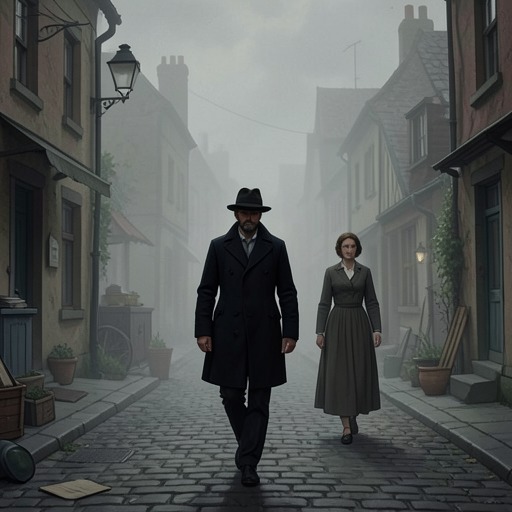
West Coast Times Office
The LuminariesThe West Coast Times Office on Weld Street is the newspaper’s practical and evidentiary hub: a small operation whose notices and reports carry information between Hokitika’s residents, politicians, and investigators. Under Benjamin Löwenthal, the office turns local events into public record, but its significance is not merely editorial. A decision about the space available for one advertisement helps preserve the name Crosbie Francis Wells, a clue that later complicates the story of identity and the missing crate.
Setting and newspaper operation
The office belonged to a young daily gazette. The West Coast Times was founded on 29 May 1865, about a month after Benjamin Löwenthal first arrived in New Zealand. Its initial print run was twenty copies: one for each of Hokitika’s eighteen hotels, one for the magistrate, and one for Löwenthal himself. The paper’s growth was reflected in the equipment kept at the office. A steam-powered press arrived on 1 July; within a month the print run had reached two hundred, and by January 1866 it was nearly a thousand copies per edition. Löwenthal had also hired two staff members.
The first edition remained on display behind glass in the front office, where Löwenthal saw it each morning. This preserved a precise reference point for the paper’s own history: he could date a visitor’s advertisement to June 1865 because it had been processed on the old hand-powered press, before the new machine arrived. The office thus served both as a place of production and as an informal archive, with its machinery, display, and daily routines giving Löwenthal a way to verify details months after an encounter.
Political news and local events
The newspaper’s pages became a stage for political publicity as Alistair Lauderback prepared to contest the Westland seat. Thomas Balfour arranged Lauderback’s lodgings and other preparations, and told the editor that the candidate would cross the alpine pass from Canterbury. He suggested that favorable coverage of the journey might recommend the paper to Lauderback’s future administration. The episode shows the office operating within the town’s political networks, where news and anticipated influence could be closely connected.
Lauderback’s arrival, however, generated attention for reasons he had not intended. On the journey he and his aides found a hermit, Crosbie Wells, dead in his cottage; on the outskirts of Hokitika they encountered a woman lying insensible in the road. A duty sergeant recorded Lauderback’s account, which appeared in the West Coast Times the next morning. During the following two weeks, the election received little notice by comparison: the paper devoted two columns to the dead hermit, while Lauderback’s journey was mentioned only briefly. Löwenthal later heard from Lauderback that Wells had died and inferred that the property might soon be sold, information he passed to Edgar Clinch. The newspaper’s reporting therefore helped set a chain of events in motion beyond its pages.
The missing-crate advertisement
In June 1865, a dark-haired man with a scar on his cheek entered Löwenthal’s small office on Weld Street to place an advertisement. He said that a shipping crate containing items of great personal value had been lost. He offered twenty pounds for its return, or fifty if it came back unopened. He did not give his name when asked; instead, he presented a birth certificate. Löwenthal copied the name Crosbie Francis Wells and recorded Gibson Quay as the address for anyone who found the crate.
The advertisement became memorable because of a printer’s constraint. Its text exceeded the space paid for by one word. If left unchanged, the final word, Wells, would have been stranded at the top of a third column, an awkward effect known in typesetting as a widow. After the man had left, Löwenthal removed the middle name Francis to make the notice fit. The man returned before noon the next day and insisted that Francis be restored, though he gave no reason. Löwenthal apologized, printed the corrected notice again, and ran it through the paid week, adding a further printing without charge.
A record with consequences
The office’s role in the mystery depends on the distinction between what a document records and what it proves. The advertisement and the birth certificate show that the scarred man used the name Crosbie Francis Wells and sought the crate at an address on Gibson Quay; they do not, by themselves, explain why he used that identity or how he obtained the certificate. Nearly eight months later, Löwenthal recalled the encounter in detail, drawing on the paper’s founding date, the change of presses, and the unusual typesetting problem. His memory helped establish the advertisement’s timing and exact wording, while leaving the larger questions unresolved.
In this way, the West Coast Times Office connects seemingly separate kinds of evidence: a political campaign, the report of a death, a property sale, and a reward notice. Its modest printing decisions acquire unusual weight. The newspaper records public events, but its working details—the old press, the framed first edition, and the single word that would not fit—also preserve the traces by which private identities can later be questioned.