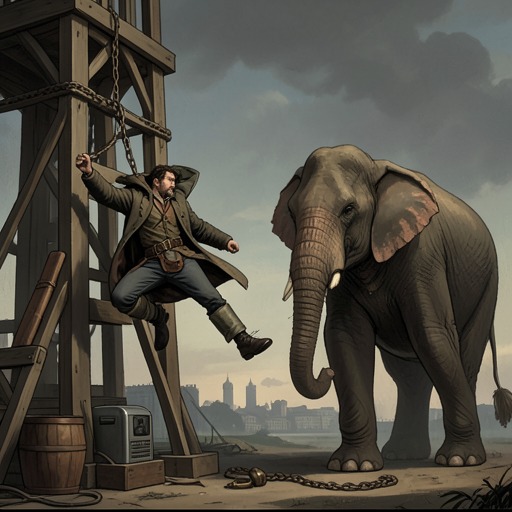
“What if Why not Could it be”
The Magician's Elephant“What if? Why not? Could it be?” is a recurring expression of possibility in the novel, most closely associated with Leo Matienne. It begins as the question of a man who enjoys imagining answers that may not exist, but it gathers force through repetition: spoken against grief, shared with Peter, and brought to bear on a magician who believes he has already failed. The refrain does not promise that every hope will be fulfilled. Instead, it challenges the assumption that the present arrangement of the world must be final.
Form and First Association
Leo has “the soul of a poet,” and the narration connects that disposition to his pleasure in considering questions without answers. He likes to ask “What if?” and “Why not?”; the fuller rhythm of “What if? Why not? Could it be?” is later described as the song of his “glowing, wondering heart.” The progression moves from imagining an alternative, through challenging the reasons against it, to wondering whether it might actually be possible. Its linked questions make uncertainty active rather than paralyzing.
That inward habit is given a quiet visual counterpart when Leo pauses at the top of a hill and watches a lamplighter bring the globes along the avenue to life one by one. He waits until the avenue is fully lit, then walks home whistling. The scene places his speculative temperament beside a gradual change that can be seen: darkness gives way lamp by lamp. The phrase belongs to this interval between what is and what might emerge, without claiming that thought alone makes the transformation happen.
Possibility Against Grief
The refrain becomes more painful when Leo uses it with Gloria Matienne. The couple’s repeated failures to have children have left Gloria unwilling to entertain another hope. She says that God does not intend them to have children and warns Leo that her heart has been broken too many times to bear his foolish questions. His response is not evidence that he can promise a child; it is a refusal to treat past disappointment as proof that the future has been settled. He whispers the first question, then persists with the others, while Gloria answers each attempt with a firm no.
This exchange establishes both the comfort and the risk in Leo’s expression. Possibility can keep despair from becoming certainty, but for someone repeatedly hurt, even asking may reopen the wound. Gloria’s resistance is not presented as a simple failure to understand him: she is guarding herself against another disappointment. Leo, meanwhile, will not be silenced by the pain that makes the questions difficult. The refrain holds those positions together without erasing their conflict.
An Unexpected Elephant and a Promise Heard Differently
The novel’s early scenes establish how thoroughly expectation has narrowed. While Peter Augustus Duchene waits at the fishmonger’s, he hears that no one expected anything special from the magician; the fishmonger adds that an elephant was not expected. At the word, Peter feels a shock and steps backward. The impossible arrival has already exceeded the ordinary limits of what people think they have reason to expect, giving Leo’s later questions a world in which the improbable has become concrete.
Adele’s recurring dreams of the elephant offer a related contrast between what is said and what a listener can accept. In the dream, the elephant comes to the Orphanage of the Sisters of Perpetual Light and tells Sister Marie that she has come to take Adele where she belongs. Sister Marie says she cannot understand the elephant and closes the door; Adele watches the elephant walk away. Yet the dream persists. Adele learns the elephant’s words verbatim and repeats the promise to herself during the day, treating it like a poem, blessing, or prayer. The scene does not use Leo’s refrain, but it sharpens its concern with possibility: a declaration dismissed by one hearer can remain vivid and meaningful to another. The closed door makes hope neither easy nor assured.
A Question Shared With Peter
When Leo later speaks with Peter and Gloria, the expression changes from Leo’s private habit into a shared exchange. Leo comes slowly forward, returns all four legs of his chair to the floor, and smiles as he asks his familiar question. A muffled thump from above interrupts them: Vilna Lutz is beating his wooden foot on the floor and demanding something. In that tense domestic setting, Peter keeps his eyes on Leo rather than looking up. He answers with the opening question, Leo replies with the next, and the two briefly make possibility a conversation rather than a solitary hope.
Gloria tells them that enough is enough. Leo rejects the limit: they must ask these questions as often as they dare, because the world cannot change if people do not question it. Gloria insists that the world is what it has always been. Leo answers softly that he will not believe this, pointing to Peter standing before them and asking them to make it something different. The phrase has thus acquired a practical stake. Peter’s presence is not proof that every desired change is possible; it is the immediate reason Leo gives for refusing to treat established conditions as unalterable.
The Question Put to Magic
Leo brings the same reasoning to the magician, who quietly says no and remains silent for a long moment. Leo clears his throat and asks the opening question. The magician recognizes it as belonging to magic, but Leo insists that it belongs equally to everyday life, then asks whether the magician might merely try. This moment connects the expression’s imaginative force to an actual decision: speculation matters because it can prompt someone to act again.
The magician’s refusal has a particular history. He says that he has already tried and failed to send the elephant back, and admits that he did not want to send her back because she was the finest magic he had performed. Leo does not deny either the failure or the magician’s attachment. He offers a different understanding of the task: returning the elephant to where she belongs would also be fine magic. The exchange reframes possibility without making it effortless. The refrain cannot undo a failed attempt or remove the cost of parting; it opens another way to understand what a renewed attempt could mean.
Across these scenes, the expression moves from the glow of Leo’s wondering heart into conversations shaped by grief, institutional dismissal, pressure, and failure. Its repetition makes it a verbal motif, but each return changes its immediate force: a private inclination becomes a marital disagreement, a bond with Peter, and an appeal to the magician. It is not a guarantee of an outcome. It is the insistence that uncertainty leaves room for choice, and that refusing to ask can make an existing hardship look permanent.