Baltese
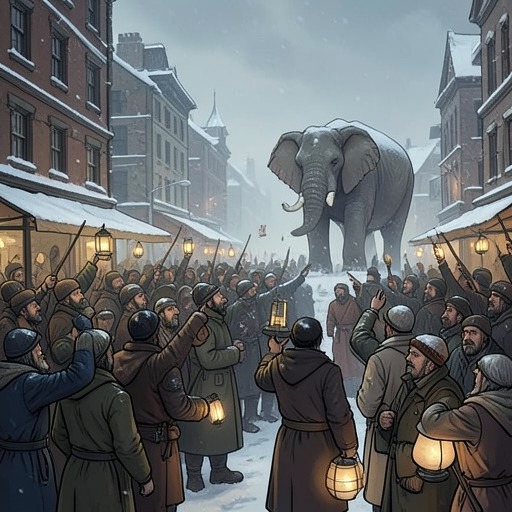
The Magician's ElephantBaltese is the city in which the elephant's sudden arrival turns an ordinary winter setting into a test of how people respond to what they cannot explain. Its public spaces carry the story from Peter Augustus Duchene's private hope, through a civic dispute over blame and ownership, to a lasting image of people connected across the city.
Setting and First Appearance
At the end of the century before last, Peter Augustus Duchene stands in Baltese Market Square with a hat on his head and a coin in his hand. His guardian, Vilna Lutz, has sent him to buy fish and bread. Around him are the ordinary stalls of fishmongers, cloth merchants, bakers, and silversmiths; into this familiar market appears a fortuneteller's red tent, promising answers for a florit. Baltese is established at once as a place where everyday errands and extraordinary possibilities meet.
The elephant's arrival makes that contrast civic rather than merely personal. The chief of police consults his handbook but finds no procedure for a beast that has appeared from nowhere, destroyed an opera-house roof, and crippled a noblewoman. The gap in the rulebook is a concrete measure of how far the event exceeds the city's ordinary categories: Baltese must decide what to do before it can even decide what kind of event has occurred.
Public Judgment and Responsibility
The police discussion in Baltese turns on whether the elephant should be treated as a criminal. One officer argues that because she has caused damage, she should be tried and punished; a small policeman, Leo Matienne, challenges the assumption that causing harm makes her morally guilty. He compares her to a rock thrown through a window and stresses that the elephant did not choose to crash through the roof. His argument separates the consequences of the accident from the elephant's intent, while the chief's request for practical solutions shows how little guidance the law offers.
After leaving the meeting, Leo walks home through the early-evening gloom, whistling a sad song and thinking about the elephant's fate. He believes the chief is asking the wrong questions: not simply how to manage her, but where she came from and what her arrival means for Baltese. The city thus becomes a place of competing interpretations. Official attention initially centers on punishment and procedure; Leo redirects it toward origin, meaning, and the animal's lack of choice.
Spectacle, Ownership, and Confinement
The inhabitants of Baltese become absorbed by the elephant. Talk of her spreads through the market square, ballrooms, stables, gaming houses, churches, and other squares. Even the city's food reflects the obsession: bakers make an oversized, cream-filled pastry dusted with cinnamon and sugar, call it an elephant ear, and find that people cannot get enough of it. The novelty is rapidly converted into both conversation and commerce.
The Countess Quintet's residence gives that fascination a more coercive form. Because the house has no door wide enough for an elephant, the countess hires twelve craftsmen, who work around the clock to knock down a wall and install an enormous painted and decorated entrance within a day. The elephant is brought there under cover of night, escorted by the chief of police. Once he leaves, the door is locked behind him, and the countess claims ownership. She has paid the opera-house owner enough to repair and retile the roof twelve times over, written to Madam LaVaughn in support of pursuing and punishing the magician, and made a generous contribution to the police fund. The city's response therefore moves beyond an unresolved legal question: compensation, influence, and a specially built doorway place the elephant in private hands. Installed in the ballroom, she draws a stream of visiting nobles, turning confinement into an elite spectacle.
Public Memory and Significance
Baltese's final image of the events is not the locked door but a carving high atop Baltese Cathedral. The Elephant Procession Carving in Baltese Cathedral shows a boy leading the elephant and carrying a girl, with one hand resting on the animal. Behind them are a magician, a policeman, a nun, a noblewoman, a manservant, a beggar, a dog, and, at the end, a small bent man. Each figure holds another; the line looks forward as though toward a bright light. The arrangement gives visual form to connection across differences of position and circumstance.
The account identifies Bartok Whynn with the truth preserved in the stone and suggests that a visitor who asks enough people in Baltese may find someone to lead them to the cathedral. The city is therefore more than the site of the elephant's arrival and confinement: its shared memory survives in a public monument that gathers the story's separated people into one linked procession.