Baltese’s winter gloom
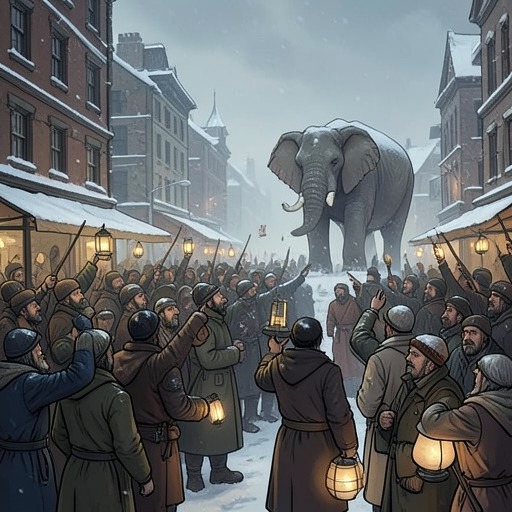
The Magician's ElephantBaltese’s winter gloom is the citywide season of oppressive cloud, cold, and darkness that accompanies the winter of the elephant. The weather seems to hold the city in suspension: daylight dwindles, the cold intensifies, and snow fails to come even as the city longs for some change. Its eventual arrival, falling across Baltese and settling over places touched by the story, gives the long gray interval a decisive turn without erasing the hardship that preceded it.
A City Held in Dusk
The winter is introduced as a defining condition of Baltese rather than as a passing spell of bad weather. Thick, lowering clouds obscure the sun and make the days resemble one unending dusk. The description makes the loss of daylight cumulative: instead of a sequence of distinct days, the city seems to inhabit a single stretch of dimness. The cold is described as unimaginably severe, while darkness is said to prevail. Together, these conditions make the winter feel comprehensive, reaching beyond temperature into the city’s sense of time and possibility.
The winter is associated with the elephant from the outset of its description: it is called the winter of the elephant. That association places the extraordinary animal’s arrival within the city’s ordinary physical world, but also gives the season the shape of a larger upheaval. The weather does not cause the elephant’s appearance; rather, the shared naming makes the elephant and the winter inseparable features of this period in Baltese. The gloom becomes the atmospheric setting for a story in which familiar rules and expectations are repeatedly unsettled.
Cold, Darkness, and the Withheld Snow
The weather does not remain static. As Peter thinks of his father, first in the garden and then bleeding on the battlefield, the cold worsens despite already seeming impossible to surpass. Darkness deepens as well. The paired intensifications make the season feel less like a stable background than a pressure that continues to build. The narration emphasizes that the expected snow still does not fall. Cold and darkness arrive without the change of scenery that snow might bring, leaving the city with worsening conditions but no visible transformation.
That absence matters in the account of Baltese’s collective mood. The city feels besieged, not by a foreign army but by the weather. The comparison gives the season the force of an adversary while distinguishing it from a human conflict: the threat is not an invading power but the atmosphere surrounding everyone. No one can remember a winter so uniformly gray. The language turns the city’s experience into something shared and nearly total, while the mention of collective memory conveys how exceptional the season appears to its inhabitants.
The narration’s questions about where the sun has gone and whether it will shine again lead to a smaller, more immediate longing: if the sun will not appear, could it at least snow? The wish does not deny the cold; it asks for a change within it. Snow might offer an event the unbroken gray has withheld. The movement from longing for sunshine to hoping for snowfall captures the narrowed expectations of a city that has begun to ask for any alteration at all.
The Gloom Around Adele
The winter’s effects are especially visible in the scenes surrounding Adele. In the cold, dark dormitory of the Orphanage of the Sisters of Perpetual Light, she continues to dream about the elephant. In the dream, the elephant comes to the orphanage door seeking Adele, but Sister Marie cannot understand her and closes the door. Adele watches the elephant walk away from a dormitory window. The scene places the child behind a barrier at the same time that the city is enclosed by weather: the dream’s shut door and the season’s persistent darkness reinforce one another without making them the same obstacle.
The dream recurs with such persistence that Adele learns the elephant’s words verbatim. She repeats a sentence about the elephant coming to keep her, saying it to herself during the day while peeling potatoes with Lisette in the orphanage kitchen. The repetition carries the dream out of sleep and into daily routine. Against the gloom, the remembered words supply Adele with a promise she can hold onto; the contrast is grounded in the difference between the cold, dark dormitory and the language that she keeps repeating within it.
The weather also frames a separate movement through the city. At the close of the long dark interval, Hans Ickman looks into the darkness and sees one snowflake, then another. He opens the door and calls the others inside because the snow has begun. The change is first registered as a small, visible occurrence, not as an abstract declaration that winter is over. From those first flakes, the narration widens its view to the whole city.
Snow Across Baltese
The snowfall reaches all of Baltese. It falls in darkened alleys and on the newly repaired tiles of the Bliffendorf Opera House; it settles on the prison turrets and the roof of Apartments Polonaise. At the Countess Quintet’s residence, it outlines the curve of the elephant door, the enormous entrance made for the elephant. At Baltese Cathedral, snow caps the gargoyles. These distinct landmarks make the change legible across the city: the snow touches repaired, confined, domestic, aristocratic, and religious spaces alike.
The details also connect the weather to earlier consequences of the elephant’s arrival. The opera-house roof has been repaired, and the elephant door at the countess’s home remains a conspicuous sign of the animal’s forced transfer there. Snow settles on both sites, covering neither their histories nor their differences, but bringing them into one citywide scene. At the orphanage, the snowfall forms a white curtain around the bleak building, as though trying to hide it from view. That image returns the weather to Adele’s setting while making the new snow visually distinct from the earlier, snowless gloom.
Narrative Significance
Baltese’s winter gloom works through contrast and delay. The skies obscure the sun, the cold becomes still more severe, and the city waits for snow that does not arrive. When it finally does, the change is registered through individual flakes and then through a catalogue of familiar places. The sequence gives the snowfall weight: it is not merely another description of winter but a marked change after an extended period in which even the weather seemed to offer no variation.
The winter also links private experience to the condition of the city. Adele’s repeated dream and the words she carries into the kitchen unfold within the same cold and darkness that make Baltese feel besieged. The eventual snow reaches the orphanage as well as the opera house, prison, apartments, countess’s home, and cathedral. In that pattern, the gloom establishes a common atmosphere across separated lives and settings; the snowfall makes that shared atmosphere visible changing. The text does not claim that the city’s troubles vanish with the flakes. Instead, the arrival of snow marks a shift from an oppressive, unbroken gray toward movement and renewed possibility.