Bartok Whynn
The Magician's ElephantBartok Whynn’s life is marked by a fall that changes both his body and his work: once a stonecutter who coaxed frightening gargoyles from stone, he becomes a bent, laughing man employed to clean up after the elephant in Countess Quintet’s ballroom. His story turns a past accident into a present vulnerability, then gives him a place in the group that leads the elephant away from captivity.
Identity and Background
Before he worked for Countess Quintet, Bartok was a stonecutter high atop Baltese Cathedral, where he carved gargoyles. His creations were each different and frightening, and each new one surpassed the last in horror. His craft depended on remaining at the stone with chisel in hand, bringing figures into being through patient work.
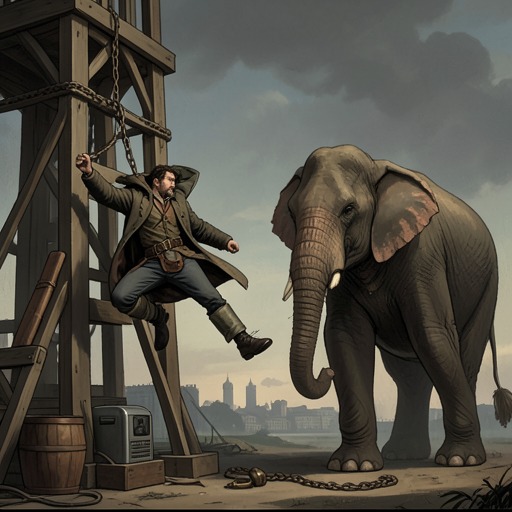
In late summer, before the winter when the elephant arrived in Baltese, Bartok lost his footing while carving what he had conceived as his most gruesome gargoyle. His fall from the cathedral was long enough for him to think he was going to die. Instead, his broken back healed in a crooked way, and he lived. The accident left him physically changed, but survival did not restore the life he had known before it.
Injury and the End of His Craft
Before the fall, Bartok stood five feet nine inches, was dour, and laughed at most once a fortnight. Afterward, he stood four feet eleven inches and laughed darkly and knowingly every day, even every hour, at everything and nothing. The account connects his altered body with a changed response to the world, without making that response a return to ordinary happiness.
Bartok tried to resume his former work. He went back to the cathedral, took up his chisel, and stood before the stone, but his laughter shook his hands and prevented him from carving. The stone remained untouched; the gargoyles did not appear. He was dismissed. The fall therefore cost him not only physical height but also the occupation through which he had expressed his skill.
A Post Behind the Elephant
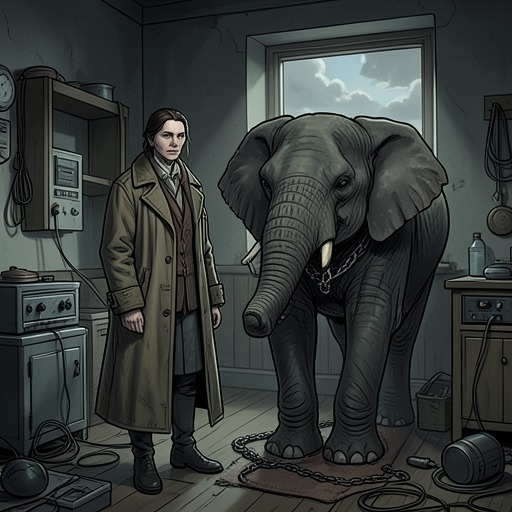
After the elephant came to belong to Countess Quintet, the countess found that keeping her in the ballroom created problems of cleanliness. She hired Bartok as a discreet attendant, whose task was to stand behind the elephant with a bucket and shovel. His back remained bent and twisted, making it nearly impossible for him to lift his face and look directly at anyone or anything; he saw the world sideways.
The position places Bartok at the rear of a spectacle attended by Baltese’s social elite and, on the first Saturday of each month, by a long line of people from across the city. His work is practical and deliberately unobtrusive: he is there to manage the mess created by an animal whom the countess keeps as property. The contrast with his earlier craft is sharp. The man who once shaped stone into individual, frightening figures now stands behind the elephant, assigned to a repetitive task that makes his labor almost invisible.
Fear and a Different Possibility
When the group prepares to take the elephant away, Bartok imagines the consequences of the countess discovering the escape. He fears that she will wake to find her elephant gone and hold him responsible. His laughter, usually constant, is caught up in that fear; when Leo Matienne asks what would happen if Bartok, too, were gone the next morning, the laughter disappears altogether. Leo’s question turns the danger from a sentence Bartok expects to face into a possibility of departure.
The suggestion does not erase the risk, but it changes the terms in which Bartok can imagine his future. Leo proposes that Bartok might be gone, like the elephant, to the place where he was meant to be. The exchange gives Bartok more than a reprieve from the countess’s authority: it offers belonging as an alternative to remaining behind, responsible for another being’s captivity.
Place in the Journey
Bartok joins the party moving through the snowy streets with the elephant. Peter Augustus Duchene walks in front of her carrying Adele; Leo Matienne walks beside him, while Bartok follows behind the elephant. His place in the procession reverses the arrangement at the ballroom: he is no longer stationed at her rear as a paid keeper, but travels with the people leading her home.
Bartok’s arc remains closely tied to bodily vulnerability, lost work, and the prospect of being left to answer for a powerful owner’s possession. Yet the group’s departure gives him a path out of that fixed position. The man who once fell from the cathedral and could no longer make figures from stone becomes part of a collective journey whose destination is described as the place each belongs.