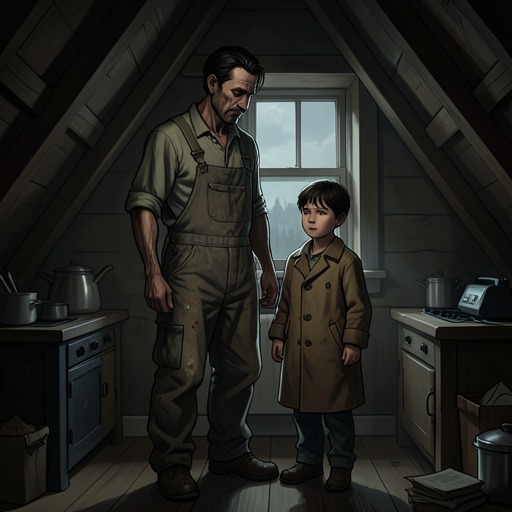
Peter confronts Vilna Lutz and learns the truth
The Magician's ElephantPeter confronts Vilna Lutz and learns the truth is a pivotal reckoning in which a supposed certainty about his sister’s death gives way to the possibility that she survived. Vilna admits he lied: the midwife took the infant away, and he had no knowledge of her eventual fate. The revelation changes Peter’s understanding of his past and ends his trust in the man who raised him.
Background and Stakes
The confrontation is driven by Peter’s new conviction that his sister lives. He tells Vilna that the fortuneteller said she was alive and that an elephant would lead him to her. The elephant’s sudden appearance, Peter says, has made him believe the fortuneteller rather than his guardian. His words turn the elephant from an astonishing event into evidence that the explanation he has been given about his family may be false.
The elephant’s arrival has already exposed how difficult Baltese finds it to assign responsibility for the impossible. The chief of police, committed to the letter of the law, searches the handbook without finding any guidance for a beast that has appeared from nowhere, destroyed an opera-house roof, and crippled a noblewoman. One officer proposes treating the elephant as a criminal; Leo Matienne challenges that conclusion, arguing that she did not choose to crash through the roof. The Countess Quintet later takes possession of her, after a special door is made for her and the police escort her into the countess’s home. Against this background, Peter’s trust in the elephant’s arrival is not a claim that the city has made sense of what happened. It is his refusal to treat the impossible as proof that his sister is dead.
The Disputed Past
Vilna first answers Peter’s demand to know where his sister is by repeating the account he has given him before: she is with their mother in heaven. He presents this as settled fact, not uncertainty. Peter counters with a memory of his own: he heard the baby cry and held her. Their disagreement is therefore not only over what happened to the infant; it is over whose account of Peter’s earliest experience deserves belief.
Vilna insists that the baby was stillborn and never drew breath. Peter maintains that she cried. The two accounts cannot be reconciled by Vilna’s repetition, and his explanation begins to fracture when Peter asks where she was taken. Vilna finally says he does not know: the midwife took the infant away, saying she was too small and too delicate to be placed in his care. The admission replaces the supposed certainty of death with an unresolved separation. Vilna did not witness the child’s death; he was left without her and without knowledge of what became of her.
Vilna’s Admission
Vilna resists calling his statement a lie, recasting it as scientific conjecture: babies without their mothers often would not live, and this one was exceptionally small. But that distinction does not restore the certainty he had imposed on Peter. He had repeatedly told Peter that his sister was dead when, as he now acknowledges, the midwife had taken her away and he did not know what happened afterward.
His confession also supplies his stated motive. Vilna says he lied to protect Peter from the pain of knowing, and explains that he cared for him and hoped he would become a soldier like his father, whom Vilna admired. He emphasizes the limits of his own capacity: he knew soldiering, not mothering, and the midwife had refused to entrust the infant to him. These circumstances explain why he was unable to keep the baby, but they do not undo the choice to tell Peter she was dead. His protective account of the lie is also an attempt to preserve the bond and the future he had imagined for Peter.
Consequences and Significance
For Peter, the disclosure destroys the authority of Vilna’s account. He says he cannot believe him any longer, and the broken trust extends beyond the question of his sister: Peter rejects soldiering as useless and pointless. The encounter thus turns a search for information into a separation from the role Vilna had prepared him to inhabit. Peter’s memory of the baby’s cry, once contradicted by the claim that she was stillborn, becomes a reason to keep searching rather than accept a death he never saw confirmed.
The scene does not establish where the sister is or prove that she survived. Its decisive revelation is narrower and more consequential: Vilna did not know that she had died, and he concealed that uncertainty by telling Peter she was dead. The elephant’s arrival gives Peter hope, but the confrontation gives that hope a newly exposed foundation—the possibility that the truth was never known by the person who claimed to know it.