Sisters of Perpetual Light Orphanage
The Magician's ElephantThe Sisters of Perpetual Light Orphanage is both Adele’s austere home and the threshold through which she moves from lonely expectation into reunion. Its front door, ordinarily governed by Sister Marie’s strict vigil, becomes the point where a dream of the elephant knocking gives way to Adele’s decision to answer in waking life.
Setting and Structure
Less than five streets from the Apartments Polonaise, the orphanage occupies a grim, dark building whose somewhat improbable name contrasts with its severe interior. On its top floor, a draughty, overlarge dormitory holds a line of small iron beds set side by side like metal soldiers. Adele occupies the last bed. The regimented arrangement makes the children’s shared sleeping space feel ordered and austere rather than intimate, while its exposed position and cold, dark stairs shape the scenes in which Adele moves between bed and door.
The orphanage’s front entrance has a specific guardian and rule. Sister Marie, known as the Sister of the Door, admits unwanted children and is the only person permitted to open and close the front door. Her place is a chair beside that entrance, where she keeps watch; the door is therefore not merely part of the building but a controlled boundary between the orphanage and the city outside.
Adele’s Dreams and the Knocking
Soon after the opera-house incident, Adele begins dreaming of the elephant. In these dreams, the elephant comes to the orphanage and knocks at its door, and Sister Marie answers. The elephant says she has come to collect the little person called Adele. The recurring image joins the orphanage’s defining threshold to Adele’s longing for connection, though the dream does not itself open the door or bring the elephant inside.
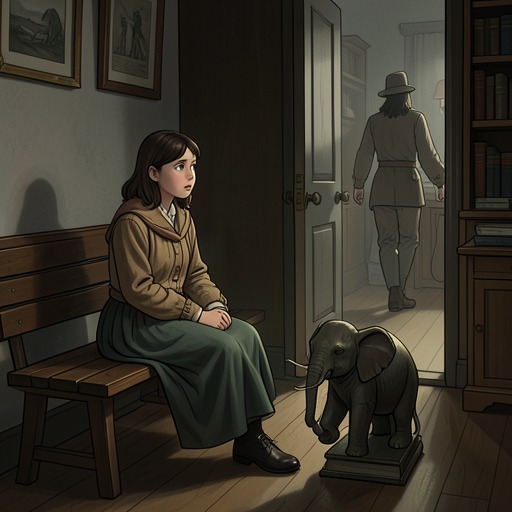
In a later dream, the pattern changes: Sister Marie is absent from her post, and no one answers the elephant’s repeated knocking. Adele wakes and tries to tell herself it was only a dream, but each time she closes her eyes she sees the unanswered knock again. She gets out of bed, crosses the cold, dark building, and goes downstairs to the front entrance. There she finds Sister Marie still in her chair, asleep, with her head bent forward and a small snoring sound coming from her mouth. The scene turns Adele’s anxious dream into a real encounter with the closed boundary she has been imagining.
The Door Opens
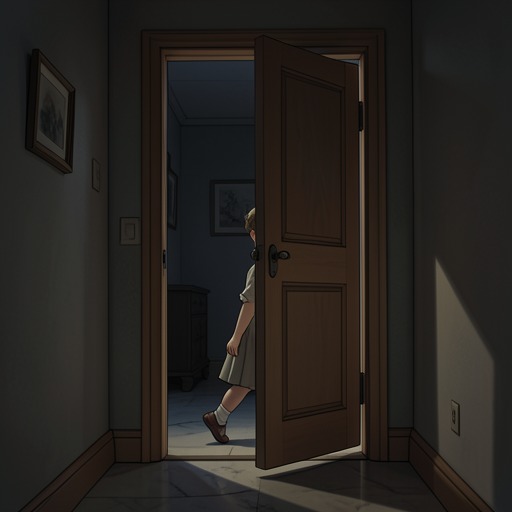
When Adele later sees the elephant moving through the snowy street with a boy and a larger company, she does not dismiss the sight as another dream. She turns from the window, runs barefoot down the dark stairway, crosses the great room and hallway, and passes the sleeping Sister Marie. At the front door, Adele throws it wide and calls out that she is there. The movement reverses the orphanage’s usual arrangement: instead of Sister Marie controlling who passes through, Adele opens the entrance herself and makes herself visible to the arriving party.
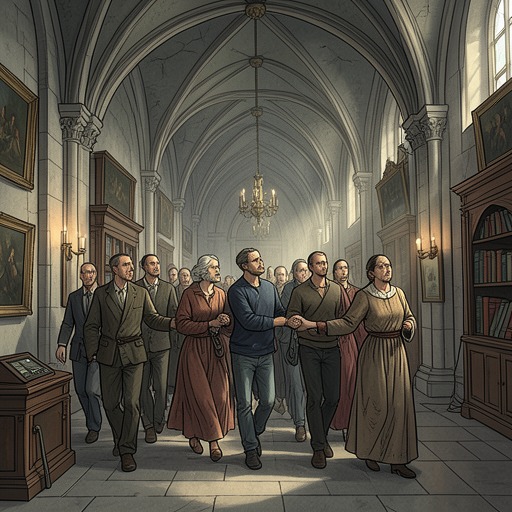
The black dog runs toward Adele through the snow, barking. The reunion that follows carries the company away from the orphanage: Peter Augustus Duchene carries Adele as they set out to take the elephant home, with Leo Matienne beside them and Sister Marie joining the procession. The route through the door thus leads not to the elephant’s imagined collection of Adele, but to Adele’s actual reunion with Peter and her departure with the group.
Change and Significance
Sister Marie’s departure gives the threshold a final change in meaning. She has guarded the orphanage’s entrance for fifty years, but for the first time she is no longer standing at the door: she leaves it to accompany the others. The building remains the place where Adele has slept and dreamed, yet its boundary no longer keeps her apart from the people and animal she has been waiting to meet.
The orphanage’s importance lies in the contrast between its fixed rules and the opening that finally interrupts them. Its iron beds, cold stairs, and guarded entrance establish a world of confinement and routine; Adele’s response to the knocking turns that same entrance into a passage toward family and collective movement. The door first belongs to Sister Marie’s duty, then to Adele’s choice, and finally is left behind as Sister Marie joins the journey outside.