The Matiennes’ childlessness
The Magician's ElephantThe Matiennes’ childlessness is a shared grief that has hardened into Gloria’s belief that they must accept a life without children, while Leo continues to question whether that conclusion is final. Their conversation makes the difference between them plain: he sees possibility in uncertainty; she hears another invitation to hope, and another chance for her heart to be broken.
A loss acknowledged by both
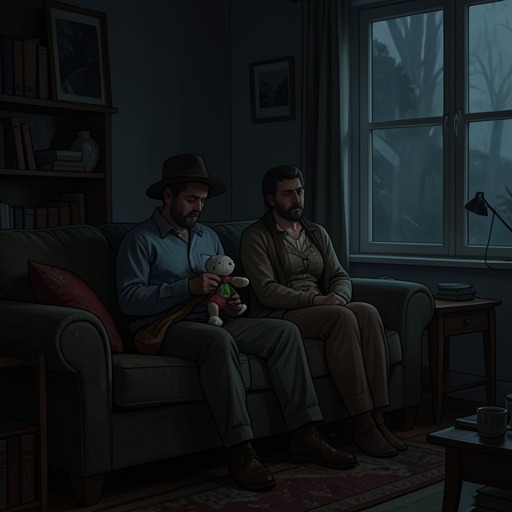
Leo and Gloria Matienne speak of their childlessness in a quiet exchange at home. Leo has just described the boy upstairs as having “a lot of love in his heart,” but also as having no one to love. The observation turns his attention to the couple themselves: “And we are all alone down here.” His words place their loneliness beside the boy’s, without suggesting that the two situations are identical.
Gloria immediately resists the direction Leo’s thought might take. She tells him not to say it, then gives the reason for her refusal: “We have tried and failed. God does not intend for us to have children.” The statement establishes that their hope has already been tested more than once and that, for Gloria, those failures have become evidence of a settled limit. Her appeal to God gives that limit the weight of an intention beyond their control, not merely a discouraging run of circumstances.
Different ways of living with disappointment
Leo does not deny that they have suffered disappointment. Instead, he disputes the certainty Gloria draws from it: “Who are we to say what God intends?” His question challenges the authority of their interpretation, not the reality of their past failures. The pause that follows matters: he remains silent for a long moment before asking, “What if?” His hesitation suggests care around a subject that is already painful, even as he chooses to raise it.
Gloria’s response reveals how costly that question feels to her. “My heart has been broken too many times,” she says, explaining that she cannot bear to hear his “foolish questions.” Her refusal is therefore not simply a rejection of Leo’s reasoning. It is also a boundary formed by repeated hurt: reopening the possibility of children could mean reopening the expectation that has preceded those disappointments. Where Leo treats uncertainty as a reason not to surrender hope, Gloria experiences it as a danger to an already wounded heart.
The repeated question
Leo persists, but softly. He whispers “What if?” and then asks “Why not?” and “Could it be?” Gloria answers each attempt with “No,” ending with the more complete insistence that “it cannot be.” The exchange moves in short repetitions rather than toward a settled argument. Leo’s questions widen the space of possibility one step at a time; Gloria’s repeated refusals try to close it again.
That structure makes the couple’s disagreement intimate rather than abstract. Neither is shown as indifferent to the other: Leo raises the possibility in a quiet voice, while Gloria names the emotional cost of hearing it. Yet the passage gives their positions unequal momentum. Gloria ends the exchange with a firm denial, but Leo has refused to be silenced; the question remains active even though she rejects it. The text does not establish what, if anything, will follow from his persistence.
The boy upstairs and the unresolved possibility
The scene’s immediate context gives Leo’s appeal a particular focus. He has been thinking about the boy upstairs, whom he describes as gentle and ill suited to soldiering, and about the lack of anyone for the boy to love. He then turns from the boy’s isolation to the couple’s own. This juxtaposition invites the possibility that their concern for him bears on their longing for children, but the exchange does not state a decision or make a promise about what they will do.
The conversation is followed by a scene at the Orphanage of the Sisters of Perpetual Light, where Adele wakes from a dream of an elephant knocking at a door that no one opens. That transition places the Matiennes’ private exchange near another image of loneliness and unanswered need, without making the dream a consequence of their childlessness. At this point, their grief remains unresolved: Gloria insists that children are not meant for them, Leo continues to ask whether that must be true, and the narration leaves the question open.