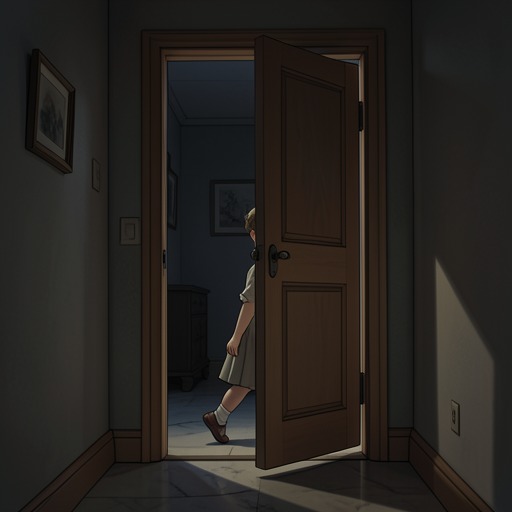
The Orphanage's Front-Door Rule
The Magician's ElephantThe Orphanage's Front-Door Rule is the apparent contradiction at the heart of the entrance to the Orphanage of the Sisters of Perpetual Light: Sister Marie alone is permitted to operate the door, but she maintains that it is never locked and that anyone seeking entry need only knock. First tested in Adele's dreams of the elephant, the rule ultimately becomes something Adele acts upon herself, turning a regulated threshold into an invitation she can answer.
Custody and Access
Sister Marie, known as the Sister of the Door, admits unwanted children to the orphanage and is described as the only person ever allowed to open and close its front door. The rule therefore assigns control of the threshold to a single caretaker. Yet its stated purpose is not to keep people out. When Adele wakes troubled by her dreams and finds Sister Marie at the entrance, the nun insists, “The door is forever unlocked. You must simply knock!” Access depends on making oneself heard and on the presence of someone willing to respond, rather than on a key or a formal test.
That distinction matters in a city where doors can enforce confinement. At the Countess Quintet's Residence, the purpose-built Elephant Door is locked after the elephant is installed inside; citizens who knock cannot get in, and some try unsuccessfully to open it themselves. The orphanage rule offers a pointed contrast: its door is presented as open to those who knock, even though the authority to open it remains with Sister Marie.
Adele's Dreams and the Rule's Test
Soon after the opera-house incident, Adele begins dreaming that the elephant comes to the orphanage and knocks. In one dream, the elephant asks Sister Marie for the little person called Adele. Adele later recounts another version in which Sister Marie opens the door but will not admit the elephant. Her dream makes the rule's promise uncertain: a knock may be heard without producing welcome, and the elephant's imagined arrival does not guarantee that the door will be opened for her.
Adele's account prompts Sister Marie to defend both her constant presence and her willingness to receive people. She says that she turns no one away, then explains her role in simpler terms: “I understand how to open a door.” The reply shifts the emphasis from the dream's imagined refusal to the act that defines her care. When Adele asks what she was like upon arriving at the orphanage, Sister Marie recalls that she was only a few hours old. She had opened the door for Adele, making the rule part of Adele's own history of being received.
From Rule to Welcome
The waking encounter also gives the rule a practical, intimate form. Adele finds Sister Marie asleep in her chair by the entrance and wakes her; the nun initially reacts as if a visitor has knocked, then recognizes that Adele is already inside. The exchange joins the rule's public instruction to the personal relationship between caretaker and child: Sister Marie's readiness to answer is what made the orphanage a place Adele could enter as a newborn.
At the story's later reunion, Adele sees the elephant approaching through the snow with the people accompanying her. She runs barefoot down the stairs, passes the sleeping Sister Marie, and throws the orphanage door wide, calling, “Here I am!” The moment carries the rule beyond its original allocation of authority. Sister Marie had been the only person permitted to open and close the door; now Adele performs the opening herself, answering the knock that her dreams had feared would go unheard. The black dog runs through the snow toward her, barking and circling, as the entrance becomes the site of a real reunion rather than an imagined one.
Narrative Significance
The rule makes a physical threshold carry the story's concern with separation and belonging. Its wording insists that the door is unlocked, but the dreams show that openness is not meaningful unless someone attends to the knock. Sister Marie's care gives that promise substance; Adele's final action makes her more than the recipient of it. The door's movement from guarded responsibility to an opening Adele chooses also contrasts with the locked Elephant Door, which keeps both the elephant and the city's would-be visitors apart. In this way, the rule is not merely an instruction about who may handle a door: it frames welcome as something that must be enacted.