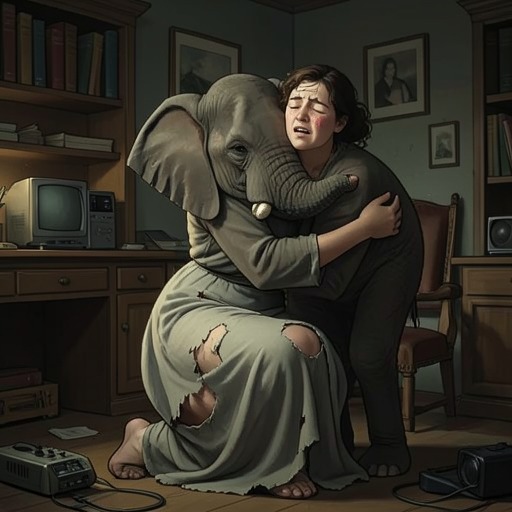
The elephant is rescued from the Countess’s home
The Magician's ElephantThe elephant is rescued from the Countess’s home when Peter, Leo Matienne, Hans Ickman, and Bettine LaVaughn go to Countess Quintet’s Residence, open its massive elephant door, and bring the captive animal into the snowy streets. The rescue reverses a chain of official judgment and private possession: the elephant had been treated first as a criminal and then as the countess’s property, although she never chose to crash through the roof of the Bliffendorf Opera House. Her removal begins not with force but with a knock, and leads toward the magician, the elephant’s return, and Peter’s reunion with Adele.
Causes and Legal Impasse
The predicament begins with an accident that leaves the Bliffendorf Opera House roof destroyed and a noblewoman crippled. The chief of police of Baltese believes firmly in the letter of the law, but repeated, increasingly flustered consultations of the police handbook yield no instructions for dealing with a beast that has appeared from nowhere and caused such damage. Lacking a rule to apply, he asks his subordinates what should be done with the elephant.
One policeman proposes treating her as a criminal, trying and punishing her. Leo Matienne challenges the premise rather than offering a different penalty. He asks whether a rock would be blamed if a magician threw it through a window, and argues that the elephant did not ask to come crashing through the opera-house roof. His distinction between causing harm and choosing to do harm exposes what the legal response cannot settle: the elephant is physically involved in the damage, but the evidence does not make her a willing offender. The chief, however, has asked for possible solutions, and the debate does not itself secure her freedom.
From Public Custody to Private Possession
The Countess Quintet turns the unresolved case into an opportunity to claim the elephant. Her home has no door wide enough for the animal, so she hires twelve craftsmen, who work around the clock. Within a day, they knock down a wall and install an enormous, brightly painted, handsomely decorated door. Under cover of night, the chief of police escorts the elephant through it; once he leaves, the door is locked behind him.
The countess pays the owner of the opera house enough to repair and retile the roof many times over, and the elephant becomes hers. She also writes to Bettine LaVaughn to express sorrow for the tragedy and offer support in pursuing and punishing the magician. A generous contribution to the police fund accompanies the countess’s hold over the elephant’s fate. The animal is installed in the ballroom, where titled visitors flock to see her. The custom-built entrance, initially a practical answer to the problem of moving an elephant indoors, becomes the conspicuous boundary of her confinement.
That confinement is made public on the first Saturday of each month, when Baltese turns out to view the elephant. The line stretches from the countess’s home down the hill, gathering people from many occupations and circumstances: candle makers and washerwomen, babies and old men, priests and fortunetellers. Each person carries hopes, wishes, desires for love, or wishes for revenge; many secretly expect the mere sight of the elephant to make those longings come true. The crowd’s expectation contrasts with the elephant’s actual condition. She is an object of public fascination, but the gathering does not release her or give her a voice in what will happen to her.
The Knock at the Elephant Door
The immediate cause of the rescue is the magician’s condition for trying to undo the spell. He tells Peter that the elephant must be present, because he cannot make her disappear without her there, and that Bettine LaVaughn must also be brought to him. Peter calls this impossible. The magician answers that magic begins and ends with the impossible. His response does not remove the practical obstacle; it makes the retrieval of both the elephant and the noblewoman the necessary first step.
Hans Ickman pushes Bettine LaVaughn’s wheelchair through the snowy streets, while Leo Matienne holds Peter’s hand. They travel quickly toward the countess’s home. Bettine finds the plan highly irregular, but Peter states its immediate purpose: they must retrieve the elephant and take her to the magician. At the residence, the four stand together before the massive, imposing elephant door. Leo says they will begin by knocking. When they knock and call out, deadbolts sound one after another from the other side. The door opens slowly, and a small, bent man steps outside, looks up at the falling snow, and laughs. The arrival of the group has turned the entrance built to keep the elephant inside into the threshold of her release.
The Elephant Joins the Journey
In the ballroom, the elephant opens her eyes and sees Peter standing before her. She is not surprised: she has expected him to come. The scene gives the rescue an intimacy that stands against the earlier crowds who came to look at her. For them, the elephant was a spectacle to which they brought private hopes; for Peter, her presence is bound to a promise to take her home.
Once outside, the elephant follows Peter through Baltese. Adele sees the procession from a dormitory window at the Orphanage of the Sisters of Perpetual Light: the elephant following a boy, with a policeman, a woman in a wheelchair, a bent man, a beggar, and a black dog. She trusts what she sees, runs downstairs barefoot, passes the sleeping Sister Marie, and throws open the orphanage door. The rescue has carried the elephant out of the countess’s house and into a public street where the sight of her leads directly to the siblings’ reunion.
The group continues together through the snow. Peter walks in front of the elephant, carrying Adele; Leo walks beside him. Behind the elephant, Hans pushes Bettine LaVaughn in her wheelchair, followed by Bartok Whynn, Tomas, and Iddo. Sister Marie brings up the rear, away from the orphanage door where she has stood for fifty years. Peter leads, and the warmth of the elephant’s breath on his cheek confirms the hope repeated in his mind: Adele lives. When the magician later walks away and they let him go, Bettine LaVaughn feels a great weight break free of her, laughs, and hugs Adele. The movement out of captivity thus begins as a practical retrieval but gathers people into a shared passage toward home, reunion, and release.
Significance
The rescue exposes the limits of the arrangements that have governed the elephant’s fate. The police cannot find a provision for her in their handbook; the proposed criminal charge mistakes an unwanted consequence for a chosen act; and the countess’s payment converts the case into ownership without addressing what the elephant needs. Against those forms of control, Leo’s appeal to knock starts with a request rather than a claim of force. The door that marks the countess’s possession is opened from within, and the captive animal herself follows Peter out.
The event also changes the scale of the story. The elephant first draws a city-wide viewing line, in which people wait with separate longings and hope to be transformed by looking. Her departure instead creates a moving company whose members travel together: a boy carrying his sister, a policeman, a disabled woman, the magician’s former visitor, a beggar, a blind man, and a nun who has left her customary post. The rescue does not simply remove the elephant from a room. It sets in motion the reunion and journey home that the spectacle of her captivity could only make the people of Baltese imagine.