The elephant’s captivity
The Magician's ElephantThe elephant’s captivity is the novel’s sustained contrast between public fascination and the captive animal’s own experience. After she appears through the roof of the Bliffendorf Opera House, authorities first treat her as a problem of law and order and then deliver her into private ownership. Her new surroundings attract the city, but do not make her less confined: the crowd’s attention and the Countess’s display of generosity do not answer the elephant’s longing for home.
From Accident to Police Custody
The elephant is imprisoned after the opera-house accident, even though she did not choose to appear there. Her confinement begins amid the confusion of officials who have no clear procedure for dealing with a beast that has appeared out of nowhere, damaged the opera house, and injured Bettine LaVaughn. The police chief consults the handbook repeatedly but finds no guidance for this extraordinary situation; unable to locate a rule, he asks his subordinates what should be done.
One policeman proposes that the elephant be treated as a criminal and punished. Leo Matienne challenges that conclusion by separating the cause of the damage from moral responsibility for it: if a magician threw a rock through a window, he argues, the rock would not be to blame. The elephant did not ask to crash through the roof, and Leo questions how she could be guilty of an event she did not will. The exchange exposes a basic injustice in her treatment: the authorities classify her by the consequences of the accident, although the evidence presented here gives no reason to regard her as having chosen it.
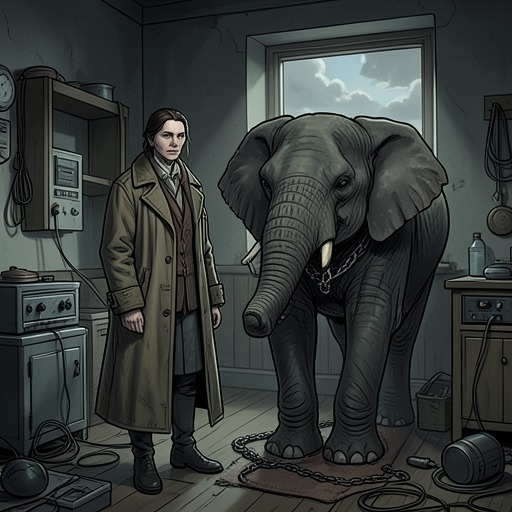
That argument does not prevent her imprisonment. She is locked in a stable, with a chain around her left ankle attached to an iron rod planted in the earth. Immediately afterward, she is dizzy and keeps her eyes closed, wanting the world to stop moving. The surrounding hubbub does not alter the material fact of her custody. Her first response is not to the city’s curiosity but to disorientation and the need for stillness.
Transfer into Private Ownership
The Countess’s acquisition changes who controls the elephant without ending her confinement. Because her residence has no door large enough for an elephant, Countess Quintet hires twelve craftsmen. They work around the clock, and within a day a wall has been knocked down and an enormous, decorated door installed. The architectural alteration is made expressly to admit the elephant: rather than find a place where she can move freely, the household reshapes itself to receive and keep her.
The elephant arrives under cover of night, escorted by the chief of police. He ushers her through the purpose-built entrance, tips his hat to the Countess, and leaves; the door is then shut and locked behind him. The Countess has paid the opera-house owner enough to repair and retile the roof twelve times over, and the elephant is described as belonging to her entirely. Compensation for the damaged property and custody of the animal thus run on separate tracks: the roof’s repair is financially covered, while the elephant’s fate rests with the Countess, who has also made a generous contribution to the police fund.
The move from a chained stable to the Countess’s ballroom may look like a change of setting, but the crucial relation remains ownership. The elephant is installed in a room designed for aristocratic gatherings, and the Countess’s guests come to see her. The newly constructed door, the locked entrance, and the ballroom together make the household’s priorities concrete: access is arranged for the owner and her visitors, not for the elephant’s return to her former life.
A Public Spectacle and a Private Distress
For the elephant, being admired is not the same as being welcomed. The citizens of Baltese may long to see her, but she does not long for them; finding herself in the Countess’s ballroom is a terrible turn in her circumstances. The room’s social bustle and lavish surroundings overwhelm her. She tries to shut out what is happening by closing her eyes, but when she opens them again nothing has changed. The contrast is stark: the city regards her presence as an extraordinary attraction, while she experiences the room as confinement and separation.
Countess Quintet presents public viewing as an act of social justice. After careful consultation with her advisers, she decides that people excluded from her private balls, dinners, and soirées may view the elephant for free on the first Saturday of each month. Posters and leaflets advertise the arrangement across the city. Leo Matienne reads one on his way home from the police station and responds with emphatic thanks to the Countess. The policy widens access to the spectacle, but it does not give the elephant control over her circumstances; the Countess still determines the terms on which others may see her.
On the first free viewing day, a line stretches from the Countess’s home down the hill, bringing together people from across Baltese: workers, families, older residents, priests, and fortunetellers, among others. The breadth of the crowd shows how thoroughly the elephant has captured the city’s imagination. Inside the ballroom, people file past her, and the episode describes them touching, leaning close, laughing, weeping, praying, and singing. Yet the elephant stands broken-hearted amid their attention, faced with things she does not understand and wondering where her mother and siblings are. Public access makes her visible to the city while leaving her own family and home beyond reach.
Longing, Dreams, and the Limits of Display
The elephant’s captivity also resonates with Adele’s life at the Orphanage of the Sisters of Perpetual Light. Soon after the opera-house incident, Adele begins dreaming that the elephant comes to the orphanage door to take her elsewhere. In the dream, the elephant says that Adele belongs somewhere besides the orphanage, but Sister Marie cannot understand her and closes the door. Adele watches the elephant walk away. This is a dream, not an actual visit or rescue; its importance lies in the form longing takes for a child who has lost her family.
The dream persists in Adele’s mind. She learns to repeat the elephant’s words and recites them during the day as though they were a poem, blessing, or prayer. An older girl, Lisette, tells her to stop moving her lips and insists that no one intends to come for them. The scene places Adele’s hope beside the elephant’s actual confinement: in the dream the elephant offers to take the child somewhere she belongs, while in the ballroom the elephant herself cannot reach her own family. Neither the Countess’s decorated entrance nor the monthly audience changes that separation. Captivity is therefore more than the physical fact of a chain or locked door; it is the condition that turns the elephant into something the city can visit while keeping her own desires and attachments out of its view.