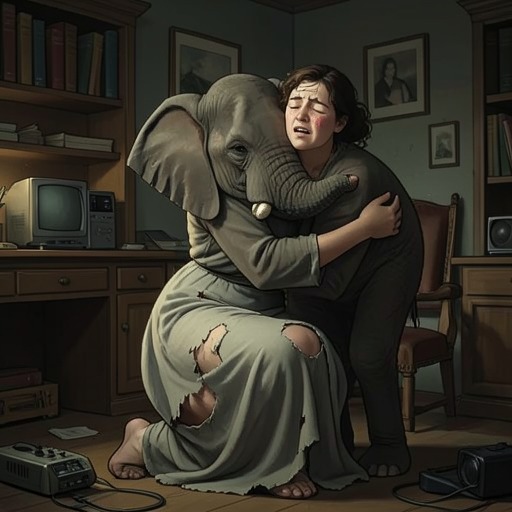
The magician conjures the elephant
The Magician's ElephantThe magician conjures the elephant is the accident that sets the novel’s central chain of consequences in motion: an attempted bouquet of lilies becomes an elephant falling through an opera-house roof. The spectacle injures Madam Bettine LaVaughn, imprisons the magician, and subjects the elephant herself to confinement. Its aftermath turns a magical mishap into a question of responsibility: who should answer for harm when the creature at its center did not choose to appear?
The failed conjuring
At the Bliffendorf Opera House, an aging magician of failing reputation performed what became the most astonishing magic of his career. He meant to conjure a bouquet of lilies for Madam Bettine LaVaughn. Instead, the elephant came crashing through the ceiling in a shower of plaster dust and roofing tiles, landing in LaVaughn’s lap. The reversal is both spectacular and brutally physical: a gift intended for a noblewoman arrives as a living animal falling from above, and the opera house’s architecture becomes part of the disaster.
The accident immediately gives the elephant’s appearance a human cost. LaVaughn’s legs were crushed, and she was thereafter confined to a wheelchair. She repeatedly returned to the circumstances of her injury, exclaiming with wonder that an elephant had crippled her by coming through the roof. Her account makes the improbable event impossible to dismiss as a mere rumor, but it also fixes the elephant in public memory as the instrument of LaVaughn’s suffering.
The magician had wanted to perform true magic, even though he had intended lilies. When the mayor, a duke, a princess, and the chief of police later commanded him to send the elephant away, he spoke the spell and its words backwards, as the magic required. Nothing happened. The elephant remained unmistakably present. His failure to reverse the conjuring both prolonged the crisis and left her presence as evidence that his power had been real, even if he could not control what it produced.
Responsibility, punishment, and custody
At LaVaughn’s behest, the magician was imprisoned. The elephant was imprisoned too, though her treatment took a different form: she was locked in a stable, with a chain around her left ankle attached to an iron rod driven into the earth. Disoriented after her arrival, she kept her eyes closed and avoided turning her head as the world seemed to spin. The restraints made a practical custody decision into a bodily fact; the animal who had appeared without warning was held in place while others decided what her appearance meant.
The city’s chief of police believed firmly in the letter of the law, but repeated consultations of the police handbook yielded no rule for a beast that had appeared from nowhere, destroyed an opera-house roof, and crippled a noblewoman. Unable to find a procedure, he asked his subordinates what should be done. One proposed waiting for the elephant to disappear; another declared that she was a criminal and should be tried and punished as one. The proposed solution converts an unexplained arrival into an accusation, without establishing that the elephant intended or chose any part of the damage.
Leo Matienne challenges that reasoning by separating the cause of the broken roof from the creature that passed through it. He asks whether a rock would be blamed if a magician threw it through a window, then applies the comparison to the elephant: she did not ask to come crashing through the opera-house roof, and a sensible elephant would not wish for such an arrival. His objection gives the incident an ethical dimension beyond its legal confusion. The elephant is present at the scene of harm, but presence alone does not establish culpability; nevertheless, she is among those confined while the authorities manage the consequences.
From police custody to private possession
The crisis eventually shifts from the stable to the Countess Quintet’s Residence. The countess wanted the elephant brought to her, but her home had no door large enough for the animal. She hired twelve craftsmen, who worked around the clock; within a day, they had knocked down a wall and installed an enormous, brightly painted, decorated door. The specially made entrance records the scale of the countess’s demand in the structure of the house itself.
Under cover of night, the chief of police escorted the elephant through the new door. Once he had ushered her inside, he tipped his hat to the countess and left, relieved to be done with the affair. The door was shut and locked behind him. The countess had paid the opera-house owner enough to repair and retile the roof a dozen times over, and the elephant was declared her property, lock, stock, and barrel. She also wrote to LaVaughn expressing sorrow over the tragedy and offering enthusiastic support for further prosecution and punishment of the magician. Compensation for the roof, sympathy for the injured woman, and influence over the elephant’s fate thus gather around the countess’s possession of the animal; the elephant herself remains the person whose custody is being transferred.
Installed in the ballroom, she drew dukes, duchesses, princes, princesses, counts, countesses, and other visitors around her. The change of setting did not undo the earlier confinement: she had been moved from a chained stable into a noble household, but was still treated as something held by someone else. The sequence makes ownership, rather than any resolution of the elephant’s wishes, the practical answer reached by the authorities and the countess.
The incident’s echoes
The story of the conjuring travels beyond the opera house. At a fishmonger’s stall, Peter Augustus Duchene overhears an account of the magician and hears that no one had expected anything special—least of all an elephant. The fishmonger’s telling makes the extraordinary event part of ordinary conversation, while Peter’s shock at hearing the impossible word from another person gives the rumor personal force. The incident has entered the city’s shared knowledge even as its meaning remains unsettled.
In the Orphanage of the Sisters of Perpetual Light, Adele begins dreaming of the magician’s elephant. In the dream, the elephant comes to the orphanage door seeking the child, but Sister Marie cannot understand her unusual speech and closes the door. Adele watches the elephant walk away. The dream does not change the legal or physical outcome of the opera-house accident, but it gives the elephant’s arrival a second, imagined direction: rather than an unwanted intrusion into a grand public building, she becomes a figure seeking someone who belongs elsewhere. Adele later repeats the elephant’s words to herself during the day, preserving the promise of being sought beyond the dream.
The event’s decisive reversal is therefore larger than lilies becoming an elephant. A magician’s intended display becomes injury and imprisonment; an animal’s unchosen arrival becomes a case about guilt, custody, and ownership; and a spectacular public accident continues into private stories and dreams. The elephant’s presence is undeniable, but the novel keeps asking whether the people who classify and confine her have understood what that presence means.