The relationship between Adele and Sister Marie
The Magician's ElephantThe relationship between Adele and Sister Marie is shaped by a guarded door that also becomes a threshold of welcome. Sister Marie is the nun responsible for admitting unwanted children to the Orphanage of the Sisters of Perpetual Light, and the only person permitted to open and close its front door. But her bond with Adele is more than a matter of duty: she welcomed Adele as a newborn, remembers the name her dying mother chose, and gives her a lasting account of being received into the world. In the story’s final movement, Sister Marie leaves her post to join Adele and the others, making visible how care can carry people beyond the places and roles that have defined them.
The Door and Adele’s Dreams
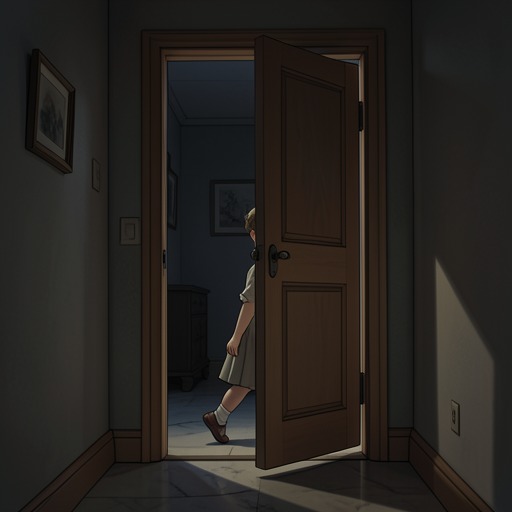
Soon after the elephant appears at the opera house, Adele begins dreaming that it comes to the orphanage and knocks. In these dreams Sister Marie answers the door. The image draws together two kinds of welcome: the elephant’s imagined arrival for Adele, and Sister Marie’s established role as the person who decides who may cross the orphanage’s threshold. Adele’s dream gives her a visitor who seems to know where she belongs, while Sister Marie occupies the position of the one who can admit that visitor.
When Adele dreams again, Sister Marie is absent from her post and no one answers the elephant’s repeated knock. Adele wakes, tries to tell herself it was only a dream, then goes downstairs through the cold and dark to check the front door. She finds Sister Marie asleep in her chair, still at the entrance, her head bent forward and her shoulders rising and falling. The scene reveals how much reassurance Adele draws from the nun’s familiar presence: the dream’s unanswered knock has brought her out of bed to verify that the guardian of the door is still there.
Adele wakes Sister Marie by putting a hand on her shoulder. Startled, the nun protests, “But the door is unlocked! The door is forever unlocked. You must simply knock!” Her words answer the immediate confusion, but the scene also turns the door’s rule into a form of care. Sister Marie does not need to understand the elephant for her role in Adele’s dream to matter. When Adele later recalls that Sister Marie had said she could not understand the elephant, the nun distinguishes understanding from welcome: “I understand how to open a door,” she says. “I did it for you.”
Adele’s Arrival and Her Name
That exchange leads Adele to ask what she was like when she first came to the orphanage. Sister Marie remembers her as “so small, like a mote of dust” and says she was only a few hours old. Adele had just been born. The account grounds their connection in a specific beginning: Sister Marie was present as the caretaker who received a child newly separated from her mother.
Sister Marie also explains that Adele’s mother had insisted on the name before she died. The midwife conveyed it, and Sister Marie spoke the name to the baby. Adele remembers, or imagines herself through the story, that she smiled when she heard it. Sister Marie confirms that afterward “it seemed that there was light everywhere. The world was filled with light.” Her recollection gives Adele an origin story in which her name was chosen by her mother and carried to her by the person who opened the orphanage door. The telling does not erase Adele’s loss, but it gives her concrete evidence that she was named and welcomed.
Adele asks whether Sister Marie was glad she came, although she already knows the answer. The need to ask, and Sister Marie’s willingness to answer, show their intimacy without requiring a formal label for it. Sister Marie can tell Adele what she was like as a baby, where her name came from, and how her first response seemed to brighten the world. In turn, Adele listens closely and asks whether elephants have names. Sister Marie answers that all of God’s creatures have names, linking her assurance about Adele’s identity to her conviction that the elephant, too, is a named creature.
Care Beyond the Orphanage
The relationship takes place within a wider story of people answering vulnerability with practical care. When Peter reaches Leo and Gloria Matienne, Gloria insists that he come inside and puts stew in his hands; Leo tells him that they will do together what needs to be done. Their welcome gives Adele’s story a broader context: care in the novel is expressed through actions such as opening a door, feeding a hungry child, and remaining beside someone who needs help. Sister Marie’s care is especially associated with the threshold, but it is not confined to keeping others out; she once opened the door for Adele, and her familiar presence is what Adele seeks after the frightening dream.
That pattern widens at the end. When the elephant stands in the snow, Adele remembers her and asks her brother whether she must be cold and where they are taking her. Peter answers that they are taking her home. Adele’s concern brings the elephant’s needs into the family’s immediate plans, and Sister Marie joins the procession that accompanies the elephant. She walks at its very end, away from the orphanage door where she has remained for fifty years. The departure changes the meaning of her post: the guardian who once made welcome possible by staying at the entrance now participates in a shared act of care beyond it.
Significance of Their Bond
Sister Marie’s relationship with Adele joins protection to recognition. She is the orphanage’s appointed keeper of the door, but her most personal importance to Adele lies in remembering the infant who arrived there, preserving the name her mother chose, and telling her that her arrival brought light. The dreams of the elephant make the doorway a place of longing and uncertainty; Adele’s waking visit restores the familiar figure at her post, while their conversation turns that reassurance into knowledge of her own beginnings.
The ending does not show Sister Marie ceasing to care for Adele. Instead, it places their bond within a larger circle: Adele can leave the orphanage with her brother, and Sister Marie can leave the doorway to walk with the others. Her first absence from the post in fifty years is a concrete change in her established role, and a quiet measure of how far the story’s community of care has expanded. The door remains central to their history, but it no longer marks the limit of where their care can reach.