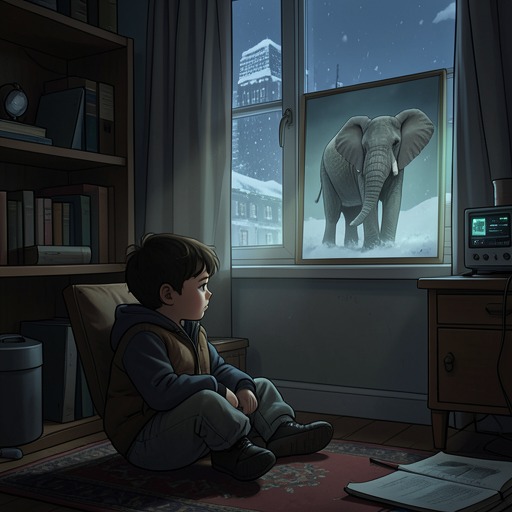
Tomas
The Magician's ElephantTomas is a beggar whose life at the edge of Baltese is marked by poverty and an unknown past, but whose ability to make songs from everyday hardship sustains a vision of a better world. With Iddo beside him, he becomes part of the unlikely company that accompanies the elephant and Adele through the snowy streets.
Identity and Background
Tomas sits in a narrow alley outside the Orphanage of the Sisters of Perpetual Light, close to a large black dog who huddles against him for warmth. He does not know whether he ever had a surname, or whether he had a mother or father. He knows only that he is a beggar, and that he can stretch out his hand and ask.
The dog is named Iddo. Their closeness is practical as well as affectionate: in the cold, Tomas keeps his hand on Iddo’s head while the dog whimpers. The brief gesture places their companionship within the same precarious conditions they share in the alley.
Song and Iddo
Tomas’s defining gift is singing. He cannot explain how he came to know how, but he can make a song from the apparent nothing of daily life and sing it into something beautiful enough to sustain a vision of a whole and better world. His art does not erase his circumstances; it gives them another shape.
That gift emerges in his response to Iddo’s distress. Tomas sings to soothe the dog, joining the falling darkness to the hope that a boy will see the elephant and calling that prospect wonderful news. The song transforms comfort into expectation: it offers Iddo reassurance while also voicing a hope that belongs to the wider story.
Place in the Story’s Hope
Tomas’s alley lies outside the orphanage where Adele dreams persistently of the elephant. In those dreams, the elephant comes to the orphanage door seeking Adele, but Sister Marie cannot understand her and closes the door. Tomas’s song imagines a boy’s desire to see the elephant as something that will be fulfilled, setting his hopeful voice against the barriers and disbelief surrounding the children’s lives.
The story also places Tomas’s private song beside the city’s shared longing. On the first Saturday of the month, people from across Baltese queue to see the elephant, bringing hopes, dreams, desires for love, and wishes for revenge; many secretly expect that seeing her might somehow make those wishes come true. Tomas’s song is not presented as a guarantee that every longing will be granted. Instead, it gives hope a modest, human scale: a hand on a dog’s head, a melody made from daily life, and the possibility that a boy’s wish may come to pass.
The Journey Toward Home
When the group sets out through the snowy streets, Tomas joins them with Iddo at his heels. He walks behind Bartok Whynn, among people whose ordinary positions have brought them into a common undertaking: Peter carries Adele and leads the elephant, Leo Matienne walks beside him, and Hans Ickman pushes Madam LaVaughn’s wheelchair. Sister Marie, who has guarded the orphanage door for fifty years, comes at the very end of the procession.
Tomas’s place in this company is significant without making him its leader. The beggar from the alley and the dog who shared his cold are no longer confined to the margins of the scene; they travel with the others as the elephant is taken home. His earlier song had anticipated the boy’s desire to see her, and the journey brings that desire into view alongside Adele’s return to her brother. Tomas’s movement from a solitary alley to this collective passage gives concrete form to the hope his singing had sustained.