Vilna Lutz's Code for Soldiers
The Magician's ElephantVilna Lutz's Code for Soldiers is the military discipline that Vilna Lutz enforces on Peter Augustus Duchene through commands to control emotion, practise manoeuvres, and march with purpose. It begins as a way of ordering Peter's grief around the model of his dead father, but Peter's resistance exposes the code's limits: where it demands movement and obedience, the story's eventual answer to vulnerability is attentive care.
Identity and Principles
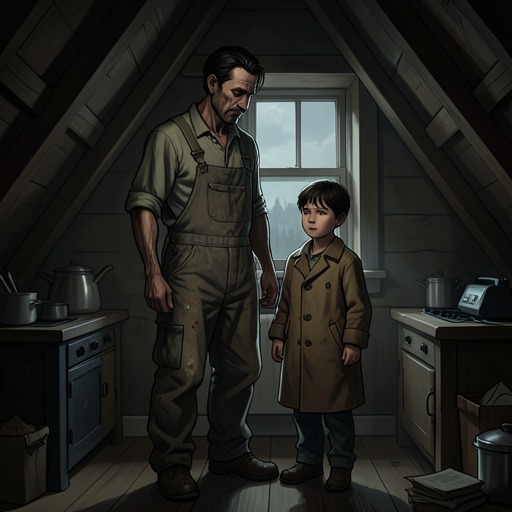
The code is not presented as a written charter but as Vilna Lutz's repeated instructions and ideals. Its clearest rule is that a soldier should not weep. When Peter denies that he is crying, then discovers his cheek is wet, Vilna Lutz treats the tears as a disturbance in the moral order: “Soldiers do not weep; at least, they should not weep. It is not to be borne, the weeping of soldiers. Something is amiss in the universe when a soldier cries. Hark! Do you hear the rattle of muskets?” The imagined muskets turn grief into a summons to military readiness; sorrow is not met with comfort but interpreted as evidence that the world has gone wrong.
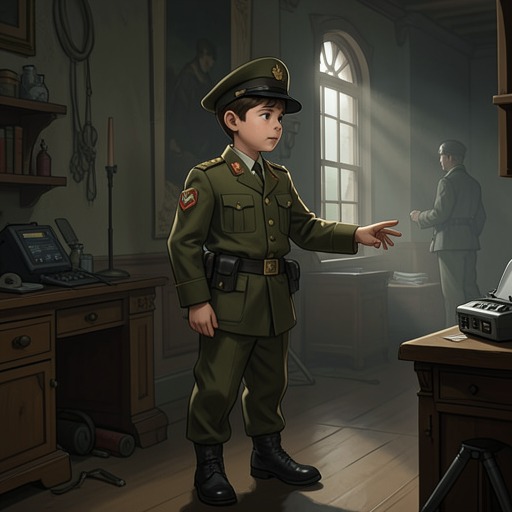
The code also insists that armies move and soldiers march. Vilna Lutz orders Peter to practise manoeuvres even when it is cold, then sharpens a general instruction into a personal command. When Peter remains still, Vilna Lutz tells him to march higher and with purpose, measuring him against his father's example. The code thus binds obedience to inheritance: Peter is expected not only to perform a soldier's motions but to reproduce the bearing of the father he has lost.
Peter's Resistance
The marching scene makes the difference between outward compliance and inward conviction visible. Peter lifts one foot and then the other, but his heart feels too heavy for movement; he marches in place rather than advancing. While Vilna Lutz treats marching as necessary action, Peter privately doubts that the elephant can answer the fortune-teller's prediction that his sister lives. His despair turns the exercise into an image of effort without hope: the body follows orders while the mind rejects the possibility that there is a reason to go forward.
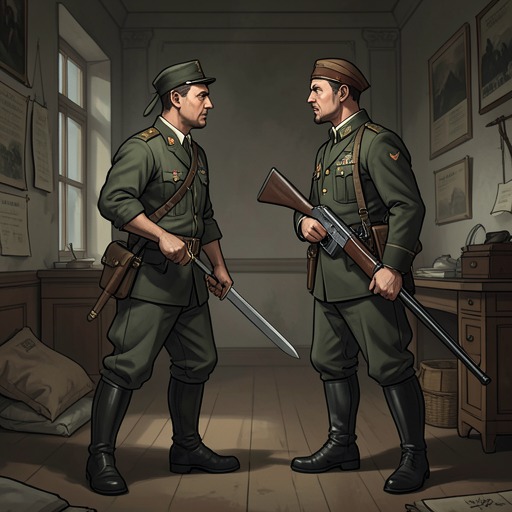
The code's appeal to Peter's father becomes especially charged when Vilna Lutz demonstrates a flanking manoeuvre with toy soldiers. He calls the strategy brilliant, praises its grace and bravery, and demands Peter's undivided attention because he is speaking of Peter's father's work. Vilna Lutz strikes the floor with his wooden foot as he insists on the lesson's importance. Peter, however, sees not an abstract military achievement but his father in a muddy field, wounded by a bayonet and dying. The same inheritance that Vilna Lutz presents as a model of masculine discipline summons Peter's memory of war's bodily cost.
Peter finally states the opposition directly. Asked what he sees in the toy-soldier arrangement, he says that he wishes it could be undone, then clarifies his meaning: “No wars. No soldiers.” Vilna Lutz stares at him, but Peter's words mark more than refusal of a particular lesson. They challenge the assumption that military action is intrinsically admirable, and redirect the scene from the arrangement of troops toward the possibility of preventing the suffering that gives such arrangements their purpose.
Discipline and Care
The later scenes around Peter provide a sharp counterpoint to the code's treatment of emotion and need. When Gloria Matienne sees how thinly Peter has been living on bread and tiny fish, she insists that he come inside. Leo Matienne welcomes him in, and Gloria puts a bowl of stew into his hands. Peter's tears return as he eats; Leo answers not with a demand for composure but by reassuring him that they will do together whatever must be done, while urging him to finish his food. The contrast is practical as well as emotional: military discipline commands Peter's body to march, while the Matiennes notice that he is hungry and feed him.
The invitation to shelter becomes a form of protection. After Leo Matienne and Gloria Matienne decide that it is time to go to the prison, Gloria turns to Peter and embraces him. He stands as if awaiting a soldier's inspection and is unprepared for the embrace; held close, he begins to cry again. The scene reverses the code's prohibition without arguing against Peter's courage. His tears are neither a failure to perform nor a disruption to be corrected; they are part of receiving the care he has lacked.
From Orders to Collective Action
The code's military language belongs to a wider contrast between isolated people and a community learning to act together. On the first Saturday of each month, residents of Baltese gather in a long line to see the elephant. The crowd includes people across occupations and ages, and each carries private hopes, wishes, or desires; many quietly expect that seeing the elephant might somehow fulfil them. This collective expectation does not itself amount to the disciplined marching Vilna Lutz teaches. It does, however, place many separate longings in one shared public space.
Later, the journey toward the Countess Quintet's home turns concern into coordinated action. Bettine LaVaughn travels in her wheelchair with Hans Ickman pushing, while Leo Matienne holds Peter's hand. Once Adele is with Peter, she remembers the elephant and worries that she must be cold. Peter answers that they are taking her home. He leads with Adele in his arms, Leo walks beside him, and the others follow: Bettine LaVaughn and Hans Ickman, Bartok Whynn, Tomas with Iddo at his heels, and Sister Marie, away from her accustomed place at the orphanage door. Unlike the exercises imposed on Peter, this movement has a shared purpose shaped by attention to another's need.
The code's significance lies in this change of emphasis. Vilna Lutz's commands make marching, emotional restraint, and a soldierly inheritance the measures of conduct; Peter's experience tests those measures against grief, hunger, and the wish to undo war. By the time the group moves through the snow to bring the elephant home, protection is no longer expressed as an order to endure alone. It is enacted through joined hands, food, shelter, an embrace, and a procession in which people who had been separated by their private circumstances travel together.