Andrew Ketterley
The Magician's NephewAndrew Ketterley is Digory’s uncle and an amateur magician whose experiments with enchanted rings draw children into journeys between worlds. His history links secret study and reckless exploitation to a later, imperfect change: he gives up magic and becomes kinder in old age, but retains a fondness for telling visitors about Jadis as though their encounter were a grand social adventure.
Identity and the Secret Study
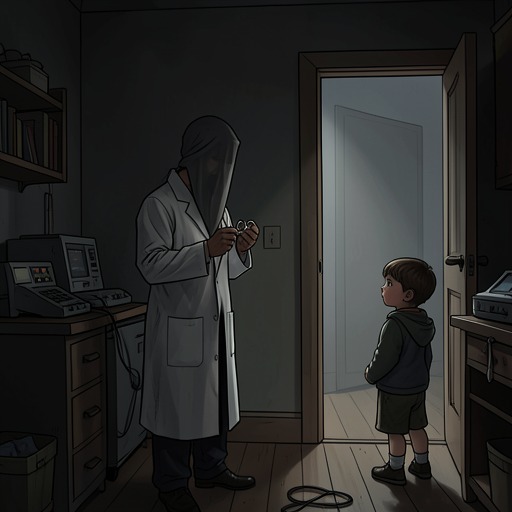
Before Digory understands what is happening in the attic, he suspects that Andrew is either mad or concealing a mystery. Andrew keeps a study on the top floor that Digory is forbidden to enter, and at meals Digory’s aunt repeatedly interrupts Andrew whenever he tries to speak to the boy. Digory also recalls hearing a yell near the attic stairs the previous night. The household’s efforts to keep Andrew’s business from Digory therefore make the forbidden room a focus of both secrecy and apprehension.
The children discover the truth when they mistakenly enter the wrong house: they are in Digory’s home, inside Andrew’s study. Andrew rises from a high-backed chair, shuts the door, and locks it, turning their accidental arrival into a confrontation in a closed room. His striking appearance—tall and thin, with bright eyes and untidy grey hair—makes an already alarming encounter more imposing. For Digory, the room’s danger has been anticipated in fragments: the forbidden upstairs space, Andrew’s interrupted explanations, and the unexplained yell now converge around the man himself.
The Box and Andrew’s Self-Justification
Andrew explains that he knew Digory’s mother’s acquaintance, Mrs. Lefay, who had been allowed out before her death. In her last illness, she permitted only a few people, including Andrew, to visit. Shortly before she died, she told him to retrieve a small box from a secret drawer in an old bureau. When he picked it up, he felt that it held a great secret. Mrs. Lefay gave it to him on the condition that, after her death, he burn it unopened with specified ceremonies. Andrew admits that he broke this promise.
Digory calls the breach wrong. Andrew initially treats the judgment as a childish rule: promises, he argues, may bind boys and ordinary people, but not exceptional scholars who possess hidden wisdom. He describes such men as cut off from ordinary pleasures and exempt from common restraints, casting himself as a figure of solitary greatness. The speech reveals more than pride. Andrew’s sense of intellectual distinction supplies a rationale for treating other people as instruments and ordinary obligations as beneath him.
The Rings and the Children’s Peril
Andrew refuses to test his experiment on himself. When Digory challenges him for sending Polly somewhere he is afraid to go, Andrew asserts his authority as scholar, magician, and experimenter, and compares the children to guinea pigs whose permission need not be sought. He claims that knowledge requires sacrifice, but makes clear that he expects others to bear the risk: if he were killed, he says, his life’s work would be lost. His conduct thus turns his grand language about wisdom into a practical hierarchy in which his safety matters more than the children’s consent.
He nevertheless explains a procedure for returning. Andrew says that the green rings will bring the children back, and demonstrates that the rings work only through contact with skin: gloves allow him to handle them without disappearing, and a ring kept in a pocket is harmless unless touched. He places two green rings in Digory’s right-hand pocket, using the mnemonic that the first letters of “Green” and “right” match, and directs him to put on a yellow ring for the outward journey. Andrew presents these instructions with confidence, but his confidence exceeds his knowledge.
The distinction he draws between the rings proves mistaken. The yellow rings draw their wearers into the Wood between the Worlds because their material is trying to return to its own place; the green rings carry a wearer out of the Wood and into a world because their material is trying to leave it. Andrew does not know about the Wood and misunderstands what the rings do. Digory also does not grasp the full explanation immediately. The children’s experience consequently exposes the gap between Andrew’s experimental claims and the workings of the materials he has handled: his method is not the reliable system he thinks he has devised.
Jadis and the Limits of Andrew’s Authority
When Jadis appears, Andrew’s standing as a magician does not protect him. She asks where the magician is, and Andrew identifies himself while trying to excuse the children’s presence. Jadis recognizes him as a magician “of a sort,” but treats him as a subordinate rather than an equal. Her examination of his face recalls her scrutiny of Digory in the palace of Charn; Andrew, meanwhile, stammers that the Ketterleys are an old Dorsetshire family, an appeal to ancestry that does not establish the royal blood she doubts he possesses.
This encounter sharply reverses Andrew’s preferred picture of himself. In his study he invokes hidden wisdom and a lofty destiny to place himself beyond common rules; before Jadis, his claims do not command respect. His fascination with power has brought him into proximity with a figure who can recognize his limited magic and disregard his pretensions. The contrast makes his self-image look less like genuine mastery than a defense of his right to experiment without accepting comparable risks.
Narnia, Consequences, and Later Life
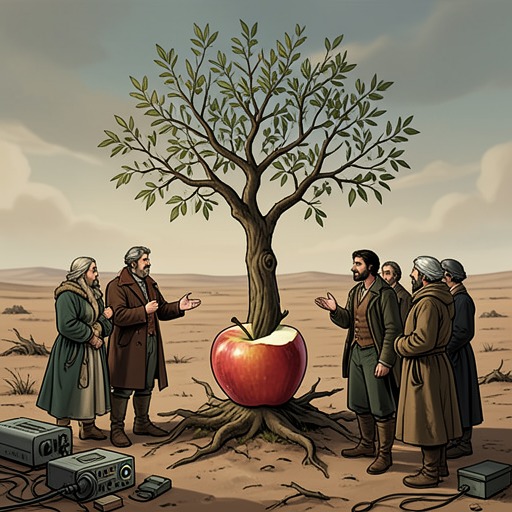
In Narnia, Andrew interprets the world through the prospect of profit. When he sees the lamp-post growing from the ground, Digory identifies it as the iron bar Jadis tore from a lamp-post at home: the bar fell to earth and is now rising as a young lamp-post. Andrew instead imagines a commercial scheme. He supposes that buried scrap iron could grow into railway engines or battleships, which he could sell in England, and considers turning the country into a health resort. His response makes the contrast plain: where Digory recognizes the history of a particular object in a new world, Andrew immediately turns its transformation into a business opportunity. He even ends his speculation by proposing that the perceived obstacle be shot.
The book’s ending gives Andrew a modest but real change. When Digory and his family move to their country house, they take Andrew with them, partly so that he will not be left for Digory’s aunt to manage alone. Andrew never attempts magic again. In old age he becomes nicer and less selfish than he had been, suggesting that he has learned from the consequences of his experiments, although the account does not describe this change as a complete moral transformation.
His remaining habit preserves the tension between improvement and self-dramatization. Andrew likes to draw visitors aside in the billiard room and tell them about a mysterious foreign royal lady with whom he once drove around London. He remembers Jadis chiefly as a woman with a formidable temper and as a striking companion. The story closes his arc not with restored magical authority but with an anecdote: the former experimenter has stopped meddling with magic, yet still reshapes a dangerous encounter into a tale that flatters his own importance.
Narrative Role
Andrew’s story binds the rings’ material workings to the consequences of incomplete knowledge. He possesses objects capable of crossing worlds, but neither his theory nor his ambition amounts to understanding them. The rings’ true operation, the growing lamp-post, and his schemes for converting Narnian growth into English wealth each expose the same limitation: he sees power and opportunity while overlooking the conditions, histories, and responsibilities attached to what he uses.
His treatment of the children makes that limitation ethical as well as intellectual. Andrew calls them experimental subjects and reserves danger for them while protecting himself; later events repeatedly place his confidence beside a reality he cannot control. His eventual renunciation of magic is therefore significant without erasing his earlier conduct. He becomes less selfish, but the billiard-room stories show that a taste for vanity survives after the experiments end.