Apple of Life
The Magician's NephewThe Apple of Life is the fruit that links Aslan’s garden to Digory’s home: given in response to his grief, it heals his mother, and its core takes root in England, preserving a trace of Narnia that will later enter the history of the wardrobe. The apple’s power is not simply a matter of what the fruit can do. The contrast between Digory’s gift and Jadis’s theft makes the manner of its use part of its consequence: one fruit grants life on terms that become misery, while another brings healing and joy.
The fruit and the terms of its power
The apple grows in Aslan’s garden from the tree Digory has been sent to plant in Narnia. Aslan explains that the fruit is good, but that taking it at the wrong time and in the wrong way changes the eater’s relation to it. Jadis has already eaten an apple of the same kind after stealing it; she gains unwearying strength and endless days, yet the remaining fruit becomes a horror to her. Her choice achieves her heart’s desire, but turns its source into something she loathes. The apple therefore distinguishes between possessing power and receiving a gift rightly: its effects follow its nature, but do not guarantee happiness.
Aslan makes the difference explicit when Digory is grieving for his mother. A stolen apple could have healed her, but the outcome would not have brought joy to either of them; in time, both would have thought it better if she had died of her illness. What Aslan gives Digory, by contrast, will heal without granting endless life in the human world. The distinction is not between a magical and a powerless fruit, but between taking it for oneself and accepting it as a gift. The apple’s healing is real, while its limits are also part of the mercy Aslan offers.
From Aslan’s garden to Digory’s mother
After Aslan tells him to pluck an apple, Digory crosses the garden, takes one from the tree, puts it in his pocket, and returns. The moment overturns his expectation: he had given up hope of saving his mother, and now receives a remedy on terms different from the forbidden, stolen fruit he had feared might be the only answer. He asks to go home, having forgotten to say thank you, though he means it and Aslan understands.
At home, Digory carries the Apple of Life into his mother’s room. The fruit’s brightness makes the room’s other colours, even the sunlight, seem faded; its scent fills the ordinary bedroom with the impression of an opening onto Heaven. His mother admires it and says she feels she might eat it, despite wondering what the doctor would say. Digory peels it, cuts it up, and feeds it to her piece by piece. Once she has finished, she smiles and falls into a natural, gentle sleep—the rest she most wants, without the drugs she has had to take. Digory thinks her face already looks different. He kisses her softly and leaves, carrying the core with him, still uncertain whether the change will last.
The next morning, the doctor calls her case extraordinary and compares it to a miracle, while cautioning that he does not want to raise false hopes. The narrative thus lets the visible first effect—a peaceful sleep and a changed expression—precede medical confirmation. Digory’s certainty comes instead from remembering Aslan; the fruit’s promise of healing is not presented as the same thing as endless life, nor as an instant transformation whose full course is already shown in the bedroom.
Jadis and the wrong use of the apple
Jadis’s earlier eating of an apple supplies the counterexample that clarifies Digory’s gift. When Digory tells Aslan that the Witch has already eaten one, Polly reasons that taking it wrongly should mean the fruit will not make her immortal. Aslan corrects her: it does work according to its nature. Jadis has gained the lasting strength and long life she wanted, but an evil heart makes those endless days an extension of misery, and she already begins to understand the cost. Aslan’s compressed principle is that everyone gets what they want, though they do not always like what they get.
This contrast also answers Digory’s fear that the fruit could save his mother only at a terrible price. Aslan says that the stolen apple would have healed her, but not to the happiness of either mother or son; the time would have come when both looked back and wished she had died in the illness. Then he distinguishes that imagined outcome from the apple he now gives: this one will bring joy and healing, not endless life in Digory’s world. The exchange turns the fruit from a tempting shortcut into a test of trust in the difference between seizing power and accepting a rightly given remedy.
The core and the afterlife of the fruit
Digory does not discard the remains after feeding his mother. That evening he buries the apple’s core in the back garden. The planted seed grows into a fine tree in English soil, far from Aslan’s voice and the young air of Narnia. It bears apples more beautiful than any others in England and very good for health, but they do not revive a dying woman as the Narnian fruit revived Digory’s mother. The difference in worlds limits what the fruit’s legacy can reproduce: the English apples are not fully magical.
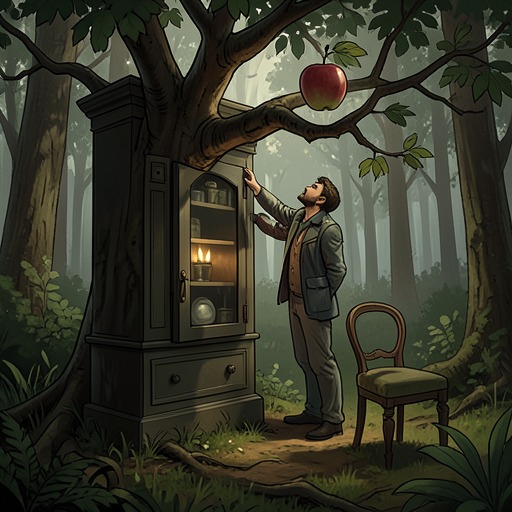
Yet the tree retains a connection to its Narnian counterpart. Its sap, in the narrator’s description, never forgets the other tree; at times the English tree moves without any wind, as though it were answering high winds in Narnia. That bond becomes materially important when Digory is middle-aged, a professor and a great traveller. A storm blows the tree down across southern England. Unable to bear the thought of having it simply chopped up for firewood, Digory has some of its timber made into a wardrobe and puts it in his country house. He never discovers the wardrobe’s magical properties, but someone else does. The story identifies this object as the beginning of the later comings and goings between Narnia and the human world.
The apple’s significance therefore outlasts the healing scene without making its English descendants identical to the original fruit. Its core passes through burial, growth, storm damage, and careful reuse; the material that once carried a gift to Digory’s mother becomes the wood of a threshold between worlds. The sequence also gives the apple’s power a domestic history: a fruit taken from a Narnian tree enters an ordinary garden, survives as timber, and reaches the wardrobe not through Digory’s knowledge of its magic, but through the choices he makes to preserve the fallen tree.