Aslan
The Magician's NephewAslan is the singer through whom Narnia comes into existence and the ruler who gives its creatures both a home and a moral charge. First heard before he is seen, his voice brings light and life into a bare world; later, the same creative authority awakens animals to speech and assigns Digory the task of protecting Narnia from the Witch. His power is not merely forceful: it is joined to delight, restraint, and a sympathy that meets Digory’s grief without allowing private need to eclipse the future of the land.
Identity and First Appearance
At first Aslan is not visible. In the darkness, Digory hears a voice whose direction is impossible to locate: it seems at times to come from everywhere, at times from beneath the earth. The sound has scarcely a tune and no words, yet its beauty is almost unbearable. Even the horse responds, as if the music had returned it to the remembered affection of an earlier life. The scene establishes Aslan through what his voice does before the narrative gives him a shape: creation begins as an encounter with music, and the first response is recognition and wonder.
The singing soon acquires a chorus. Countless higher voices join the deep one, and stars appear all at once in the previously black sky. Their sudden arrival alongside the new voices makes the heavens seem to sing, while the First Voice is understood as the power that has made them appear. At sunrise, the travellers see a young-looking sun rise over a valley of vivid earth, rock, and water, still empty of plants. Only then does Digory see the singer: a huge, shaggy, bright Lion, standing about three hundred yards away with his mouth open in song. Aslan’s physical presence gathers the scene’s dispersed signs of creative power into one figure.
The first responses to him reveal the difference between his power and the power already familiar to the Witch. She recognizes that the world is filled with a Magic unlike hers and stronger than hers, and hates it enough to wish the singing—and, if necessary, all worlds—destroyed. Uncle Andrew, by contrast, recoils in fear. The horse stands alert, no longer seeming merely a worn cab-horse. Aslan does not need to argue for his authority: the world’s transformation, and the sharply different reactions it provokes, make that authority perceptible.
Creation and the Awakening of Narnia
Aslan’s creation proceeds in distinct movements. The first song calls forth stars and sun; then, as he walks across the empty land singing a softer, lilting melody, grass spreads outward like a pool and climbs the hillsides. Heather darkens the higher slopes, and unfamiliar green growths swell into trees. The music changes in character, but not in its creative force: what had been a vast, overwhelming summons becomes a rippling accompaniment to a landscape taking shape beneath the Lion’s steps.
The animals’ awakening is not simply a change in appearance. Under Aslan’s steady gaze, small creatures grow larger and the largest, most noticeably elephants, grow somewhat smaller. Some animals sit upright and tilt their heads as if trying to understand. Aslan breathes over them without speaking; the warm breath moves them like wind through trees. A flash, which burns no one, accompanies the stars’ returning song, and Aslan’s voice calls on Narnia to awake, to love, think, and speak, and summons trees, beasts, and waters into living forms. Creation thus culminates not in a finished landscape alone, but in a community capable of response and understanding.
When the cab-horse speaks, Polly welcomes him among the animals chosen to become Talking Beasts, and the Cabby recognizes that the horse had always seemed unusually sensible. The moment makes the transformation immediate and particular: a familiar animal is now a speaker in the new world. Aslan’s gift is not restricted to the human witnesses, and the animals are not merely part of the scenery. They possess voices and can answer their creator.
Gifts, Speech, and Responsibility
Aslan declares the land and its riches to belong to the creatures of Narnia: its woods, fruits, rivers, and stars. He also gives himself to them, making the gift more than a grant of territory or resources. At the same time, he distinguishes the Talking Beasts from the Dumb Beasts he has not chosen. The latter are to be treated gently and cherished, but the newly awakened creatures must not return to their former ways: they came from the Dumb Beasts and could become like them again. Their new identity is a gift, but the speech and understanding that mark it carry a continuing responsibility.
That responsibility is not an order to remain solemn. When a jackdaw’s loud reassurance arrives just after everyone else has finished answering, its embarrassment prompts the animals’ laughter. Aslan explicitly welcomes their laughter, explaining that creatures who are no longer dumb and witless need not always be grave. His account of speech includes jokes as well as justice. The detail gives the new community room for ease and comic awkwardness alongside its ethical obligations: speaking life permits delight as well as duty.
Compassion, Conflict, and Digory’s Task
Aslan’s care for Narnia includes an awareness of danger. When Digory has agreed to help, he is overwhelmed by the thought of his ill mother and asks whether Aslan can give him something to cure her. Looking up from the Lion’s great feet and claws, Digory sees tears in Aslan’s eyes—tears so large and bright that he feels Aslan may be sorrier for his mother than he is himself. The creator’s authority is therefore not presented as emotional distance. Aslan acknowledges the child’s grief, even as he refuses to reduce the future of Narnia to a bargain for immediate relief.
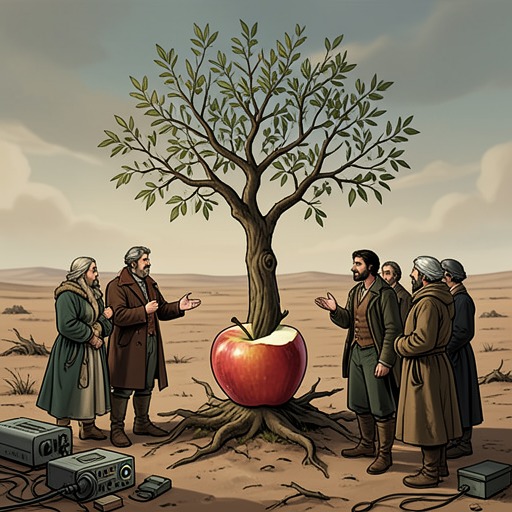
Aslan explains that the Witch whom Digory has brought into this world will return to Narnia, though not yet. He intends to plant a tree that she will not dare approach, so that it can protect the country for many years and give it a long, bright morning before clouds come over the sun. Digory must obtain the seed from which that tree will grow. Aslan’s answer places Digory’s private sorrow within the wider future of the land: the mission is a form of protection, and the promised interval of peace has to be secured before the Witch’s later threat can be faced.
The task also changes Digory’s confidence. Although he does not know how he will carry it out, he becomes sure that he can do it after Aslan bends his head and kisses him. Digory feels new strength and courage enter him. Aslan’s influence works here through recognition and encouragement, not just command: he gives the boy a serious responsibility, tells him what to do, and strengthens him for the undertaking without pretending that his grief has disappeared.
Character and Narrative Significance
Aslan’s creative song and his later instructions form one continuous account of what Narnia is for. A world first made through music becomes a home where creatures possess speech, freedom of response, and duties toward one another. The repeated movement from voice to answer—from the joining stars, to the awakening animals, to the community’s laughter—makes relationship part of creation rather than an afterthought. Aslan’s gifts include both the things creatures may enjoy and a standard for how they should live among those who did not receive the same gift.
His contrast with the Witch is especially sharp. She wants to smash the world rather than endure a form of Magic stronger than her own; Aslan’s power instead produces a fertile landscape and living, speaking beings. Against her hatred of creation, his authority appears as generative care. Yet the tenderness of his response to Digory does not erase the danger she poses. Aslan sees the long span of Narnia’s life, names the coming threat, and prepares protection before it arrives. He is both the singer at the beginning of the world and the guardian who sets its first acts of stewardship in motion.